Mark the Evangelist: An Anglican Perspective
April 25 is the Feast of Mark the Evangelist. He was not one of the Twelve. He turned back from the first missionary journey. He was restored and made useful. And by his hand, God gave the Church the Gospel of Jesus Christ. The earliest. The most urgent. The one that shaped all the others.
Feast Day: April 25
The Anglican calendar is ordered by a hierarchy of holy days, each carrying a different weight of observance. At the top sit the seven Principal Feasts — the highest days of the liturgical year. Below them are the Red-Letter Holy Days, appointed in the BCP 2019 with their own collects, propers, and lectionary readings, listed on page 688. They are called Red-Letter Days because, in the tradition of printing church calendars, these days appear in red ink, distinguished from the Optional Commemorations which appear in ordinary type. The Feast of Saint Mark the Evangelist, observed on April 25, is one of these Red-Letter Holy Days.
Mark is not one of the Twelve Apostles. He did not walk with Jesus through the Galilean ministry, was not present at the Last Supper, and was not among those who first witnessed the resurrection. What he gave the Church instead is something the Twelve did not give it: widely regarded as the first of the four Gospels, written with a speed and urgency that mirrors its subject, preserving what most scholars believe to be the eyewitness testimony of the Apostle Peter. The Church honors Mark on April 25 not because of what he witnessed himself but because of what he faithfully transmitted — and because the Gospel he gave us shaped the way every subsequent Gospel was written. What makes Mark especially striking is that, unlike the other evangelists, he left us no personal testimony or letters — only the Gospel that bears his name. His legacy is the story he told, not the life he lived in public view.
The collect for this feast names Mark’s gift precisely: by his hand, God gave the Church the Gospel of Jesus Christ. It then prays that the Church would know the truth and not be carried about by every wind of false doctrine. That petition is drawn directly from the appointed Epistle reading in Ephesians 4 — and it speaks to the reason the Gospel of Mark matters. In a world of competing claims and shifting teachings, the written Gospel is the anchor. Mark put it down in writing. The Church gives him a feast day in gratitude.
The Biblical Portrait
Mark appears in the New Testament under three names. He is John Mark in Acts 12:12, 12:25, and 15:37 — identified as the son of Mary of Jerusalem, in whose house the early church gathered and to which Peter went directly after his miraculous release from prison. He is simply Mark in Acts 15:39, Colossians 4:10, Philemon 24, 2 Timothy 4:11, and 1 Peter 5:13. And he is John in Acts 13:5 and 13:13, where he joins Paul and Barnabas as a helper on the first missionary journey.
The most consequential moment in Mark’s early career is his departure from that first missionary journey. Acts 13:13 records it without explanation: “Now Paul and his companions set sail from Paphos and came to Perga in Pamphylia. And John left them and returned to Jerusalem.” (Acts 13:13, ESV) Paul considered this a serious failure, serious enough to refuse Mark’s participation in the second journey — the disagreement that separated Paul and Barnabas permanently in Acts 15:36–40. Barnabas took Mark and sailed to Cyprus. We know what happened next: years later Paul wrote to Timothy, “Get Mark and bring him with you, for he is very useful to me for ministry.” (2 Timothy 4:11, ESV) The man who abandoned the mission became, in Paul’s own words, useful for ministry. The arc of Mark’s rehabilitation is one of the more quietly moving stories in the New Testament.
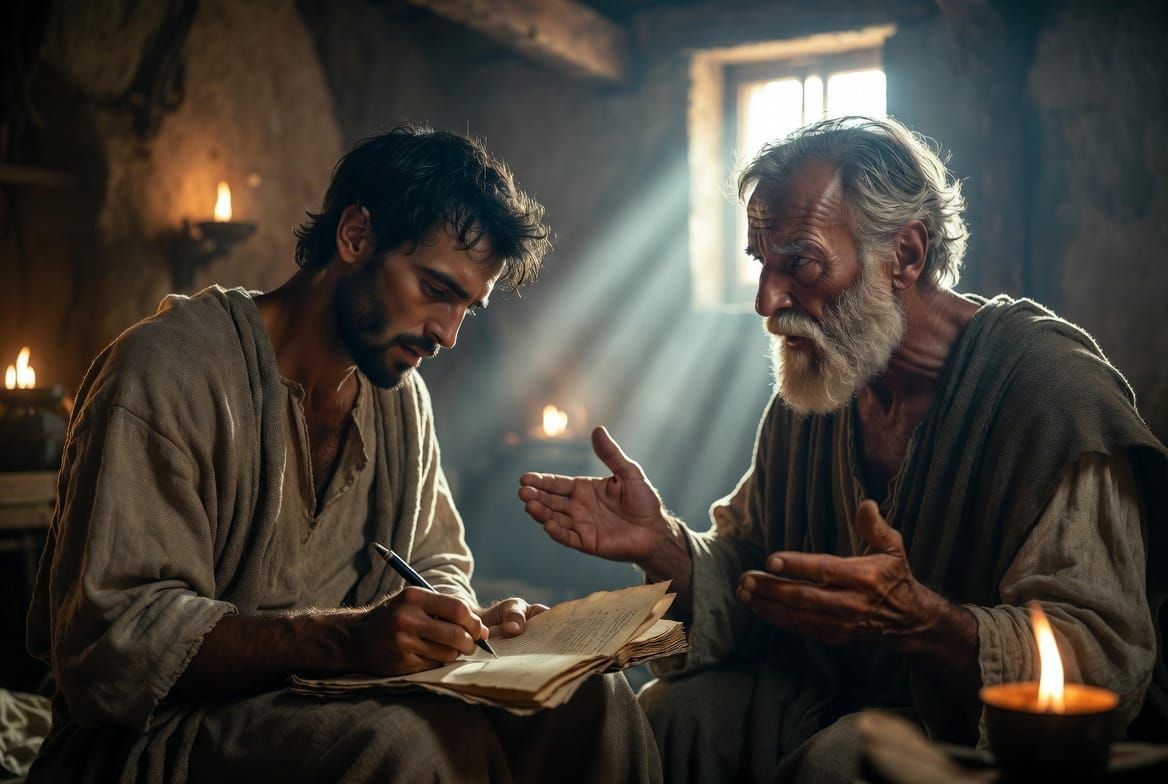
The most theologically significant relationship of Mark’s life, however, is with Peter. In 1 Peter 5:13, Peter writes: “She who is at Babylon, who is likewise chosen, sends you greetings, and so does Mark, my son.” (1 Peter 5:13, ESV) Mark, my son. The early Church consistently understood this to mean that Mark was Peter’s close associate and disciple in Rome. Papias, writing around 130 AD, records that Mark had been Peter’s interpreter and wrote down accurately, though not in order, the things that Peter had said and done. Irenaeus, Clement of Alexandria, and Eusebius all affirm this tradition. The Gospel of Mark, on this reading, is not so much Mark’s personal account as it is Peter’s eyewitness testimony filtered through Mark’s pen — which makes it among the most direct connections to the events of the Gospel that we have.
The Gospel of Mark
The Gospel appointed for this feast is Mark 1:1–15 — the opening of Mark’s Gospel itself. It begins with no nativity, no genealogy, no prologue about the eternal Word. It begins with a declaration: “The beginning of the gospel of Jesus Christ, the Son of God.” (Mark 1:1, ESV) And then it moves immediately. John the Baptist appears in the wilderness. Jesus is baptized. The Spirit descends. The voice speaks. And then, with characteristic urgency: “The Spirit immediately drove him out into the wilderness.” (Mark 1:12, ESV) That word — immediately — is the signature of Mark’s Gospel. The Greek is euthūs, and it appears more than forty times in sixteen chapters. Immediately he preached. Immediately he healed. Immediately they left their nets. Mark’s Jesus is not the reflective teacher of Luke or the eternal Word of John. He is the Son of God in action — moving through Galilee with a momentum that overwhelms everything in his path.
The appointed Gospel reading ends at Mark 1:15, Jesus’ first proclamation in Galilee: “The time is fulfilled, and the kingdom of God is at hand; repent and believe in the gospel.” (Mark 1:15, ESV) This is the summary of everything Mark will spend sixteen chapters showing. The time is fulfilled — the long wait of Israel is over. The kingdom is at hand — not coming eventually, but present, here, in this person. Repent and believe — the response required is not intellectual assent but personal reorientation. The whole Gospel is latent in these two verses. Mark spends the rest of his account demonstrating that every word of them is true.
The Theological Significance
Isaiah 52:7–10, the appointed Old Testament reading from the propers on page 730 of the BCP 2019, gives the feast its prophetic grounding: “How beautiful upon the mountains are the feet of him who brings good news, who publishes peace, who brings good news of happiness, who publishes salvation, who says to Zion, ‘Your God reigns.’” (Isaiah 52:7, ESV) Mark is the herald of Isaiah 52. His Gospel is the good news published, the salvation announced, the reign of God declared. The feet of the evangelist are beautiful because of what they carry. The feast of April 25 honors those feet — and prays that the Church would be willing to put on the same shoes.
Ephesians 4:7–8, 11–16, the appointed Epistle, gives the theological account of why evangelists exist at all. Christ, having ascended, gave gifts to his Church: “And he gave the apostles, the prophets, the evangelists, the shepherds and teachers, to equip the saints for the work of ministry, for building up the body of Christ.” (Ephesians 4:11–12, ESV) Mark is the biblical type of the evangelist — the one given by Christ to the Church for this specific purpose. And verse 14 contains the phrase the collect draws from directly: Paul prays that the Church would no longer be “children, tossed to and fro by the waves and carried about by every wind of doctrine.” (Ephesians 4:14, ESV) The written Gospel is what prevents this. A church that has the Gospel of Mark has an anchor against every wind of false doctrine. The collect’s prayer and the Epistle’s warning are the same word from two directions.
Psalm 2, the appointed psalm, is the royal psalm of the Son’s universal dominion: “I will tell of the decree: The Lord said to me, ‘You are my Son; today I have begotten you.’” (Psalm 2:7, ESV) These are the words the Father speaks at Jesus’ baptism in Mark 1:11 — “You are my beloved Son; with you I am well pleased” — and at the Transfiguration. The psalm appointed for the feast of the evangelist who begins his Gospel by announcing the Son of God is precisely the psalm about the Son whose kingship extends to the ends of the earth. Mark’s Gospel is the announcement of Psalm 2’s fulfillment.
The BCP 2019 Collect and Preface
The BCP 2019 appoints the following collect for the feast on page 628: “Almighty God, by the hand of Mark the evangelist you have given to your Church the Gospel of Jesus Christ: We thank you for his witness, and pray that you will give us grace to know the truth, and not to be carried about by every wind of false doctrine, that we may know Jesus Christ as our Lord and Savior; who lives and reigns with you and the Holy Spirit, one God, for ever and ever. Amen.” The collect is worth reading slowly. It begins with gratitude — thank you for his witness, thank you for the Gospel given by his hand. Only then does it turn to petition. The order matters: the Church receives before it asks. And what it asks for is not more evangelists, not greater reach, not institutional success. It asks to know the truth and not to be carried away from it. The feast of Mark is ultimately a feast about the stability that comes from having the written Gospel and holding it fast.
The Preface of All Saints’, found on page 155 of the BCP 2019, is appointed for this feast — an unusual and theologically rich choice for an evangelist: “For in the multitude of your saints, you have surrounded us with so great a cloud of witnesses that we, rejoicing in their fellowship, may run with patience the race that is set before us, and, together with them, may receive the unfading crown of glory.” (BCP 2019, p. 155) The preface places Mark within the communion of saints — the great cloud of witnesses of Hebrews 12:1 whose faithfulness surrounds and encourages those still running the race. Mark is not merely a historical figure to be studied. He is a member of the same household of faith, still present in his fellowship, still speaking through the Gospel he gave the Church. The preface is a reminder that the feast of April 25 is not simply a commemoration. It is a gathering of the whole Church, living and departed, around the word that Mark put down in writing.
Mark the Evangelist in Anglican Worship
The Feast of Saint Mark has been observed in the Western Church since antiquity and was retained in the Anglican calendar at the Reformation. April 25 often falls within the Easter season — the fifty days between Easter and Pentecost — and in that context the feast of the evangelist who opens his Gospel with the proclamation of the Kingdom carries particular resonance. The risen Christ has been declared. The Kingdom he announced in Galilee has been vindicated by the resurrection. Mark’s opening declaration — the beginning of the Gospel of Jesus Christ, the Son of God — is read in the light of the empty tomb.
The tradition that Mark founded the church in Alexandria and was martyred there under Nero makes him also the patron of one of the oldest and most significant Christian communities in the world. The Coptic Orthodox Church, which traces its origins to Mark, observes his feast with great solemnity. The Anglican tradition honors him more quietly, with the focus placed not on his martyrdom but on his literary gift — the Gospel that bears his name and carries his characteristic urgency into every generation that reads it.
Observing This Feast
April 25 falls within or near the Easter season most years. When it falls on a Sunday within the Easter season, the feast may be observed on that Sunday or transferred to a weekday. Consult page 689 of the BCP 2019 for the full rubrics.
To observe the feast: pray the collect from BCP 2019, p. 628. Read Mark 1:1–15 — the appointed Gospel — and notice the urgency. Count how many times Mark uses immediately in just fifteen verses. Read Isaiah 52:7–10 as the prophetic vision that Mark’s Gospel fulfills. Read Ephesians 4:7–8, 11–16 and sit with the image of the evangelist as a gift of Christ to his Church, given so that the body would not be tossed about by every wind of doctrine. And consider: what would it mean to hold the written Gospel as the anchor against the winds of false teaching that blow through our own moment? The collect prays for exactly that grace. Ask for it by name.
Conclusion
Mark gave the Church its earliest Gospel — lean, urgent, propulsive, full of the Son of God in action. He was not one of the Twelve. He turned back from the first missionary journey. He was restored and made useful. He sat at the feet of Peter and wrote down what he heard. And what he wrote became the foundation on which Matthew and Luke built their own accounts, and the document that has been read aloud in Christian assemblies for nearly two thousand years.
The collect thanks God for his witness and asks for grace to know the truth. The preface places him in the cloud of witnesses surrounding the Church still running the race. The Gospel he gave — beginning with no ceremony, no genealogy, no prologue, just the declaration that this is the beginning of the Gospel of Jesus Christ, the Son of God — is itself the answer to the collect’s prayer. We know the truth because Mark wrote it down. We are not carried away by every wind of doctrine because we have his Gospel to hold onto. “The time is fulfilled, and the kingdom of God is at hand; repent and believe in the gospel.” (Mark 1:15, ESV)