My Eyes Have Seen Your Salvation: The Presentation Of Christ In The Temple (Luke 2:22-40)
Simeon waited for the consolation of Israel. Anna waited for redemption. Then an ordinary-looking family entered the Temple carrying a child. The Lord had come to his Temple, and Simeon could say, “My eyes have seen your salvation.”
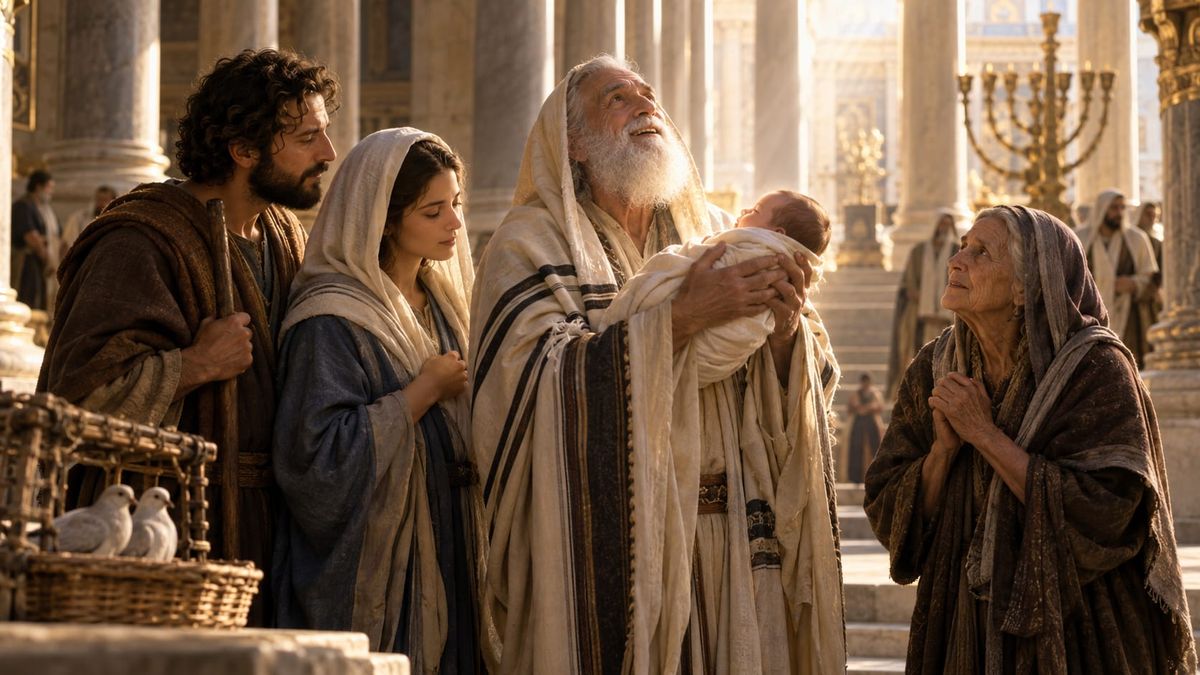
February 2, 2026, The Presentation of Christ in the Temple, Red-Letter Holy Day, Season of Epiphany
Luke 2:22–40, Psalm 84, Hebrews 2:14–18, Malachi 3:1–4
Grace, mercy, and peace from God our Father and the Lord Jesus Christ be with you on this feast of the Presentation of Christ in the Temple.
Forty days have passed since Christmas. The shepherds have returned to their fields, the angels have disappeared from the night sky, the Magi have come and gone, and Jesus has been circumcised and given the Name announced before his conception. Now Mary and Joseph carry the infant Jesus into Jerusalem to do what faithful Jewish parents were commanded to do. At first glance, there is nothing spectacular about the scene. There is no star over the Temple, no angelic choir announcing their arrival, and no crowd gathering to watch. Mary and Joseph look like one more family coming to fulfill the requirements of the Law. They bring the offering permitted for those who cannot afford a lamb, a pair of turtledoves or two young pigeons. They are poor, ordinary, obedient, and almost certainly unnoticed by most of the people around them. Yet Malachi had said, “The Lord whom you seek will suddenly come to his temple.” (Malachi 3:1, ESV) And now he has. The Lord of the Temple is being carried into his Temple in his mother’s arms.
Luke begins in verses 22 through 24 by emphasizing obedience to the Law. He tells us that when the time came for purification, Mary and Joseph brought Jesus to Jerusalem “to present him to the Lord,” because the Law required that every firstborn male be called holy to the Lord. They also came to offer the prescribed sacrifice. Luke repeats the phrase “according to the Law” again and again throughout this passage, and that repetition matters. The eternal Son of God has not merely appeared to be human. He has entered completely into our humanity and into the covenant life of Israel. The One who gave the Law submits to the Law in the human nature he has assumed. This is part of what the Collect means when it says that God’s only-begotten Son was presented in the Temple “in the substance of our flesh.” Not in the appearance of our flesh, and not disguised as one of us, but in the substance of our flesh. The infant in Mary’s arms is truly God and truly man.
Hebrews gives us the reason. Our appointed Epistle says that because God’s children share in flesh and blood, Jesus “himself likewise partook of the same things.” (Hebrews 2:14, ESV) Then Hebrews says something even stronger: “He had to be made like his brothers in every respect.” (Hebrews 2:17, ESV) That is why Christmas cannot remain sentimental. The Son of God has entered the whole reality of human life. He was conceived, born, circumcised, carried, and raised within Israel’s covenant life. He became hungry and tired. He suffered, bled, and eventually died. He does not save us from a distance. The One who will become our merciful and faithful High Priest first enters fully into the life of the people he has come to save.
Then Luke turns our attention to a man named Simeon. Verse 25 tells us that Simeon was “righteous and devout, waiting for the consolation of Israel, and the Holy Spirit was upon him.” The Holy Spirit had revealed to him that he would not die before he had seen the Lord’s Christ. We are not told how long Simeon had waited, and Scripture does not tell us his age. Tradition usually imagines him as an old man, and the words he speaks certainly sound like the words of someone prepared to die, but what Luke wants us to see most clearly is not his age. It is his waiting. Simeon is waiting for the consolation of Israel.
Israel has waited for generations. Abraham received the promise. Moses led the people out of Egypt. David received the promise of a throne. The prophets spoke of the coming King, the suffering Servant, the Lord returning to his Temple, and the light that would shine upon the nations. Empires rose and fell. Generations lived and died. The promises remained, and Simeon waited. Then Luke tells us in verse 27 that he came “in the Spirit into the temple.” Mary and Joseph arrive carrying Jesus, and Simeon sees them. Imagine how ordinary they must have looked. There is no royal escort, no priestly procession, and no visible sign announcing that this particular child is the Messiah. Yet the Spirit opens Simeon’s eyes.
He takes Jesus into his arms and blesses God: “Lord, now you are letting your servant depart in peace, according to your word; for my eyes have seen your salvation.” (Luke 2:29–30, ESV) Those words have become the Nunc Dimittis (nunk dih-MIT-iss), the song Anglicans have prayed at Evening Prayer for centuries and that we also pray at Compline. But hear what Simeon actually says. He does not say, “My eyes have seen the one who will someday bring salvation.” He says, “My eyes have seen your salvation.” Salvation is not finally an idea, a philosophy, a moral program, or humanity discovering how to climb its way back to God. Salvation is a Person, and Simeon holds him in his arms.
That is one of the great truths of this feast. God does not merely send advice to sinners. He sends his Son. He does not merely tell us how to escape darkness. He sends the Light. He does not merely show us the path to life. The One who is himself the Life comes among us. Simeon continues by saying that this salvation has been prepared “in the presence of all peoples, a light for revelation to the Gentiles, and for glory to your people Israel.” (Luke 2:31–32, ESV) That is why this feast belongs so naturally within Epiphany.
Epiphany is the season of manifestation. Christ is made known. The Magi see him as the King of the nations. At the Jordan, the Father declares him to be the beloved Son. Here in the Temple, Simeon takes the child into his arms and announces that the salvation promised to Israel will become light for the nations. Yet notice the order. Jesus is not the light of the Gentiles because God has abandoned Israel. He is “glory to your people Israel” and “a light for revelation to the Gentiles.” The promises to Israel are reaching their fulfillment, and precisely through that fulfillment the blessing moves outward toward the nations.
God had told Abraham that through his offspring all the families of the earth would be blessed. Isaiah had spoken of the Servant as a light for the nations. Now an Israelite stands in Israel’s Temple holding Israel’s Messiah and says that the salvation before him belongs to all peoples. This is where the old name Candlemas comes from. Christians began blessing and carrying candles on this feast because of Simeon’s words about Christ as light. But the candle is only a sign. Jesus is the reality. The light is not ultimately something we hold in our hands. The Light has come to us.
Then the tone changes. Simeon blesses Mary and Joseph, and in verse 34 he says of Jesus, “Behold, this child is appointed for the fall and rising of many in Israel, and for a sign that is opposed.” Then he tells Mary, “A sword will pierce through your own soul also.” (Luke 2:34–35, ESV) The light will be opposed. That matters because Christian language about light can become sentimental very quickly. We like light when it means warmth, beauty, candles, Christmas, and reassurance, but light also reveals. Light exposes what darkness hides, and when the true Light comes into the world, not everyone welcomes him.
Jesus will be a sign that is opposed. Some will fall over him, while others will rise through him. He will reveal the thoughts of many hearts, and that opposition will ultimately carry him to the Cross. Mary will watch. The infant Simeon holds is already moving toward Calvary, which is why Hebrews belongs with Luke today. Hebrews tells us that Jesus shares our flesh and blood “that through death he might destroy the one who has the power of death, that is, the devil.”(Hebrews 2:14, ESV) The child does not merely come to be admired. He comes to die, and through death he destroys death’s tyrant.
Hebrews continues that he came to deliver those who through fear of death were subject to lifelong slavery. That makes Simeon’s words even more beautiful: “Lord, now you are letting your servant depart in peace.” Why can Simeon face death in peace? Because his eyes have seen salvation. He does not have peace because death has ceased to exist. He is preparing to die. He has peace because the Savior has come. There is an enormous difference between pretending death is not frightening and knowing that death has met its conqueror.
Christians do not make peace with death by calling it natural or beautiful. Scripture calls death an enemy, but it is a defeated enemy. The child in Simeon’s arms will grow, suffer, die, and rise bodily from the grave. Because he lives, those who belong to him can face death differently. That is why the Church has placed Simeon’s song at the close of the day. Every evening is a small surrender. We stop working, release what we did not finish, and enter sleep unable to control the world around us. The Church gives us the words of a man ready to die: “Lord, now let your servant depart in peace.” We can rest because Christ has come, and we can eventually die in that same peace because Christ has risen.
Luke then introduces Anna. She is a prophetess, advanced in years, whose life has become deeply ordered around worship. Luke says that she did not depart from the Temple but worshiped with fasting and prayer night and day. At the very hour Simeon receives Jesus, Anna comes and begins giving thanks to God and speaking about the child to all who were waiting for the redemption of Jerusalem. There is a beautiful symmetry here. Simeon receives Christ and speaks. Anna sees Christ and speaks. Recognition becomes witness. That is how Epiphany works. Christ is manifested, and those who see begin to tell others who he is.
Anna also gives us another gift because she reminds us that long faithfulness is not wasted. The modern world often treats age as though usefulness steadily disappears with youth. Productivity declines, physical strength weakens, the world changes, and people can begin to wonder whether their most meaningful service is behind them. Luke will not allow us to think that way. Simeon has something to say. Anna has something to say. Their years of waiting have not made them irrelevant. Their years of prayer have prepared them to recognize the Lord when he comes.
That matters for every congregation. Some of the most important ministry in the Church is being done by people whose names will never appear on a platform and who cannot do what they once did physically, but who know how to pray. There are people in the Church who have been following Christ longer than some of us have been alive. Their prayers matter. Their witness matters. Their accumulated knowledge of God’s faithfulness matters. Anna does not spend her final years nostalgically remembering what God did in the past. She recognizes what God is doing now. That is faithful old age.
Psalm 84 gives us another way to see the scene. The psalm says, “How lovely is your dwelling place, O LORD of hosts! My soul longs, yes, faints for the courts of the LORD.” (Psalm 84:1–2, ESV) Mary and Joseph go toward the Temple. Simeon waits in the Temple. Anna worships in the Temple. Everyone seems to be moving toward God. Yet the deeper truth is that God has already moved toward them. The Lord whom they seek has come to his Temple. Before Simeon finds Christ, Christ has been brought to Simeon. Before Anna recognizes redemption, redemption has arrived. Before humanity can make its way toward God, God has come toward humanity.
That is the Gospel grammar we have been seeing again and again. Grace comes first. Simeon waits faithfully, but his waiting does not produce the Messiah. Anna prays faithfully, but her prayer does not create redemption. Mary and Joseph obey faithfully, but their obedience does not cause God to send his Son. God acts. God keeps his promise. God sends the Son. God brings Simeon into the Temple by the Spirit. God opens his eyes. God gives salvation, and then faithful human response follows.
That is precisely the order of the Collect. We pray that, as God’s Son was presented in the Temple “in the substance of our flesh,” so “we may be presented to you with pure and clean hearts by Jesus Christ our Lord.” Notice those last words: by Jesus Christ our Lord. The Collect does not ask that we might clean ourselves up sufficiently and then present ourselves to God. We are presented to God by Christ. The purity we need is not something we manufacture and offer to God as proof that we have finally become worthy of him. Christ is the one who brings sinners into the presence of God.
The infant presented in the Temple will become the High Priest who presents us. The child for whom Mary and Joseph bring the sacrifice will become the sacrifice. The one carried into the Temple will give his own body for the sins of the world. That is the Gospel at the heart of Candlemas. We cannot make ourselves clean enough to stand before the Holy God. We cannot undo our sins, conquer death, or free ourselves from the power of sin by sufficient discipline, sincerity, religious activity, or moral improvement. But the Lord has come to his Temple. The Son has taken the substance of our flesh. The merciful and faithful High Priest has come to make propitiation for sins. The Light has entered the darkness. Salvation has come to us.
The question finally becomes the same one that stands behind every Epiphany manifestation: do we recognize him? Simeon sees an infant and says, “My eyes have seen your salvation.” Anna sees an infant and begins speaking about redemption. Many others in the Temple that day probably saw only another poor family carrying another child. The difference was not that Simeon and Anna were more naturally perceptive than everyone else. God had opened their eyes.
So the application of this feast begins with prayer: Lord, open our eyes to recognize Christ. Open our eyes to recognize him in the Scriptures when he confronts what we would rather keep, in the Gospel when grace sounds too good to be true, and in the Sacraments where he gives what he promises. Open our eyes to recognize his presence among his people even when the Church looks unimpressive, and to recognize his work when it comes quietly rather than spectacularly. Most of all, help us recognize that if we have Christ, we have what Simeon had. We have salvation.
This feast also asks us to wait faithfully. Some of us are waiting for things we have prayed about for years. We are waiting for someone we love to return to Christ, for reconciliation, for healing, for clarity, or for a burden to lift. We are waiting for God to answer in a way we can see. Simeon and Anna remind us that waiting is not wasted time when it is spent before God. We do not know when or how God will answer every prayer, and Scripture does not promise that every earthly longing will be fulfilled in the way we hope. But God has already fulfilled the deepest promise. Christ has come. Christ has died. Christ is risen. Christ will come again.
So we wait from fulfillment toward fulfillment. We do not wait as people who have received nothing. We wait as people who can say with Simeon, “My eyes have seen your salvation.” That changes the character of Christian waiting. We are not trying to persuade an absent God to become faithful. We are waiting upon the God who has already kept the greatest promise by giving his Son.
And finally, this feast asks whether we are ready to depart in peace. That does not mean we want to die today, and it does not mean grief and death cease to hurt. It means asking whether our peace finally rests in Christ. There will come a day when every unfinished task will remain unfinished, every possession will belong to someone else, every earthly plan will stop, and every role we carried will pass to another person. On that day, the only question that finally matters is whether we belong to the Savior.
Simeon can open his hands because he has received Christ. He can depart because the promise has been kept. So can every Christian. The Lord has come to his Temple. The Word has taken the substance of our flesh. The High Priest has made the sacrifice. The Light has shone in the darkness. The Savior has died and risen. Because he has, the Church can take Simeon’s words upon her lips not only at the end of the day but at the end of life: “Lord, now you are letting your servant depart in peace, according to your word; for my eyes have seen your salvation.”
In the Name of the Father, and of the Son, and of the Holy Spirit. Amen.