The Presentation of Christ in the Temple: An Anglican Perspective
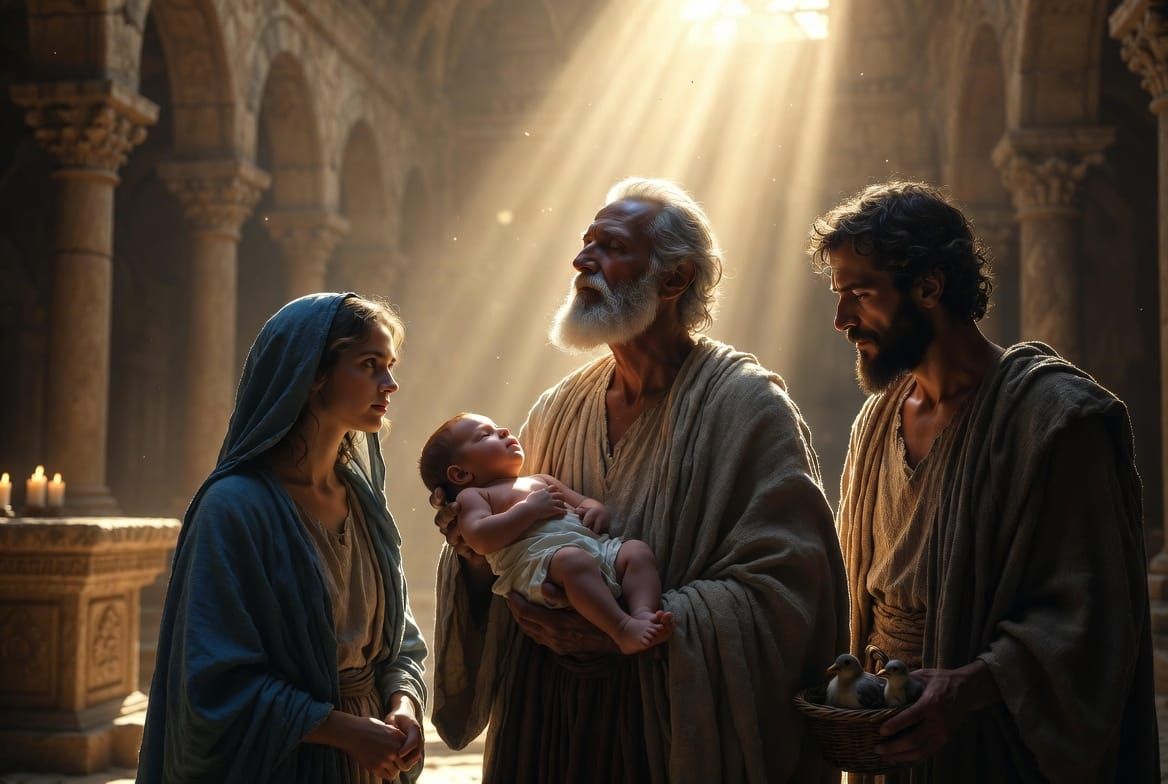
February 2 is the Feast of the Presentation of Christ in the Temple. Forty days after Christmas, Mary and Joseph bring the infant to the temple. An old man who has waited a lifetime takes him in his arms: Lord, now let your servant depart in peace. My eyes have seen your salvation.
Feast Day: February 2
The Anglican calendar is ordered by a hierarchy of holy days, each carrying a different weight of observance. At the top sit the seven Principal Feasts, the highest days of the liturgical year. Below them are the Red-Letter Holy Days appointed in the BCP 2019 with their own Collects and propers. The Presentation of Christ in the Temple, observed on February 2, is one of these Red-Letter Holy Days. The BCP lists it among the Holy Days and appoints its Collect on page 603.
February 2 falls exactly forty days after Christmas Day. Luke tells us that Mary and Joseph brought Jesus to Jerusalem when the time came for purification according to the Law of Moses. Two provisions of the Law stand behind the scene. Leviticus 12 prescribed purification after childbirth, including an offering following the birth of a son, while Exodus 13 required every firstborn son to be consecrated to the Lord in remembrance of Israel’s deliverance from Egypt. Luke brings these themes together as Mary and Joseph come to Jerusalem in obedience to the Law and present the infant Jesus before the Lord.
In the wider Western tradition, the feast is often called Candlemas, a name associated with the ancient custom of blessing and carrying candles in honor of Simeon’s declaration that Christ is “a light for revelation to the Gentiles.” (Luke 2:32, ESV) The BCP 2019 calls the feast the Presentation of Christ in the Temple, but the imagery of light that produced the name Candlemas belongs to the heart of its Gospel and Eucharistic Preface. The child carried into the Temple is the light for whom Israel has been waiting and the light by whom the nations will see.
The Biblical Event
The appointed Gospel is Luke 2:22–40. Luke carefully emphasizes the obedience of Mary and Joseph to the covenant law: “And when the time came for their purification according to the Law of Moses, they brought him up to Jerusalem to present him to the Lord (as it is written in the Law of the Lord, ‘Every male who first opens the womb shall be called holy to the Lord’) and to offer a sacrifice according to what is said in the Law of the Lord, ‘a pair of turtledoves, or two young pigeons.’” (Luke 2:22–24, ESV)
Luke’s repeated insistence that everything is done according to the Law of the Lord is not bureaucratic detail. It is a theological claim. The eternal Son has taken the substance of our flesh and entered fully into the covenant life of Israel. From infancy he submits to the Law he has come to fulfill. Mary and Joseph obey what God has commanded, and Jesus, carried in their arms, enters the Temple as Mary’s firstborn son and Israel’s promised Messiah.
The offering is significant as well. Leviticus ordinarily prescribed a lamb together with a bird for the purification offering, but permitted two birds when a family could not afford a lamb. Mary and Joseph bring the offering allowed for those of limited means. The Lord of all creation enters his Temple in humility, carried by parents who bring the sacrifice appointed for those without wealth.
Into this scene of ordinary covenant obedience comes Simeon. Luke describes him as “righteous and devout, waiting for the consolation of Israel, and the Holy Spirit was upon him.” (Luke 2:25, ESV) The Spirit had revealed that he would not die before seeing the Lord’s Christ. When Mary and Joseph enter with the child, Simeon takes Jesus into his arms and blesses God with words that have become one of the great canticles of Christian worship: “Lord, now you are letting your servant depart in peace, according to your word; for my eyes have seen your salvation that you have prepared in the presence of all peoples, a light for revelation to the Gentiles, and for glory to your people Israel.” (Luke 2:29–32, ESV)
These words are the Nunc Dimittis (nunk dih-MIT-iss), from the opening words of the canticle in Latin, meaning “Now you dismiss.” Simeon has waited for the consolation of Israel, and now he can die in peace because the promise is no longer merely something anticipated. Salvation is in his arms.
Yet Simeon’s prophecy does not end with light and peace. He tells Mary that Jesus is “appointed for the fall and rising of many in Israel, and for a sign that is opposed,” and adds, “a sword will pierce through your own soul also.” (Luke 2:34–35, ESV) Already the manifestation of Christ carries the shadow of the Cross. The light will be opposed, the Messiah will divide, and Mary will suffer as she watches the rejection and death of her Son.
Then Anna appears. Luke calls her a prophetess, tells us that she is advanced in years, and describes a life ordered around worship, fasting, and prayer. At the very hour Simeon receives the child, Anna begins giving thanks to God and speaking about Jesus “to all who were waiting for the redemption of Jerusalem.” (Luke 2:38, ESV) The shepherds have already proclaimed what they heard concerning the child earlier in Luke 2, so Anna is not the first public witness to Christ in the Gospel. She is, however, part of the growing company of faithful Israelites who recognize that God’s promised redemption has arrived. Her age has not made her spiritually peripheral. Her long years of prayer have prepared her to recognize what God is doing and to speak of it.
The Lord of the Temple Comes to His Temple
The Presentation carries a theological irony that is easy to miss: the Lord of the Temple is being brought to the Temple. The God who met with Moses above the mercy seat, between the cherubim in the Holy of Holies (Exodus 25:22), has now come among us in the incarnate Son, who is forty days old in the flesh and carried in his mother’s arms through the Temple courts. The God whose glory filled the Tabernacle and Temple has assumed our human nature and entered his own sanctuary as an infant.
Malachi 3:1–4, the appointed Old Testament reading, gives the scene its prophetic background: “And the Lord whom you seek will suddenly come to his temple; and the messenger of the covenant in whom you delight, behold, he is coming, says the LORD of hosts.” (Malachi 3:1, ESV) And so he does. The Lord comes suddenly to his Temple, not amid thunder, armies, or royal spectacle, but in poverty and infancy, carried by parents who bring the offering of the poor. An old man waiting in the courts is enabled by the Holy Spirit to recognize him.
The irony goes deeper still. John’s Gospel later records Jesus saying, “Destroy this temple, and in three days I will raise it up,” and then explains, “he was speaking about the temple of his body.” (John 2:19, 21, ESV) Jesus does not enter the Jerusalem Temple because it is meaningless or already discarded. It is his Father’s house, the covenant sanctuary given to Israel, the place of sacrifice, priesthood, worship, and the divine presence. Yet everything the Temple signifies reaches its fulfillment in him. The incarnate Son is himself the definitive meeting place of God and humanity. In him God dwells among us in the flesh, and through him sinners are reconciled to God. The true Temple has entered the Temple, not to despise what God had given Israel, but to bring its promises and purposes to fulfillment in himself.
When Simeon takes Jesus into his arms, Israel’s long expectation and the fulfillment of God’s promise meet in an old man holding a child. Simeon waits for the consolation of Israel, and Anna waits for the redemption of Jerusalem. Neither turns away from Israel’s promises in order to recognize Christ. They recognize in Christ the fulfillment of those promises.
Made Like His Brothers
Hebrews 2:14–18, the appointed Epistle, explains why the Son of God submits to this covenant life at all. Because God’s children share in flesh and blood, Christ “himself likewise partook of the same things,” so that through death he might destroy the devil and deliver those enslaved by the fear of death. (Hebrews 2:14–15, ESV)
The passage then declares, “Therefore he had to be made like his brothers in every respect, so that he might become a merciful and faithful high priest in the service of God, to make propitiation for the sins of the people.” (Hebrews 2:17, ESV) He had to be made like his brothers in every respect. This is why he is circumcised on the eighth day, presented in the Temple on the fortieth, raised within Israel’s covenant life, and obedient throughout his earthly life. The eternal Son has not merely appeared to be human. He has truly taken our flesh.
The Presentation therefore belongs to the same Incarnational movement as Christmas and the Circumcision and Holy Name. The Son does not save humanity from a distance. He comes among us in the substance of our flesh. The high priest who will offer himself as the sacrifice first enters fully into the human life of those on whose behalf he will make that offering.
The child Simeon holds is therefore already moving toward the Cross. The sacrifice brought by Mary and Joseph belongs to the Law; the child they bring is the one who will offer himself once for all. The feast begins in infancy, but its theological horizon is already Good Friday and Easter.
Psalm 84 and the Two Journeys
Psalm 84 is the appointed Psalm, the song of a pilgrim who loves the house of God: “How lovely is your dwelling place, O LORD of hosts! My soul longs, yes, faints for the courts of the LORD; my heart and flesh sing for joy to the living God.” (Psalm 84:1–2, ESV) Mary and Joseph are making precisely such a pilgrimage as they go up to Jerusalem and enter the courts of the Lord.
Yet the one they carry is the Lord of the courts they enter. The Psalm and Gospel therefore hold together two movements: the human journey toward God and the divine journey toward humanity. We go toward the Temple, while the Lord of the Temple comes to meet us. Israel seeks God, but before Israel can find him, God has come to Israel. Simeon waits for the Lord’s Christ, yet Christ is carried into the Temple to meet Simeon. Anna waits for redemption, yet redemption arrives before her in the arms of his mother. In Christ, the true Temple, these movements meet because the God whom humanity seeks has first come graciously toward us.
This is grace before it is human achievement. Simeon waits faithfully, and Anna prays faithfully, but their faithfulness does not bring Christ into existence or cause the promise to be fulfilled. God acts first. God sends his Son, keeps his promise, brings Simeon into the Temple by the Spirit, and opens his eyes to recognize the salvation placed before him.
A Light for the Nations
The Presentation belongs naturally within the Season of Epiphany because it is a feast of manifestation. Simeon does not merely say that he has seen Israel’s Messiah. He declares that his eyes have seen God’s salvation “prepared in the presence of all peoples, a light for revelation to the Gentiles, and for glory to your people Israel.” (Luke 2:30–32, ESV)
The child is the glory of Israel precisely as he becomes the light of the nations. This is not a movement away from Israel toward the Gentiles, as though one people were discarded and another substituted in its place. God’s promise to Abraham always included blessing for all the families of the earth, and Isaiah repeatedly speaks of the Servant bringing salvation to the ends of the earth. Simeon now holds the fulfillment of those promises.
That is why Candlemas imagery is so fitting. Christ does not merely carry light or point toward light. He is the light by whom the nations come to know God. The candles traditionally associated with the feast are signs; Simeon’s child is the reality.
The BCP 2019 Collect and Preface
The BCP 2019 appoints this Collect on page 603: “Almighty and everliving God, we humbly pray that, as your only-begotten Son was this day presented in the temple in the substance of our flesh, so we may be presented to you with pure and clean hearts by Jesus Christ our Lord; who lives and reigns with you and the Holy Spirit, one God, now and for ever. Amen.”
The phrase “in the substance of our flesh” is especially important. The Collect refuses any suggestion that the Incarnation was merely an appearance. The Son presented in the Temple has truly assumed our humanity. The child Simeon holds is fully and genuinely human while remaining the only-begotten Son of the Father.
The Collect then turns the historical event into present prayer. Christ was presented in the Temple, and the Church asks that we might be presented to God “with pure and clean hearts by Jesus Christ our Lord.” The direction matters. We do not purify ourselves sufficiently and then present ourselves to God. We are presented by Jesus Christ. The purity for which the Church prays is the fruit of his saving work and grace.
The Presentation is therefore not merely an event to commemorate but a pattern to inhabit. As the Son was brought before the Lord, we ask to be brought before the Lord. Mary and Joseph came with the offering appointed by the Law; we come depending upon the offering Christ has made on our behalf.
The BCP appoints the Preface of the Presentation: “Because in the mystery of the Word made flesh, you have caused a new light to shine in our hearts, to give the knowledge of your glory in the face of your Son Jesus Christ our Lord.” (BCP 2019, p. 153) The same text is used for the Presentation, Annunciation, and Transfiguration. The Preface gives Candlemas its deepest meaning. The new light is not finally the flame of a candle. It is the knowledge of the glory of God revealed in the face of the incarnate Son.
The Presentation in Anglican Worship
The Presentation has ancient roots in Christian worship and became firmly established in the Western calendar. The name Candlemas reflects the longstanding Western practice of blessing candles and carrying them in procession in response to Simeon’s proclamation of Christ as the light of the Gentiles.
The Anglican Reformation retained the biblical heart of the feast even where particular medieval ceremonial customs changed. The BCP 2019 gives the Presentation its own Collect, readings, Psalm, and Eucharistic Preface, placing the biblical event and its theological meaning firmly within the Church’s annual worship.
The liturgical color is white, fitting the festal joy, divine glory, purity, and manifestation of Christ. White connects the Presentation visually with the Incarnation and Epiphany mysteries surrounding it. The child brought to the Temple is the Word made flesh, and the Preface praises God because a new light has shone through him. The color therefore expresses the theology of the feast itself: Christ has appeared, God’s glory has been revealed in his Son, and light has come for Israel and the nations.
The feast also forms a theological hinge within Epiphany. It does not end the Season of Epiphany, but its themes begin to look unmistakably toward the Passion. Purification, sacrifice, priesthood, opposition, and the sword that will pierce Mary’s soul all point ahead. The light of Epiphany is already casting the shadow of the Cross.
The Nunc Dimittis has an especially enduring place in Anglican prayer. Cranmer included Simeon’s song in Evening Prayer in the first Book of Common Prayer in 1549, and Anglicans have prayed it at the close of the day ever since. It also belongs naturally to Compline. Each evening the Church takes Simeon’s words upon her own lips and entrusts herself to the Lord in peace. Having heard the promises of God in Scripture and knowing the salvation revealed in Christ, Christians can face the end of the day, and ultimately the end of earthly life, in the peace of the salvation Simeon held in his arms.
Simeon, Anna, and Faithful Old Age
The feast speaks with particular force to Christians in old age. Simeon and Anna are not marginal figures waiting for younger people to carry out the important work. Their long faithfulness has prepared them to recognize what others may overlook. Simeon waits in hope, and Anna worships with fasting and prayer. When Christ appears, both are ready.
The Church therefore learns from the Presentation that faithful waiting is itself part of Christian vocation. Decades of prayer are not wasted years, and age does not remove a Christian from meaningful witness. Anna sees Christ and immediately speaks of him to others, while Simeon receives Christ and proclaims what God has done. Their long lives of expectation culminate not in nostalgia but in recognition and testimony.
A culture that prizes youth, productivity, novelty, and visible accomplishment can easily treat aging as a gradual withdrawal from usefulness. Luke gives us a different picture. The elderly Simeon recognizes the Messiah and prophesies; the elderly Anna gives thanks to God and speaks of the child to others. The person who has spent years quietly attending to God may be precisely the person prepared to recognize what others have not yet seen.
Observing This Feast
The Presentation is observed on February 2, forty days after Christmas, within the Season of Epiphany.
To observe the feast, pray the Collect from BCP 2019, page 603, paying particular attention to the petition that we would be presented to God with pure and clean hearts by Jesus Christ. Read Luke 2:22–40 slowly, pausing at the Nunc Dimittisand praying Simeon’s words as your own. Read Malachi 3:1–4 and sit with the image of the Lord suddenly coming to his own Temple as an infant in his mother’s arms.
Read Hebrews 2:14–18 and remember why the Son had to be made like his brothers in every respect. The high priest who will offer himself for sinners has entered fully into the human life of those he came to save. Pray Psalm 84 as the pilgrim’s song and notice the two movements held together in the feast: humanity goes toward the courts of the Lord, and the Lord graciously comes to meet humanity.
The feast also gives an occasion to remember older Christians whose faithful prayer and witness sustain the Church. Ask for Simeon’s perseverance, Anna’s devotion, and eyes able to recognize the work of God even when it arrives in forms the world considers small and unimpressive. When evening comes, pray the Nunc Dimittis and entrust yourself to the Lord in the peace of Christ.
Conclusion
The Presentation of Christ in the Temple is a feast of recognition. The Lord whom Israel sought suddenly comes to his Temple, but he comes poor, small, and dependent, carried by parents offering the sacrifice permitted to those of modest means. Simeon recognizes him because he has waited upon the promise of God, and Anna recognizes him because her life has been shaped by worship, fasting, and prayer. What appears to others as an ordinary family carrying an infant into the Temple is recognized by faith as the arrival of Israel’s consolation and the world’s salvation.
The feast also points beyond the Temple courts. Simeon sees light, but he also sees opposition. He blesses Mary, but he also foretells the sword. The infant presented according to the Law will become the merciful and faithful high priest who offers himself for sinners. The Lord who comes to his Temple will give his own body as the once-for-all sacrifice, and because that saving work belongs to the same child Simeon holds, the old man can already depart in peace.
The Collect turns Simeon’s recognition toward us. The Son was presented in the Temple “in the substance of our flesh,”and through him we ask to be presented before God with pure and clean hearts. The Lord has come to meet those who seek him, and salvation is no longer only promised. Simeon holds him in his arms.
The feast of February 2 therefore becomes both a historical commemoration and a present invitation. The Church waits with Simeon, watches with Anna, and receives anew the Christ whom God has given: “a light for revelation to the Gentiles, and for glory to your people Israel.” (Luke 2:32, ESV)