One Gate. One Voice. One Shepherd: Good Shepherd Sunday 2026 (John 10:1-10)
"I am the gate" is a claim to divine identity. One narrow gate, wide open to anyone who enters. The thief comes to steal, kill, and destroy. The Shepherd comes for abundant life. The gate was opened at a cost. Only the one who died to open it can say "I am the gate."
April 26, 2026, Year A, Fourth Sunday of Easter, Good Shepherd Sunday, Season of Easter
John 10:1–10, Psalm 23, 1 Peter 2:13–25
Alleluia! Christ is risen!
Grace, mercy, and peace from God our Father and the Lord Jesus Christ be with you on this Fourth Sunday of Easter.
Today is Good Shepherd Sunday, the name the Church gives to this fourth Sunday of Easter every year, because the lectionary always appoints a passage from John 10. It is the season’s way of stepping back and asking: who is this risen Christ who has been finding his people week after week? John 10 gives us the answer.
Three Sundays now we have followed the risen Christ as he finds his people. Mary Magdalene in the garden, he spoke her name in the dark and she was turned around. The disciples behind the locked door, he came through without being invited, spoke peace, and breathed new creation life into dry bones. Two disciples on the road to Emmaus, he walked seven miles with people going the wrong direction, opened the Scriptures, broke the bread, and their eyes were opened.
Every one of those encounters had something in common. There was one gate. One voice. One shepherd. One way into the pasture. The people in those stories did not always know who was with them. Mary thought he was the gardener. The Emmaus disciples thought he was a stranger. But it was always the same voice, always the same shepherd, always the same gate. This Sunday Jesus names it.
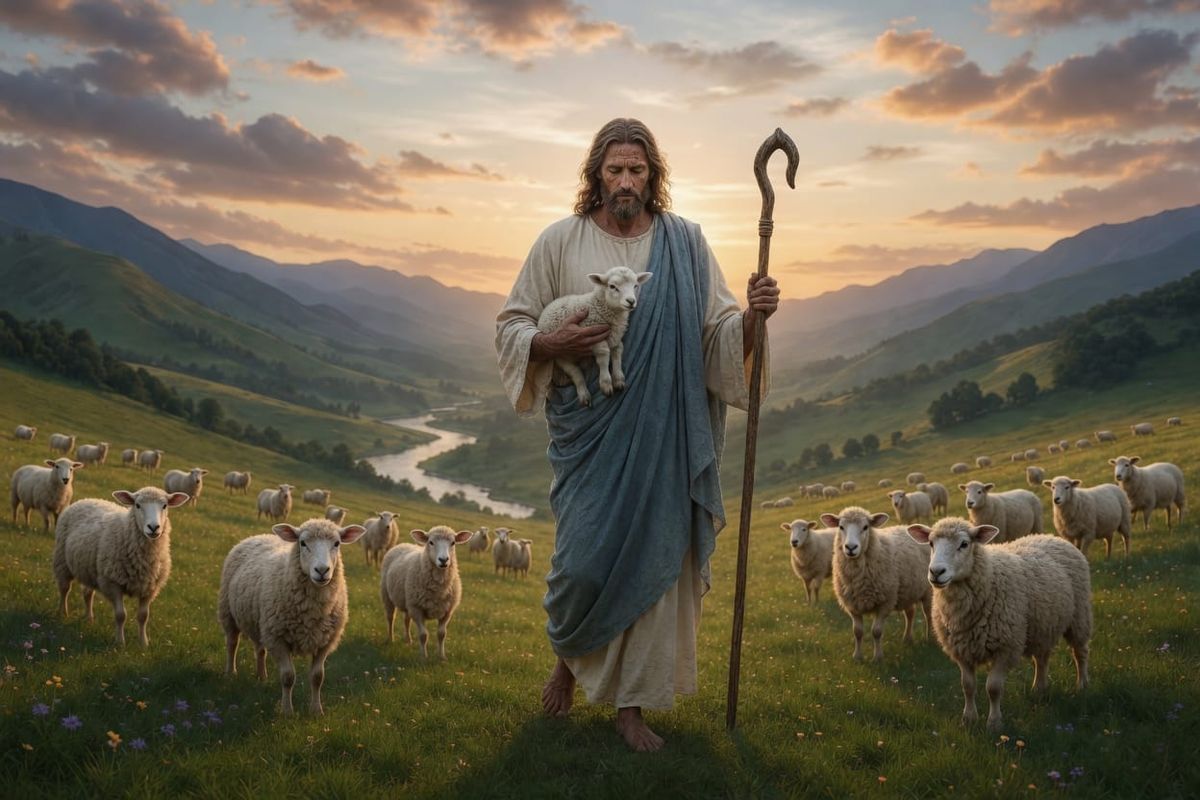
John 10 opens with a scene every person in Jesus’ audience would have understood immediately. A sheepfold, a walled enclosure, often shared by multiple flocks overnight, with a single narrow gate and a gatekeeper who controlled access. In the morning, each shepherd would come to the gate, call his own sheep by name, and lead them out to pasture. The sheep knew their shepherd’s voice. They would follow him out. They would not follow a stranger; in fact, they would flee from one.
It is a simple picture. But Jesus is not giving a lecture on ancient livestock management. John tells us in verse 6 that they did not understand what he was saying. So in verse 7 he states it plainly with the double “Truly, truly” that always signals something of great weight in John’s Gospel: “I am the gate for the sheep.” (John 10:7, ESV) And again in verse 9, in case anyone missed it: “I am the gate.” (John 10:9, ESV)
This is one of the great I AM statements of John’s Gospel, the same language we hear when Jesus says, “I am the bread of life,” “I am the light of the world,” and “I am the resurrection and the life.” Across John’s Gospel, that language reaches back into the biblical revelation of the God who told Moses, “I AM WHO I AM.” When Jesus says, “I am the gate,” he is not merely offering a helpful metaphor. He is revealing who he is and making a claim about where salvation is found.
Before we go any further, I want to note something about our lectionary reading. The Church assigns a portion of John 10 to Good Shepherd Sunday every year. In Year A, our reading stops just before verse 11, where Jesus says explicitly, “I am the good shepherd.” Year B begins there. But the shepherd is unmistakably present already in these ten verses, entering by the gate, calling his own sheep by name, going before them, and being known by his voice. The Good Shepherd is here even before he speaks the words themselves. And what he says before verse 11 is remarkable enough: “I am the gate. If anyone enters by me, he will be saved and will go in and out and find pasture.” (John 10:9, ESV)
In the ancient sheepfold, the gate was not merely an architectural feature. It was the point of security, the threshold between danger and safety, between exposure and shelter, between the predators of the night and the pasture of the morning. Everything depended on the gate. If you came through the gate legitimately, you were known and safe. If you climbed over the wall by another way, you were a thief or a robber, someone whose intentions toward the sheep were destructive, not protective.
Jesus is making a claim here that is both exclusive and enormously generous at the same time. Exclusive: there is one gate. There is not a wall with multiple doors, not a choice of several equally valid entrances. One gate. “All who came before me,” he says in verse 8, “are thieves and robbers.” (John 10:8, ESV) Jesus is speaking first against the false shepherds of Israel, the religious leaders who claimed to guide God’s people while rejecting the Shepherd God had sent. But the principle does not end with them. Every voice that claims to lead people to God apart from Christ finally offers another gate, and Jesus says there is only one. That is a hard word in a culture that wants many gates. But Jesus does not soften it.
Enormously generous: the gate is open. “If anyone enters by me, he will be saved.” (John 10:9, ESV) Not if the right person enters. Not if the qualified person enters. Anyone. The gate is narrow in the sense that there is only one, but it is wide open to all who would come through it. And what awaits on the other side is not merely safety but pasture, provision, abundance, life.
Then verse 10 gives us the climax of the passage: “The thief comes only to steal and kill and destroy. I came that they may have life and have it abundantly.” (John 10:10, ESV) This is the whole purpose stated in a single sentence. The thief, every false voice, every counterfeit shepherd, every alternative gate, comes to take. To diminish. To rob the sheep of what they were made for. Jesus came for the exact opposite: life, and life abundantly.
That word abundantly carries the sense of overflowing, exceeding what is necessary, more than enough. Not survival. Not merely getting by. Abundant life. The Psalm we read this morning has been describing this life for three thousand years: “The LORD is my shepherd; I shall not want.” (Psalm 23:1, ESV) Not partial provision. Not grudging supply. I shall not want. Green pastures, still waters, restored souls, a table prepared in the presence of enemies, a cup that overflows. That is what waits on the other side of the gate.
What is striking about how Jesus describes the relationship between the shepherd and the sheep in verses 3 and 4 is not just that the shepherd knows the sheep; it is that the sheep know him. They hear his voice. They recognize it. They follow it. And they will not follow a stranger, because they do not know the voice of strangers. That is why the Collect this morning asks God to grant that “when we hear his voice, we may know him who calls us each by name, and follow where he leads.” Hearing, knowing, following: that is the life of the sheep with their Shepherd.
This is a familiarity that has developed through time spent together, through being led and tended and cared for. The shepherd has called each sheep by name. Not as a category. Not as a number. By name. The same way Jesus called Mary by name in the garden on Easter morning. The same way he spoke “Peace be with you” to the disciples and they recognized the voice of the one who had spoken those words to them before. The same way the hearts of the Emmaus disciples burned within them as he opened the Scriptures, a burning they did not fully understand until afterwards, but which was the response of sheep who knew their shepherd’s voice without yet knowing they were hearing it.
This is also where Psalm 23 gives us the pastoral depth behind what Jesus is claiming. David wrote this psalm out of experience. As a young shepherd himself, he knew what it meant to tend, to lead, to fight for, and to lay down for the flock. And having lived that, he turned it around and saw the LORD in the role of shepherd and himself in the role of sheep. “The LORD is my shepherd.” (Psalm 23:1, ESV) That is a position of profound humility and profound trust simultaneously. It means: I am dependent. I do not know the way on my own. I am prone to wander. I need someone who goes before me, who knows the terrain, who fights what I cannot fight.
And David’s Shepherd does all of this. He leads to green pastures and still waters, not because life is without difficulty, but because the Shepherd knows where provision is. He restores the soul, which implies the soul needs restoring, that the journey is tiring, that the sheep come to the Shepherd depleted and go away replenished. He leads through the valley of the shadow of death, not around it, through it. The valley is not avoided. It is the only route to where the sheep need to go. But the Shepherd goes first. The rod and the staff, one to fight the predators, one to keep the sheep close, mean the sheep are never alone in the valley.
This is the voice the sheep know. Not a voice that promises a predator-free path. A voice that says: I will go before you. I know the way. Stay close. The thief makes promises he cannot keep. The Shepherd makes promises rooted in his own willingness to suffer on behalf of the flock.
Our passage stops at verse 10, but the very next verse completes the picture: “I am the good shepherd. The good shepherd lays down his life for the sheep.” (John 10:11, ESV) The gate and the Shepherd are the same person, and the gate was opened at a cost. Jesus did not simply stand at the entrance and wave people through. He paid for it with his life. That is what makes the exclusivity of one gate an act of grace rather than an act of restriction. The only one with the right to say I am the gate is the one who died to open it.
This is where 1 Peter 2 enters the conversation, and it enters with weight. Peter is writing to scattered Christians living under pressure, people who are suffering unjustly, who are being treated as strangers and aliens, who are being told by every competing voice that their faith is foolish and their suffering is pointless. And he points them to the Shepherd.
In verse 21 of our reading Peter says: “For to this you have been called, because Christ also suffered for you, leaving you an example, so that you might follow in his steps.” (1 Peter 2:21, ESV) And in verse 24: “He himself bore our sins in his body on the tree, that we might die to sin and live to righteousness. By his wounds you have been healed.” (1 Peter 2:24, ESV) Then verse 25 draws the whole passage together: “For you were straying like sheep, and have now returned to the Shepherd and Overseer of your souls.” (1 Peter 2:25, ESV)
Every person we have met in this Easter season has been a straying sheep. Mary straying toward grief and despair. The disciples straying toward hiding and shame. Thomas straying toward doubt. The two on the Emmaus road straying literally, walking the wrong direction. And in every case, the Shepherd did not wait for them to find their way back. He went after them. He went before them on the road. He came through the locked door. He called the name in their wilderness.
Peter’s deeper point is this: the Shepherd could do all of that because he had already gone through the deepest valley himself. The Cross was the valley of the shadow of death that he walked through ahead of his sheep, bearing in his own body what would have destroyed them. He was not a Shepherd who sent others into danger while he remained at a safe distance. He is the Shepherd who went first, who bore the wounds, so that by those wounds his sheep could be healed and brought home.
This is why Jesus as the gate is not a restrictive image but a liberating one. There is one gate, and that gate is the one who laid down his life so that the sheep could pass through. The exclusivity of one gate is not the exclusivity of a locked door. It is the exclusivity of the only one who paid the price to open it.
Psalm 23 reminds us that this psalm is going somewhere. It is not a meditation on a quiet afternoon in a field. It is a bit of a journey, a pilgrimage. Green pastures and still waters are not the destination; they are provision for the journey. The valley of the shadow of death is on the road. The table prepared in the presence of enemies is not a picnic in peaceful surroundings; it is a meal eaten while under threat, a calm confidence in the Shepherd’s presence that does not require the removal of danger before it can begin.
And it ends not with rest in a meadow but with arrival: “I shall dwell in the house of the LORD forever.” (Psalm 23:6, ESV) The sheep were going somewhere all along. The green pastures, the valley, the table, the anointing oil, the overflowing cup, all of it was the Shepherd’s provision on a journey toward a destination the sheep could not have reached alone.
Jesus said in verse 9, “I am the gate. If anyone enters by me, he will be saved and will go in and out and find pasture.”(John 10:9, ESV) There is a fitting picture here of the Church’s life as well. We are gathered by Christ to be sheltered, fed, and restored, and then sent again into the world under the care of the same Shepherd. We come in through the gate on Sunday, sheltered, fed, restored. We go out into the week, into the valley, into the presence of enemies, into the roads where straying sheep are waiting to hear the voice they do not yet know they are listening for. And we come back in again. In and out. In and out. Always through the same gate. Always the same voice calling us home.
Every Sunday of this Easter season has asked us to recognize who is speaking. This Sunday Jesus tells us directly what is at stake in that recognition: whose voice are you following?
The thief, Jesus says, comes to steal and kill and destroy, and the thieves of 2026 do not always announce themselves as thieves. Some come offering spiritual experience without a cross, a Christianity of personal flourishing and material blessing that quietly removes the Shepherd who goes through the valley first and replaces him with one who promises to route around it.
Some come offering intellectual sophistication, a faith that has been so thoroughly revised to fit the current cultural moment that it no longer has a Shepherd at all. Some come in the form of the news feed and the algorithm, offering an endless scroll of anxiety and outrage which leaves the sheep more depleted with every passing hour. And some come much closer to home: the voice that says our worth is our productivity, our identity is our politics, our peace depends on our circumstances. These are not cartoon villains. They are familiar voices, often partly true, offering real things, but offering them as substitutes for the one thing that actually satisfies.
Jesus is still doing this. The same Shepherd who called Mary by name, who breathed life into the locked room, who opened the Scriptures on the Emmaus road, that is the voice still speaking. In the Word read and proclaimed. In the bread taken and broken. In the still waters of prayer where the soul is restored enough to hear.
In verse 10 he says: “I came that they may have life and have it abundantly.” (John 10:10, ESV) Not life as mere survival. Not life as managing the valley. Abundant life, overflowing, exceeding what is necessary, the cup running over. That is what awaits on the other side of the gate. That is what the Shepherd has been offering, Sunday after Sunday, encounter after encounter, since the stone was rolled away.
The gate is open. The Shepherd is calling. Enter by him, and find pasture.
In the Name of the Father, and of the Son, and of the Holy Spirit. Amen.