Today This Scripture Has Been Fulfilled: Saint Luke, Evangelist and Companion of Paul (Luke 4:14–21)
Saint Luke’s feast therefore does not finally ask us to admire Luke from a distance. It calls us to receive again the Gospel Luke spent his life proclaiming. Jesus Christ has come. Good news is proclaimed to the poor, liberty to captives, sight to the blind, and freedom to the oppressed.
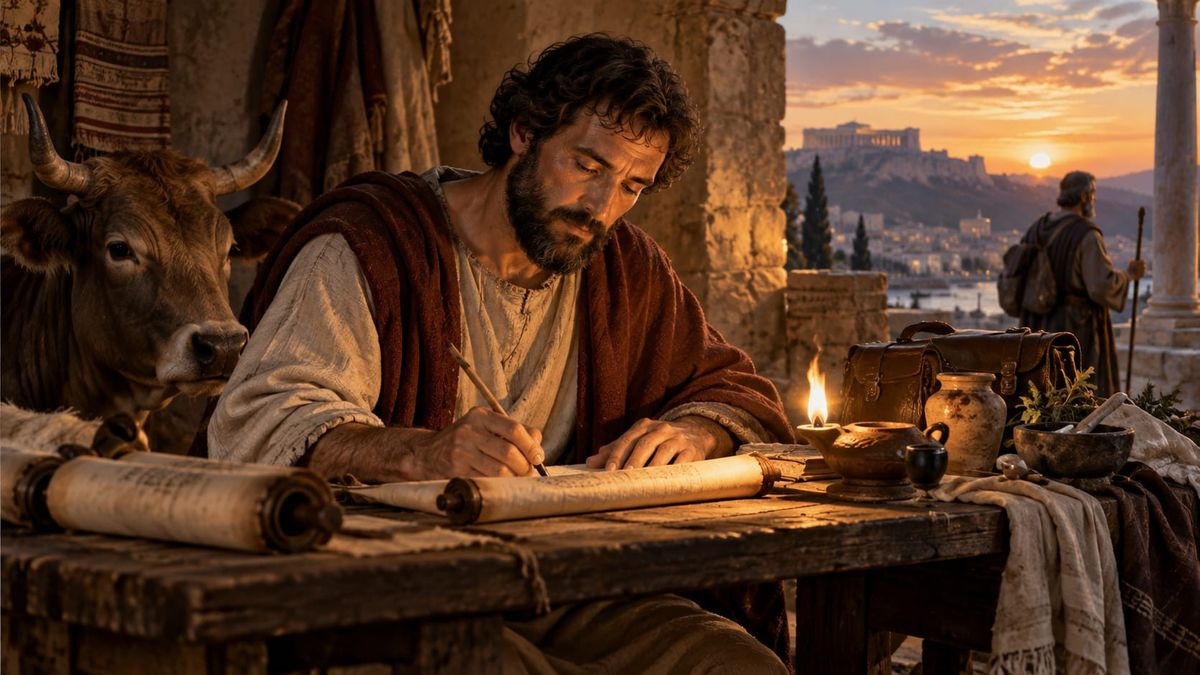
October 18, 2026, Saint Luke, Evangelist and Companion of Paul, Holy Day, Season after Pentecost
Luke 4:14–21; Psalm 147:1–11; 2 Timothy 4:1–13; Ecclesiasticus 38:1–14
Grace, mercy, and peace from God our Father and the Lord Jesus Christ be with you on this Feast of Saint Luke, Evangelist and Companion of Paul.
Saint Luke gives us one of the most dramatic opening scenes in the ministry of Jesus. Jesus has returned to Galilee in the power of the Spirit. News about him is spreading through the surrounding country. He comes to Nazareth, the town where he had been brought up, and on the Sabbath he enters the synagogue. He stands to read, the scroll of the prophet Isaiah is given to him, and he finds the place where it is written: “The Spirit of the Lord is upon me, because he has anointed me to proclaim good news to the poor.” Jesus continues with liberty for the captives, recovery of sight for the blind, freedom for the oppressed, and the proclamation of the year of the Lord’s favor.
Then he rolls up the scroll. Luke tells us that every eye in the synagogue is fixed on him. Jesus sits down, and in verse 21 he says, “Today this Scripture has been fulfilled in your hearing.”
That sentence stands at the center of the Gospel appointed for Saint Luke’s feast. It also helps us understand why the Church remembers Luke at all. Luke is important because Luke bears witness to Jesus Christ. The Evangelist does not finally point us toward himself, his profession, his travels, or even his literary achievement. He gives us the Gospel so that we may know the Lord who can stand in the synagogue at Nazareth and say that the promises of God are being fulfilled in him. That is where this feast must begin.
The Church remembers Luke as the beloved physician. Paul calls him that in Colossians, and the Prayer Book takes up that image in the Collect when it calls Luke an “evangelist and physician of the soul.” But Luke does not heal souls because he possesses some spiritual power of his own. Luke is a physician of the soul because the doctrine he teaches brings us to Christ. The medicine is wholesome because the Gospel is true, and the Gospel is true because the one it proclaims really has come.
Jesus does not enter the synagogue merely to give an inspiring reading from Isaiah. He declares that Isaiah’s promise has reached its fulfillment. The promised one is standing before them.
Verse 18 begins, “The Spirit of the Lord is upon me.” Jesus’ ministry is not a human project of moral improvement. He has been anointed and sent. His work begins with God’s action, not ours. He comes to proclaim good news because the Father has sent him and the Spirit rests upon him.
That grace-first movement matters. We often imagine Christianity beginning with what we must do: become more disciplined, make better decisions, clean ourselves up, think more positively, or become sufficiently religious. But Jesus begins somewhere else. He begins with what God has done. The good news is not that we have finally discovered a way to save ourselves. The good news is that God has acted in Jesus Christ.
And notice the people to whom the good news comes. Jesus says he has been anointed “to proclaim good news to the poor.” He speaks of captives, the blind, and the oppressed. The people described in Isaiah are people in need. They are not self-sufficient. They cannot simply reach down within themselves and discover that everything they need has been there all along.
This is where the medical language of Saint Luke’s feast becomes so fitting. Medicine is for people who know that something is wrong. A good physician does not love us by hiding the diagnosis. He tells us what is wrong because he wants us to live. Truth is not the opposite of mercy. In the hands of one who intends to heal, truth is part of mercy.
The Gospel works in a similar way. It does not flatter us about sin. It tells us that something has gone wrong in the human heart and in the world around us. Sin is not merely a collection of unfortunate mistakes. It reaches into our loves, desires, habits, relationships, memories, appetites, and wills. We hurt other people. We excuse ourselves. We cling to resentment. We envy what others have. We learn to manage appearances while hiding what we do not want brought into the light.
The Gospel tells the truth about that disease, but it tells the truth because the Physician has come. Jesus does not stand in Nazareth merely to announce the diagnosis. He proclaims good news. The captives are told of liberty, the blind of sight, and the oppressed of freedom. The poor hear good news, and the year of the Lord’s favor has come.
This is why Christian repentance can never be separated from grace. We do not repent in order to persuade Christ to become merciful. We repent because the merciful Christ has come near. We do not confess our sins in the hope that God might eventually decide to become gracious. We confess because Jesus has come to seek and save the lost.
Luke’s Gospel will show this again and again. The shepherd goes after the lost sheep. The woman searches for the lost coin. The father sees the returning son while he is still a long way off and runs to meet him. Zacchaeus is called down from the tree. The tax collector who can offer God nothing but the confession “God, be merciful to me, a sinner!” goes home justified.
Luke will not allow us to turn mercy into sentimentality. Jesus still calls sinners to repentance. He still warns about judgment. He still exposes hypocrisy, greed, self-righteousness, and unbelief. But all of those hard words belong within the larger announcement that the Savior has come.
And this is not merely theology for people whose lives are going well. The good news of Christ comes to the person waiting for the test result that may change everything, to the person waking again with chronic pain, to the widow who still reaches instinctively for the person who is no longer there, and to the person carrying wounds that no prescription can completely erase. When Jesus speaks of good news, liberty, sight, and release, he speaks into a world where people really are wounded, frightened, guilty, grieving, and bound.
That is why Psalm 147 belongs so naturally beside this Gospel. It praises the God who “heals the brokenhearted and binds up their wounds.” The same Psalm speaks of the God who determines the number of the stars and gives them all their names. The Lord whose wisdom stretches beyond our comprehension is not too distant to bind the wounds of a single broken heart.
God is neither small enough to be overwhelmed by the universe nor too great to notice our suffering. Some wounds are physical. Some are emotional. Some are wounds we did not choose. Others are wounds connected to choices we deeply regret. Some are wounds left by people we trusted. Some are wounds we have caused in the lives of others.
Psalm 147 does not tell us that every wound disappears immediately. Luke’s own life would give us no reason to expect that. He traveled with Paul through hardship, danger, opposition, imprisonment, and suffering. But the Psalm tells us something deeper: the God who made the heavens draws near to the brokenhearted.
Ecclesiasticus 38 adds another dimension to that picture of healing. It tells us to honor the physician and to receive medicine as part of God’s providence. Classical Anglicanism has always maintained the Article VI distinction here: Ecclesiasticus is read for instruction, not to establish doctrine. Yet its practical wisdom is well chosen for Luke’s feast. Prayer and medicine are not enemies. Trust in God does not require contempt for physicians, treatment, or the ordinary means by which God cares for his creatures.
That matters because Christians sometimes create false choices that Scripture itself does not require. We can pray for healing and make the appointment. We can ask the Church to intercede and take the medicine. We can trust God’s providence while receiving the skill of physicians, nurses, therapists, surgeons, pharmacists, and caregivers. Created means are not rivals to the Creator.
At the same time, created medicine has limits. Even the best physician cannot forgive sin. No prescription can reconcile us to God. No surgery can remove guilt from the conscience. No treatment can raise the dead to everlasting life. That is why Luke the physician needed Christ just as surely as we do.
All of this brings us back to the words of Jesus in verses 18 and 19. The healing imagery of the feast matters because Christ has come to proclaim and accomplish the release Isaiah promised. Luke may have been a physician, and the Church may rightly honor the created means of healing, but the deepest sickness named by the Gospel requires more than medicine. We need the Savior.
Verse 19 says that Jesus has come “to proclaim the year of the Lord’s favor.” The language echoes the biblical Jubilee, the great pattern of release, restoration, and freedom. But Jesus does not merely announce a social program or a temporary easing of circumstances. He announces the arrival of God’s saving reign in himself.
We need to hold those things together carefully. The salvation of Christ is not less than bodily, concrete, and human. Jesus cares about hunger, suffering, sickness, exclusion, injustice, and grief. Luke’s Gospel makes that impossible to miss. Yet Christ’s salvation is also deeper than the relief of our present circumstances. He goes to the root of our bondage. He deals with sin, guilt, death, and alienation from God.
The Gospel is not merely advice for making life more bearable. It is the announcement that the kingdom of God has drawn near in Jesus Christ.
Then verse 21 gives us the sentence that controls the whole passage: “Today this Scripture has been fulfilled in your hearing.” That word today matters. Jesus is not merely speaking about an interesting prediction from Israel’s past or a beautiful hope for some distant future. He declares that fulfillment has arrived because he has arrived.
Christianity finally stands or falls with Christ himself. If Jesus is only a moral teacher, then his words in Nazareth are astonishingly excessive. If he is merely pointing toward a better social order, his claim is too large. If he is only one prophet among many, he has taken Isaiah’s promise upon himself in a way no ordinary prophet could.
But Luke writes so that we may know who Jesus is. He tells us of the conception and birth of the Savior, the angels’ song, and Simeon holding the child and calling him a light for revelation to the Gentiles and the glory of Israel. He tells us of Jesus’ ministry, his parables, his table fellowship with sinners, his journey toward Jerusalem, his death upon the cross, his resurrection from the dead, and his ascension.
Then Luke continues the story in Acts. The Gospel that begins in Israel goes outward. Jerusalem, Judea, Samaria, and toward the ends of the earth. Peter enters the house of Cornelius. Paul carries the name of Christ among the Gentiles. The good news moves toward Rome. Luke’s great two-volume work bears witness to the fact that the salvation announced in Nazareth cannot be contained within Nazareth.
The Gospel Luke records is large enough to reach the nations, but Luke’s own faithfulness is remembered in one very small sentence. Near the end of 2 Timothy, Paul writes about people who have gone. Demas has deserted him. Others have traveled elsewhere. Paul knows that his own race is nearing its end. Then he says simply, “Luke alone is with me.”
We should not rush past that. The man who gave the Church one of its four Gospels and the Acts of the Apostles is also remembered as the man who stayed. That is a different kind of ministry, but it is not a lesser one.
We are often tempted to measure Christian usefulness by visibility. We notice the person speaking, leading, publishing, organizing, building, or accomplishing something that can be counted. But much of Christian faithfulness is quieter than that. Sometimes faithfulness means staying: sitting beside the hospital bed when there is nothing clever left to say, caring for an aging parent when the work is repetitive and exhausting, calling the person whose grief has lasted longer than everyone else’s attention, remaining faithful to a friend whose life has become difficult, or showing up again when there is no applause for showing up.
Luke wrote. Luke traveled. Luke proclaimed the Gospel. Luke also stayed with Paul, and that too was holy work.
But even here grace must come first. Christian companionship is not another demand laid upon exhausted people as though the Gospel were simply telling us to try harder at friendship. We remain because Christ remained faithful to us. We bear one another’s burdens because he bore ours. We show mercy because we have received mercy. We stay because the Lord who promised never to leave or forsake his people has first held us fast.
That is where this feast becomes intensely practical. Some of us need to receive the wholesome medicine of truth. There is a sin we have been renaming so that we do not have to repent of it. There is bitterness we have begun to call discernment. There is greed we have learned to call prudence. There is gossip we justify as concern. There is an appetite we insist we can control even though it increasingly controls us.
The Physician of souls does not heal us by agreeing with our excuses. He brings the truth into the light, but he does not bring it into the light in order to destroy the repentant sinner. He brings it into the light in order to forgive, restore, and heal.
So we confess. We stop bargaining with the diagnosis. We stop explaining why our sin should be treated differently. We bring it to Christ.
And some of us need to receive the medicine of mercy in a different way. We have confessed what we did, but we continue to rehearse the accusation long after God has pronounced forgiveness. We believe Christ can forgive other people, but our own failure feels somehow exempt from the reach of grace.
Luke’s Gospel speaks directly to that kind of heart. The father runs toward the returning son. The tax collector goes home justified. Jesus tells the dying criminal, “Today you will be with me in paradise.” The medicine is not our ability to punish ourselves long enough. The medicine is Christ.
And perhaps some of us need to hear Paul’s little sentence, “Luke alone is with me,” and recognize a person God has placed near us who needs more than our good intentions. They need our presence. They need the phone call made today rather than someday. They need the visit we keep postponing. They need the meal, the ride, the conversation, the prayer, or simply the assurance that we have not disappeared.
Christian love becomes visible in particular acts toward particular people. That does not save us. Christ saves us. But saved people learn to become merciful.
This is why the Collect for Saint Luke is so beautifully constructed. We pray that the God who called Luke to be an evangelist and physician of the soul would grant that, by the wholesome medicine of the doctrine he taught, the diseases of our souls may be healed.
Notice again where the action begins. God called Luke. God grants the healing. Christ is the Savior. The Holy Spirit applies the Word. Grace comes first.
Then the healed become instruments of healing. The forgiven become people who forgive. Those who have received mercy become merciful. Those whom Christ has not abandoned learn not to abandon one another.
Saint Luke’s feast therefore does not finally ask us to admire Luke from a distance. It calls us to receive again the Gospel Luke spent his life proclaiming. Jesus Christ has come. Good news is proclaimed to the poor, liberty to captives, sight to the blind, and freedom to the oppressed. The brokenhearted are bound up. Sinners are called to repentance and given forgiveness. The risen Christ sends his Church into the world bearing that same Gospel.
The deepest truth of this feast is not that Luke was a physician, though he was. It is not that Luke wrote beautifully, though he did. It is not even that Luke remained with Paul, though that quiet fidelity deserves to be remembered. The deepest truth is the one Luke places on the lips of Jesus in Nazareth: “Today this Scripture has been fulfilled in your hearing.”
The Savior has come.
So let us come honestly. Let us bring the wounds we cannot heal, the sins we cannot excuse, the guilt we cannot erase, and the death we cannot overcome. Let us stop pretending that we are well when we need a physician, and let us come with confidence because the Physician receives sinners.
He tells the truth about our disease because he intends to heal. He calls us to repentance because mercy is near. He forgives because he bore our sins. He gives life because he has conquered death.
And having received that mercy, may we become people who carry it into the lives of others, speaking truth without cruelty, showing compassion without surrendering truth, and remaining faithful when love becomes costly.
For the Gospel Saint Luke gave the Church is still wholesome medicine because the Christ Saint Luke proclaimed is still the Savior of sinners.
In the Name of the Father, and of the Son, and of the Holy Spirit. Amen.