Saint Barnabas the Apostle: An Anglican Perspective
Today the Church observes the Feast of Saint Barnabas. He stood before the apostles in Jerusalem and vouched for Saul when no one else would. If he had been wrong, the cost would have been real. He was not wrong. The man he testified for wrote half the New Testament.
Feast Day: June 11
The Anglican calendar is ordered by a hierarchy of holy days, each carrying a different weight of observance. At the top stand the seven Principal Feasts, the highest-ranking days of the liturgical year. Below them are the Red-Letter Holy Days appointed in the BCP 2019 with their own Collects and propers. The Feast of Saint Barnabas the Apostle, observed on June 11, is one of these Red-Letter Holy Days. The Prayer Book lists Barnabas the Apostle in the June calendar, provides his Collect on page 629, and appoints his readings in the Holy Day lectionary on page 730.
Barnabas occupies an unusual place in the New Testament. He was not one of the Twelve and was not chosen to replace Judas; Matthias was numbered with the eleven for that purpose in Acts 1. Yet Luke explicitly calls Barnabas and Paul apostles in Acts 14:14. The New Testament can therefore use the word apostle more broadly than the unique company of the Twelve. Barnabas belongs to that wider apostolic mission without becoming one of the Twelve, a distinction worth preserving because it allows Scripture’s own language to govern the Church’s categories.
His importance in Acts is difficult to overstate. Barnabas appears at several turning points in the Church’s expansion: the sharing of possessions in Jerusalem, Saul’s acceptance among the disciples, the reception of Gentile converts at Antioch, the calling of Saul into sustained ministry there, the first great missionary journey, and the later continuation of ministry with John Mark. The BCP Collect captures the pattern running through these episodes by describing him as a man who sought not his own renown but the well-being of the Church, gave generously for the relief of the poor, and went forth courageously for the spread of the Gospel.
Joseph Called Barnabas
Barnabas first appears in Acts 4:36–37. Luke tells us that his given name was Joseph, that he was a Levite and a native of Cyprus, and that the apostles called him Barnabas, which Luke explains as “son of encouragement.” (Acts 4:36, ESV) He sells a field, brings the money, and lays it at the apostles’ feet for the relief of those in need.
That name, given by the community that knew him, tells us something important before we learn where he traveled or what missionary work he undertook. Before Acts shows us Barnabas traveling or teaching, it shows grace bearing fruit in generosity. What is admirable in Barnabas is never detached from what God has first done in him.
Luke places Barnabas’s generosity immediately before the account of Ananias and Sapphira, and the contrast is hard to miss. Barnabas gives freely for the good of the Church; Ananias and Sapphira seek the reputation of generosity while lying about their gift. Barnabas is the genuine article. His generosity becomes the backdrop against which the counterfeit is exposed.
The BCP Collect receives Barnabas through this scriptural lens. It remembers that he “gave generously of his life and substance for the relief of the poor.” His generosity is therefore not incidental background to his later missionary work. Before Acts shows Barnabas crossing the sea, teaching converts, or supporting other ministers, it shows him giving.
That order matters. Christian mission is not only what happens from a pulpit or on a missionary journey. Barnabas’s ministry begins with the use of his possessions for the good of Christ’s people. The Gospel loosens his grip upon what he owns because he has received something greater.
Barnabas Receives Saul
Barnabas’s next major appearance comes after Saul’s conversion. Saul has encountered the risen Christ, been baptized, and begun preaching boldly in Damascus. When he later comes to Jerusalem and attempts to join the disciples, they are afraid of him because they do not believe he has truly become a disciple.
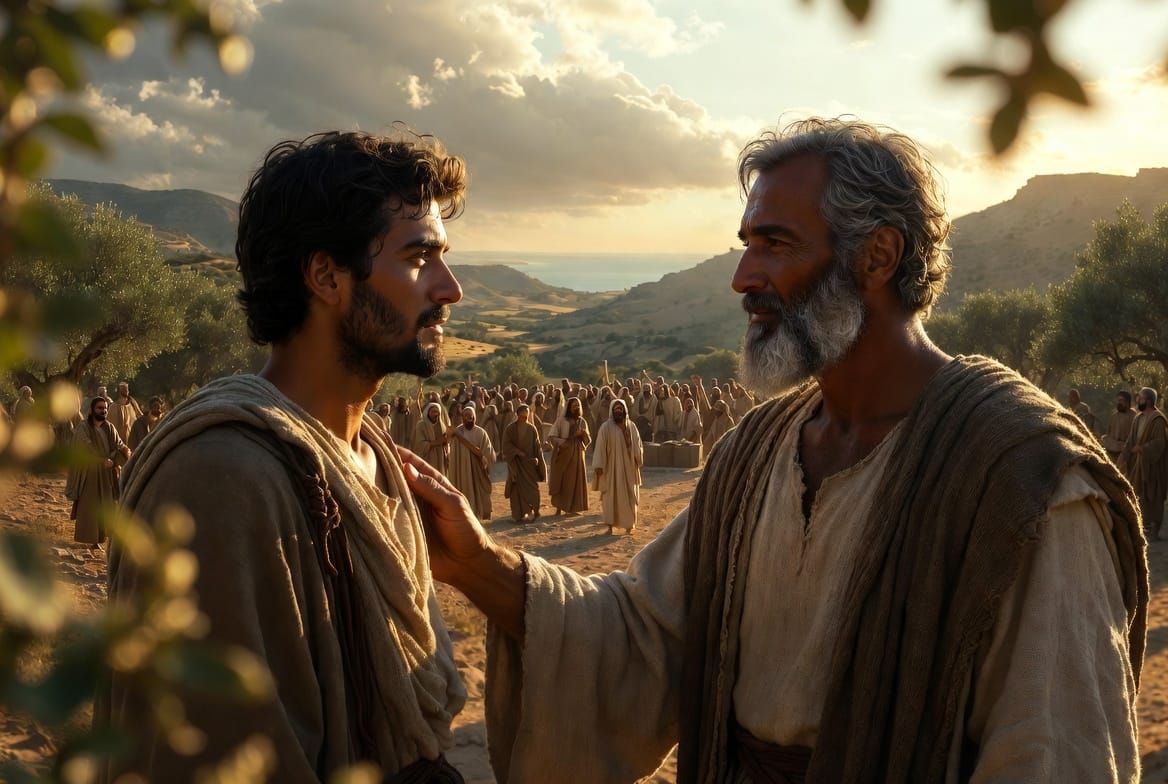
Acts then says, “But Barnabas took him and brought him to the apostles and declared to them how on the road he had seen the Lord, who spoke to him, and how at Damascus he had preached boldly in the name of Jesus.” (Acts 9:27, ESV)Barnabas does not convert Saul. Christ has already done that. Nor does Barnabas create Saul’s calling. The risen Lord has already claimed him. Barnabas recognizes what God has done and is willing to testify to it when others remain understandably suspicious.
That sentence in Acts is short. What it cost Barnabas to speak it was not. The disciples’ fear is understandable. Saul had persecuted the Church and approved Stephen’s execution. Barnabas nevertheless stands before the apostles as a character witness for a man they had every reason to fear. Barnabas stakes his own credibility on the claim that Christ has truly changed Saul.
His encouragement is therefore not mere optimism or indiscriminate trust. Saul’s conversion has evidence. Barnabas recounts what has happened and points to fruit already visible in Saul’s bold proclamation of Jesus. He is not ignoring Saul’s past. He is refusing to allow Saul’s past to outweigh what Christ has now done.
The Church still needs this kind of ministry because conversion sometimes creates a gap between what God has done in a person and what other Christians are yet prepared to believe. Barnabas does not stand between Saul and Christ. He helps the Church recognize the work Christ has already begun.
He Saw the Grace of God and Was Glad
Acts 11 gives perhaps the clearest biblical description of Barnabas’s character. Believers scattered by persecution have carried the Gospel as far as Antioch, and some begin preaching the Lord Jesus to Greeks as well as Jews. Luke says that “the hand of the Lord was with them, and a great number who believed turned to the Lord.” (Acts 11:21, ESV) When news reaches Jerusalem, the Church sends Barnabas to Antioch.
His response is revealing: “When he came and saw the grace of God, he was glad, and he exhorted them all to remain faithful to the Lord with steadfast purpose.” Luke then explains why: “for he was a good man, full of the Holy Spirit and of faith.” (Acts 11:23–24, ESV)
Barnabas does not create the Gentile mission in Antioch. Believers from Cyprus and Cyrene have already proclaimed Christ there, and Luke explicitly says the hand of the Lord is responsible for the growth. Barnabas arrives after the work has begun. His great contribution is that he recognizes the grace of God when he sees it, rejoices in it, and strengthens the new believers rather than making himself the center of what is happening.
He saw the grace of God and was glad. He did not arrive merely looking for reasons to be suspicious of something he had not started. He saw God at work among people whose background differed from his own, and his first response was joy.
This is not naïveté. Barnabas exhorts the believers to remain faithful to the Lord with steadfast purpose. Joy and exhortation belong together. He neither smothers new life with suspicion nor treats every new development as self-authenticating. He sees grace, rejoices in grace, and then strengthens those who have received it.
Christian leaders can easily become threatened by good work they did not initiate, ministries they do not control, or gifts more visible than their own. Barnabas gives us a better pattern. He sees the grace of God and is glad.
Barnabas Goes to Find Saul
Barnabas then leaves Antioch for Tarsus to look for Saul. When he finds him, he brings him back, and the two spend a year teaching the Church together. Luke adds that “in Antioch the disciples were first called Christians.” (Acts 11:26, ESV)
The importance of Barnabas’s decision is easy to miss because Acts reports it so simply. Saul has extraordinary gifts and an extraordinary calling, but Barnabas is the man who goes looking for him and brings him into the growing ministry at Antioch. The Lord who called Saul on the Damascus road now uses Barnabas as one of the human instruments by which that calling is drawn more fully into the life and mission of the Church.
This is another form of encouragement. It is not merely saying kind things. Sometimes encouragement means recognizing a gift and making room for it. It means inviting someone into useful work, placing trust where trust is warranted, and being willing for another person’s ministry to become increasingly prominent.
As Acts progresses, Luke increasingly writes Paul and Barnabas rather than Barnabas and Saul. Nothing in the text suggests rivalry. Barnabas simply continues serving beside the man he once went to find. His usefulness was never dependent upon remaining the most prominent name in the room.
The Collect’s phrase “seeking not his own renown but the well-being of your Church” therefore fits the biblical portrait particularly well. Barnabas’s usefulness repeatedly consists in helping the work of Christ grow even when someone else becomes the more prominent figure.
The Holy Spirit Sends Barnabas and Saul
Acts 13 moves from encouragement into explicit missionary sending. The Church at Antioch contains prophets and teachers, and Barnabas is named first among them. While they are worshiping and fasting, the Holy Spirit says, “Set apart for me Barnabas and Saul for the work to which I have called them.” (Acts 13:2, ESV) After further fasting and prayer, the Church lays hands upon them and sends them away.
The order of the narrative deserves attention. Barnabas and Saul do not invent their mission. The Holy Spirit speaks of “the work to which I have called them.” The Church responds by praying, fasting, laying on hands, and sending. God is the first mover, while the Church acts faithfully in response to his call.
Christian vocation is therefore neither self-invention nor ecclesiastical manufacture. The Lord calls; the Church discerns and sends. Barnabas’s missionary courage rests upon prior grace.
Luke later explicitly calls Barnabas and Paul apostles. (Acts 14:14) Scripture calls Barnabas an apostle in the context of the missionary work to which the Holy Spirit sent him. He bears witness to Christ, participates in the founding and strengthening of churches, and belongs to the apostolic mission of the early Church.
The BCP accordingly appoints the Preface of Apostles for his feast. The Prayer Book keeps Barnabas’s ministry under Christ rather than allowing the apostle himself to become the center of the feast. Barnabas is sent because Christ sends.
Barnabas and John Mark
Barnabas’s relationship with John Mark gives the feast another enduring dimension. Mark had accompanied Barnabas and Saul on the first missionary journey but left them in Pamphylia and returned to Jerusalem. When Paul later proposes revisiting the churches, Barnabas wants to take Mark again. Paul refuses because Mark had withdrawn from the earlier work.
Luke says there arose “a sharp disagreement” between Paul and Barnabas, and the two separate: Barnabas takes Mark and sails to Cyprus, while Paul chooses Silas. (Acts 15:39–40, ESV) The Greek word is paroxysmos (par-ox-oos-MOSS), a strong word for sharp contention or provocation. This was no minor difference of opinion. Two faithful servants of Christ reached a serious disagreement over a practical missionary judgment.
That prevents us from turning Barnabas into a flawless hero. Scripture gives us saints truthfully rather than sentimentally. Paul had serious reasons for not wanting to take Mark again. Barnabas believed Mark should be given another opportunity.
Colossians 4:10 identifies Mark as Barnabas’s cousin, which helps us understand the closeness of their relationship. The later New Testament record also makes clear that Mark became useful in ministry. Paul himself eventually tells Timothy, “Get Mark and bring him with you, for he is very useful to me for ministry.” (2 Timothy 4:11, ESV)
We do not need to claim that Barnabas alone restored Mark to see the grace in the story. Paul once judged Mark unsuitable for the next missionary journey; later Paul called him “very useful to me for ministry.” Between those two moments, Barnabas was willing to take Mark with him and continue the work. Failure did not have the final word.
Early Christian tradition identifies this John Mark with Mark the Evangelist, the author of the Gospel bearing his name. The New Testament does not trace every stage of Mark’s later ministry, but the Church’s ancient identification gives Barnabas’s willingness to continue with Mark an additional resonance. The man who once turned back did not remain defined by that failure.
Barnabas Was Not Flawless
A final biblical episode keeps the feast from becoming sentimental hagiography. In Galatians 2, Paul recounts the conflict at Antioch over table fellowship between Jewish and Gentile Christians. Peter withdraws from eating with Gentiles because of fear of the circumcision party, and Paul says that other Jewish Christians joined him in hypocrisy, “so that even Barnabas was led astray by their hypocrisy.” (Galatians 2:13, ESV)
The word even is revealing. Paul expected better from Barnabas. This is the same Barnabas who had rejoiced at God’s grace among the Gentiles in Antioch and had traveled with Paul in Gentile mission. Yet here he falters under pressure.
The Church loses nothing by acknowledging this. Barnabas’s feast does not require us to pretend that he never sinned, never exercised poor judgment, or never needed correction. It commemorates grace at work in a real Christian man.
Indeed, Galatians makes the feast more useful. Encouragers need the Gospel too. Generous ministers can fail. Men described as full of the Holy Spirit and faith can still act inconsistently and require correction. Barnabas’s holiness is not sinlessness but a life profoundly shaped and used by the grace of God.
The saints are not sinless heroes set beside Christ. They are witnesses to what divine grace can accomplish in people who remain dependent upon mercy.
The Appointed Readings
The BCP 2019 appoints Isaiah 42:5–12; Psalm 112; Acts 11:19–30 and 13:1–3; and Matthew 10:7–16 for Saint Barnabas. The readings bring together mission, generosity, divine calling, and the free gift of the Gospel.
Isaiah 42 speaks of the Servant of the LORD, whom God calls in righteousness, takes by the hand, and gives “as a covenant for the people, a light for the nations.” (Isaiah 42:6, ESV) The Servant’s mission finds its fulfillment in Christ. Barnabas does not replace the Servant; rather, by the Holy Spirit he is drawn into Christ’s mission to the nations.
Psalm 112 gives a particularly direct connection with Barnabas’s generosity. It describes the righteous man who fears the LORD and says, “He has distributed freely; he has given to the poor; his righteousness endures forever.” (Psalm 112:9, ESV) Barnabas’s sale of his field makes the Psalm unusually concrete. The righteous life is not merely inward piety; it bears fruit in generosity.
Acts 11 and 13 place the feast where it belongs in salvation history. The hand of the Lord causes the Antioch mission to grow, Barnabas sees grace and rejoices, he finds Saul, the Church is strengthened, and then the Holy Spirit sets Barnabas and Saul apart for missionary work. The order of grace remains clear from beginning to end. God acts; Barnabas recognizes, encourages, teaches, and goes.
The Gospel, Matthew 10:7–16, records Jesus sending the Twelve. Barnabas is not thereby being retroactively numbered among them. The Church hears the Twelve’s missionary commission because Barnabas participates in the Gospel mission that flows from Christ’s sending. Jesus commands, “You received without paying; give without pay.” (Matthew 10:8, ESV) That sentence gives the feast a fitting theological center. Barnabas gives because he has received.
The whole shape of his life can be heard beneath those words. He gives property for the poor, credibility in support of Saul, time to the Church at Antioch, himself to missionary work, and another opportunity to John Mark. None of this purchases grace. It is the fruit of grace already given.
The BCP 2019 Collect and Proper Preface
The BCP appoints this Collect on page 629:
“Grant, O God, that we may follow the example of your faithful servant Barnabas, who, seeking not his own renown but the well-being of your Church, gave generously of his life and substance for the relief of the poor, and went forth courageously in mission for the spread of the Gospel; through Jesus Christ our Lord, who lives and reigns with you and the Holy Spirit, one God, for ever and ever. Amen.”
The Collect is remarkable for how much of Barnabas’s biblical character it compresses into one prayer. Generosity and mission stand side by side. Barnabas gives both life and substance. The Church is therefore not invited to admire encouragement merely as a temperament but to imitate a costly form of Christian service.
The phrase “seeking not his own renown but the well-being of your Church” gives the feast particular relevance in an age tempted to turn ministry into personal platform-building. Visibility is not itself sinful, and some Christian vocations necessarily become public. Paul became more prominent than Barnabas, and the Church rightly treasures Paul’s public ministry. The question is what prominence is for.
Barnabas offers a different measure of usefulness. The question is not whether a minister’s name becomes known but whether Christ’s Church is strengthened, the poor are served, the Gospel is proclaimed, and others are enabled to flourish in their callings.
The appointed Proper Preface is the Preface of Apostles. It keeps the feast centered upon the risen Christ who sends his Church into the world. Barnabas’s apostolic ministry is not self-originated. He is a sent man serving a sending Lord.
Apostolic Honor Without Confusing the Twelve
Barnabas’s feast is a useful occasion to recover precision about apostolic language. The Twelve are unique. Jesus chose twelve in deliberate correspondence with Israel, and after Judas’s death Matthias was chosen to restore that company. Barnabas never becomes another member of the Twelve.
Yet Scripture itself uses apostle beyond that group. Acts 14:14 explicitly calls Barnabas and Paul apostles. Barnabas therefore demonstrates why it is better to distinguish the Twelve from every broader New Testament use of apostle rather than simply equating the two.
This distinction also preserves differences between Barnabas and Paul. Paul grounds his apostleship in the appearance and commission of the risen Christ and vigorously defends that calling in his letters. Scripture gives us no parallel Damascus-road account for Barnabas.
But Scripture gives us enough to speak clearly. Barnabas is truly called an apostle. He is not one of the Twelve. His apostolic ministry belongs to the missionary work to which the Holy Spirit sends him. His feast honors the calling Scripture actually gives him without forcing every apostle into an identical pattern.
Grace That Makes Room for Others
The most distinctive theme running through Barnabas’s life may be his ability, at his best, to make room for the grace of God in other people.
He makes room for the poor by loosening his hold upon property. He makes room for Saul by speaking for a converted persecutor when the Church remains afraid. He makes room for Gentile believers by rejoicing when he sees God’s grace among them. He makes room for Saul’s gifts by bringing him into Antioch. He makes room for Mark after an earlier failure.
This is not a sentimental theology in which encouragement means affirming everyone without judgment. Barnabas exhorts the Antioch Christians to remain faithful to the Lord. Saul’s conversion has evidence. Mark really did withdraw from the first missionary journey. Paul’s concern was not frivolous. Galatians shows that Barnabas himself could be wrong.
Christian encouragement is not the suspension of discernment. It is discernment governed by grace. It refuses both cynicism and gullibility. It sees what God is doing, tells the truth about failure, and remains open to repentance, restoration, growth, and unexpected usefulness.
The Kingdom expands not only through the bold proclamation of the Peters and the Pauls, but also through the quiet, credibility-staking, reputation-risking encouragement of the Barnabases. Barnabas himself proclaims the Gospel and goes in mission, so encouragement is not a substitute for proclamation. It is one of the ways grace makes room for others to serve.
The Church loses something when it produces no Barnabases, when every newcomer must prove himself without anyone willing to stand beside him, when an earlier failure becomes a permanent identity, or when the person gifted for the next stage of ministry remains in Tarsus because nobody goes looking for him. Barnabas asks a deeply ecclesial question: What is Christ doing here, and how can I serve the good of his Church?
Barnabas in History and Tradition
The biblical record becomes sparse after Barnabas and Paul separate in Acts 15. Paul still refers to Barnabas in 1 Corinthians 9, showing that Barnabas remained known as a missionary worker after the separation. Beyond the New Testament, later Christian tradition fills out the story of Barnabas, though Scripture remains our firmest historical ground.
An early Christian work known as the Epistle of Barnabas circulated under his name and was highly regarded in portions of the ancient Church. Clement of Alexandria and other early Christian writers attributed it to Barnabas, though it is generally not regarded today as the work of the Barnabas of Acts. Its ancient association with his name nevertheless shows the esteem in which he was held.
Tertullian also attributed Hebrews to Barnabas, an ancient proposal concerning that anonymous book, though it never became the settled judgment of the Church.
Later Christian tradition connects Barnabas particularly with Cyprus and remembers him as a martyr there. Cyprus is a natural center for his memory because Acts identifies him as a native of the island and records him sailing there with John Mark. Later accounts give further details of his death and burial, but Scripture does not record them.
A work known as the Acts of Barnabas preserves some of these later traditions. It belongs to the Church’s developing memory of Barnabas rather than to the New Testament record itself.
None of this leaves us with a diminished Barnabas. Scripture has already given the Church a rich portrait: a Levite from Cyprus, generous to the poor, trusted by the apostles, full of the Holy Spirit and faith, glad at the grace of God, sent in mission, willing to stand beside Saul, and willing to continue laboring with Mark.
Honoring Barnabas as Anglicans
Anglican observance of the saints is best described positively before it is described polemically. The Church gives thanks to God for his grace in his servants, remembers their witness, and asks for grace to follow what is faithful in their example. The BCP Collect for Barnabas does exactly this: it addresses God and asks that we may follow the example of his faithful servant.
Classical Anglican doctrine rejects the invocation of saints and directs Christian prayer to God through Christ. Christ alone is the mediator of redemption. Honoring Barnabas therefore means neither ignoring him nor assigning him a role Scripture gives to Christ.
The Prayer Book gives a simpler and richer pattern. We remember Barnabas so that we may praise the grace of God that formed him and ask the same Lord to produce generosity, courage, faith, humility, and missionary zeal in us.
That is genuine Christian honor because it keeps the glory where Barnabas himself would have wanted it. Acts does not finally say that Barnabas was remarkable because he possessed an unusually encouraging personality. It says he was “a good man, full of the Holy Spirit and of faith.” (Acts 11:24, ESV) What was good in him was the fruit of grace.
The Liturgical Character
The liturgical color for Saint Barnabas is red. Red fittingly marks apostolic witness, missionary courage, and costly service to the Gospel. It is especially appropriate for a feast whose Collect remembers a servant who gave generously of both his life and substance for the Church’s mission. Later Christian tradition also remembers Barnabas as a martyr in Cyprus. Scripture does not record the circumstances of his death, but the color speaks truthfully even apart from those later details: the apostolic life is a life poured out in witness to Christ.
Observing This Feast
Saint Barnabas the Apostle is observed on June 11. The Collect is found on page 629, the Preface of Apostles is appointed, and the Holy Day readings are Isaiah 42:5–12, Psalm 112, Acts 11:19–30 and 13:1–3, and Matthew 10:7–16.
Begin with Acts 11 and pay attention to the sequence: the hand of the Lord is already at work, Barnabas sees the grace of God, he rejoices, and then he exhorts the believers to remain faithful. Ask for grace to recognize good work you did not begin and to rejoice when Christ’s Kingdom advances through someone else.
Read Acts 4 and consider Barnabas’s generosity. The Collect does not separate mission from possessions because Barnabas did not separate them. Ask whether money, time, influence, or reputation are being held chiefly for personal security or offered for the well-being of Christ’s Church.
Read Acts 9, Acts 15, and Galatians 2 together. Barnabas stands beside Saul when others fear him and later continues with Mark when Paul will not take him on the next journey. Neither episode teaches us to abandon discernment. They do show the importance of Christians willing to recognize repentance, advocate responsibly for others, and refuse to define a person forever by an earlier failure. Galatians reminds us that Barnabas himself needed correction. His feast is ultimately about grace, not personality.
Finally, pray the Collect and allow its contrast between our own renown and the well-being of the Church to become an examination of motive. That question applies to clergy and laity alike. Much Christian service can look outwardly faithful while inwardly being shaped by hunger for recognition. Barnabas’s feast asks us to desire something better: that Christ’s Church flourish even when someone else receives the attention.
Conclusion
Saint Barnabas appears throughout Acts as a man through whom God repeatedly strengthens the work of others. He gives for the poor, speaks for Saul, rejoices over Gentile converts, brings Saul to Antioch, receives the Spirit’s missionary call, and continues with John Mark after an earlier failure. He is not flawless, and Scripture does not hide his failures, but the overall portrait is one of unusual generosity, courage, faith, and willingness to serve without needing to remain at the center.
The feast is therefore not simply about being encouraging in the modern sense of being pleasant or affirming. Barnabas’s encouragement costs him something. It costs property, time, effort, reputation, missionary labor, and sometimes the risk of being wrong. At its best, his encouragement is the capacity to recognize the grace of God and place his own life at its service.
Yet even here God acts first. Christ converts Saul before Barnabas receives him. The hand of the Lord creates the Antioch mission before Barnabas arrives. The Holy Spirit calls Barnabas and Saul before the Church sends them. Barnabas gives because he has received, serves because God has called, and encourages because grace has already been at work.
The Collect therefore gives the feast its proper center. The Church asks God that we may follow Barnabas, who sought not his own renown but the well-being of the Church, gave generously for the poor, and went courageously into mission. The prayer does not ask us to become impressive. It asks us to become useful to Christ.
Barnabas could not produce the harvest that followed his faithfulness. He could stand beside Saul, strengthen the Church at Antioch, and continue the work with Mark, but he could not manufacture what God would do through any of them. As Paul would later write, “God gave the growth.” (1 Corinthians 3:6, ESV) Even the ministry of the son of encouragement finally points beyond Barnabas to the Lord who gives the increase.
Barnabas’s lasting witness may be expressed in the words Luke uses at Antioch: “When he came and saw the grace of God, he was glad.” (Acts 11:23, ESV) The Church will always need Christians capable of seeing grace, rejoicing in it, strengthening what God is doing, and making room for the people through whom he intends to carry his Gospel farther than we could have imagined.