Saint Matthias the Apostle: An Anglican Perspective
February 24 is the Feast of Saint Matthias. He followed Jesus from the beginning, witnessed the resurrection, was chosen by lot, and is never mentioned again in the New Testament. The feast of the faithful unknown; a Red-Letter Day for the man no one remembers.
Feast Day: February 24
The Anglican calendar is ordered by a hierarchy of holy days, each carrying a different weight of observance. At the top sit the seven Principal Feasts, the highest days of the liturgical year. Below them are the Red-Letter Holy Days appointed in the BCP 2019, including the Feasts of the Apostles. The Feast of Saint Matthias the Apostle, appointed for February 24, is one of these Red-Letter Holy Days. The BCP 2019 appoints its Collect on page 627 and its Holy Day readings as Acts 1:15–26, Psalm 15, Philippians 3:12–21, and John 15:1–16.
Matthias is one of the most anonymous of the apostles. He appears by name in a single New Testament passage, Acts 1:15–26. Scripture records no sermon or miracle from his later ministry, and no New Testament letter bears his name. After the lot falls upon him and he is numbered with the eleven, he disappears almost entirely from the biblical record.
Later Christian traditions place his ministry and death in several different regions. The accounts are late and conflicting, and they do not allow his later ministry to be reconstructed with confidence. That caution matters. Matthias does not need an embellished biography to make his feast significant. What Scripture tells us is already enough: he had accompanied the disciples throughout Jesus’ public ministry, belonged to the company from whom a witness to the Resurrection could be chosen, and was chosen by God to take Judas’s place among the Twelve. Later traditions about his travels and death may be noted as traditions, but they should not be presented with the certainty that belongs to Scripture.
That very obscurity gives his feast unusual power. The Church honors a man whose name is scarcely remembered by history but who was known, chosen, and used by God. His feast is therefore not simply about an obscure apostle. It is about the faithfulness of Christ to his Church when one of its leaders proves false, the continuity of apostolic ministry, and the Church’s continuing need for faithful and true pastors.
The Biblical Event
The biblical account is Acts 1:15–26, the appointed first reading for the feast. The disciples have returned to Jerusalem after the Ascension. About one hundred and twenty believers are gathered, and the eleven remaining apostles are among them. Judas Iscariot has betrayed the Lord and is dead. The full number of the Twelve has been broken.
Peter stands before the gathered Church and interprets what has happened through Scripture, citing the Psalms: “May his camp become desolate, and let there be no one to dwell in it” and “Let another take his office.” (Acts 1:20, ESV) The second quotation comes from Psalm 109:8. The word translated office is episkopēn (eh-pis-koh-PAYN), meaning an office, charge, or oversight. It belongs to the same Greek word-family from which the English word episcopal ultimately derives. In Acts 1, Peter is speaking specifically of Judas’s apostolic charge, the ministry from which Judas had turned aside.
The point is significant. Judas’s betrayal does not abolish the office. His sin does not invalidate Christ’s calling of the Twelve. Guided by Scripture, Peter concludes that another must take Judas’s place.
Peter then states the qualifications: “So one of the men who have accompanied us during all the time that the Lord Jesus went in and out among us, beginning from the baptism of John until the day when he was taken up from us, one of these men must become with us a witness to his resurrection.” (Acts 1:21–22, ESV) These requirements govern the restoration of the apostolic company of the Twelve. The man taking Judas’s place must have accompanied Jesus’ followers throughout his public ministry, from the baptism of John to the Ascension, and must be able to join the others as a witness to the Resurrection.
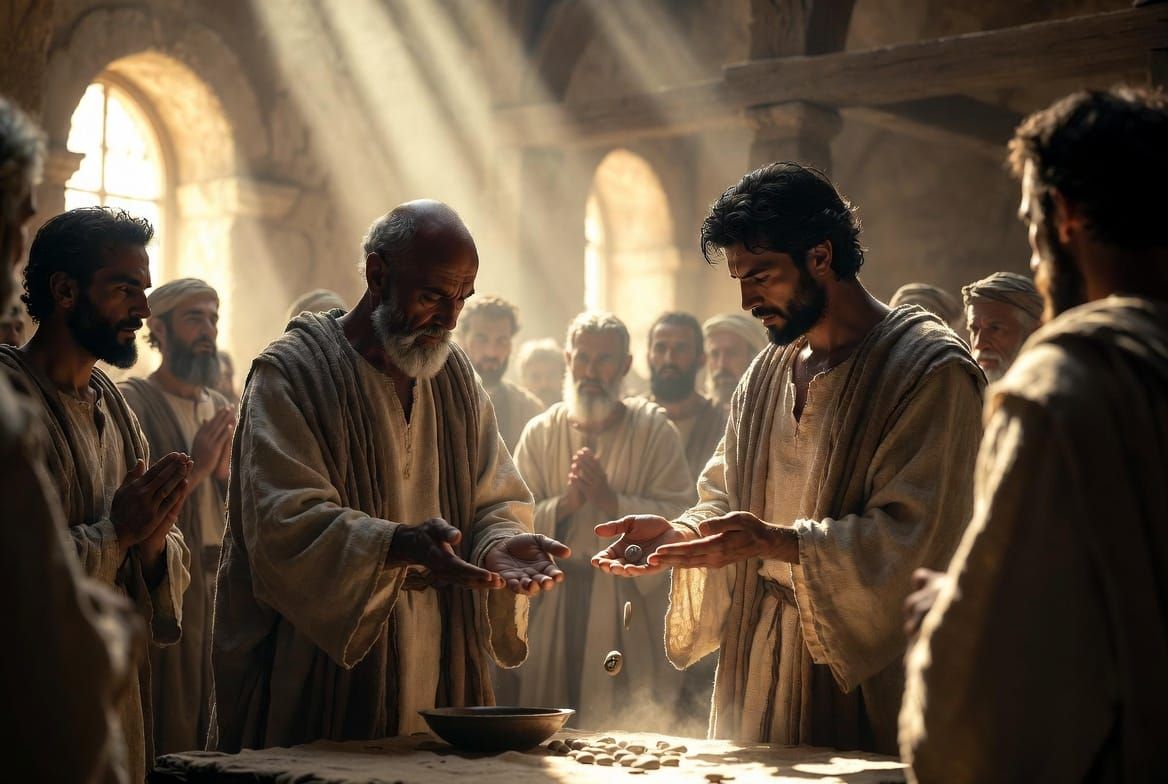
Two men satisfy those requirements: Joseph called Barsabbas, also known as Justus, and Matthias. The gathered Church then prays, “You, Lord, who know the hearts of all, show which one of these two you have chosen to take the place in this ministry and apostleship from which Judas turned aside to go to his own place.” (Acts 1:24–25, ESV) The community has identified two men who meet the apostolic requirements, but the final choice belongs to the Lord. They ask which one God has chosen.
They then cast lots, and the lot falls to Matthias. He is numbered with the eleven, restoring the full number of the Twelve.
The Twelve and the Wider Apostolic Ministry
Acts 1 gives the qualifications required to restore the Twelve after Judas’s betrayal, but the New Testament does not restrict every use of the word apostle to the Twelve.
Paul is the clearest example. He is not one of the Twelve and did not accompany Jesus from the baptism of John through the Ascension, yet his apostleship is not a later human appointment. Paul says plainly that he is an apostle “not from men nor through man, but through Jesus Christ and God the Father.” (Galatians 1:1, ESV) He likewise appeals to his encounter with the risen Lord when he asks, “Am I not an apostle? Have I not seen Jesus our Lord?” (1 Corinthians 9:1, ESV)
Paul does not receive his apostleship from the Twelve. The risen Christ calls and commissions him. What the leading apostles in Jerusalem later do is recognize the grace and commission already given to him. Paul says that James, Cephas, and John “perceived the grace that was given to me” and gave to him and Barnabas “the right hand of fellowship.”(Galatians 2:9, ESV) They recognize what Christ has already done rather than creating Paul’s apostleship themselves.
Barnabas likewise demonstrates that apostle can be used beyond the Twelve, since Acts explicitly speaks of “the apostles Barnabas and Paul.” (Acts 14:14, ESV) Neither Paul nor Barnabas, however, is thereby numbered among the Twelve.
The distinction matters. The Twelve constitute a unique apostolic company chosen by Christ and tied symbolically to the twelve tribes of Israel. Matthias is chosen to restore that company. Paul’s apostleship comes by the direct appearance and commission of the risen Christ and is subsequently recognized by the apostolic leaders in Jerusalem. Acts 1 therefore does not give a generic job description for Christian leadership, nor does it exhaust every New Testament use of apostle. It gives the qualifications required for the man who would take Judas’s place among the Twelve.
The Casting of Lots
The casting of lots can sound strange to modern ears, but Scripture does not present it as superstition. In the Old Testament, lots could be used as a recognized means of placing a decision before God. The land was apportioned by lot, priestly duties could be determined by lot, and Proverbs says, “The lot is cast into the lap, but its every decision is from the LORD.” (Proverbs 16:33, ESV)
The Greek word klēros (KLAY-ros) means a lot, portion, or allotted share. It belongs to the same word-family that later contributed to Christian vocabulary from which the English word clergy developed, reflecting the idea of a portion or inheritance rather than establishing lot-casting as a normal method of choosing ministers.
Acts 1 is the last recorded use of lots for such a decision in the New Testament. The Church is already praying here, so Pentecost should not be described as replacing lots with prayer. What changes in the narrative of Acts is the explicit activity of the Holy Spirit within the apostolic Church. After Pentecost, the Spirit directs mission, sets apart ministers, guides apostolic judgment, and leads the gathered Church in its decisions. At Antioch, the Holy Spirit says, “Set apart for me Barnabas and Saul for the work to which I have called them.” (Acts 13:2, ESV) At Jerusalem, the apostles and elders can write, “It has seemed good to the Holy Spirit and to us.” (Acts 15:28, ESV)
Scripture never tells us that the use of lots was formally abolished, but Acts never records the Church returning to them after the Spirit is poured out. What remains constant on both sides of Pentecost is the conviction that the Church belongs to God and that her ministry stands under his authority.
In Acts 1, Matthias does not campaign, Joseph Barsabbas does not campaign, and there is no speech from either candidate. The Church identifies two men who meet the requirements, prays to the Lord who knows every heart, and places the choice in his hands. The apostolate is received, not achieved.
The Twelve Restored
The number twelve matters. Jesus did not accidentally gather twelve disciples. The Twelve correspond to the twelve tribes of Israel and signify the gathering and renewal of God’s covenant people around Israel’s Messiah. Jesus tells them that “in the new world, when the Son of Man will sit on his glorious throne,” they will sit on twelve thrones judging the twelve tribes of Israel. (Matthew 19:28, ESV)
Judas’s betrayal therefore leaves more than an administrative vacancy. The full symbolic company appointed by Jesus has been broken, and Acts 1 shows the Church refusing simply to accept that loss as though the office no longer mattered. Peter does not conclude that eleven is sufficient or that one apostle’s failure has invalidated the whole structure. Guided by Scripture, the Church acts to restore the full number of the Twelve. Matthias is chosen “in the place of Judas,” as the BCP Collect puts it, and numbered with the eleven.
There is a deeply consoling ecclesiology here. Christ’s Church can be wounded by the sins of its leaders. Judas was not an outsider attacking from beyond the walls but one of the Twelve. Yet Judas also shows that a man may truly hold ecclesiastical office while remaining false within it. He heard Christ’s teaching, witnessed his works, and was sent with the others, yet John tells us that Jesus “knew from the beginning who those were who did not believe, and who it was who would betray him.” (John 6:64, ESV) Jesus later says, “Did I not choose you, the twelve? And yet one of you is a devil.”(John 6:70, ESV)
Judas therefore should not be imagined as a faithful believer who later became inwardly false. His apostolic office was real, but Scripture reveals an unbelief and treachery known by Christ from the beginning. Judas’s falsehood does not invalidate the office, overthrow Christ’s calling of the Twelve, or defeat the apostolic Gospel. Christ remains Lord of his Church, the vacancy is filled, and the apostolic ministry continues.
The Theological Significance
The Feast of Saint Matthias presses several truths upon the Church. The first is that Christian ministry begins with the calling of God.
The appointed Gospel, John 15:1–16, contains the theological crown of the feast: “You did not choose me, but I chose you and appointed you that you should go and bear fruit and that your fruit should abide.” (John 15:16, ESV) Few apostolic callings display that truth more visibly than Matthias’s. He does not seize the ministry. He receives it.
The gathered Church itself acknowledges this in prayer when it asks the Lord to show which of the two men he has chosen. The initiative belongs to God. That does not mean human discernment is irrelevant. Peter gives qualifications, the community identifies two men who meet them, Scripture governs the process, and prayer surrounds it. But beneath all of those means stands the conviction that Christ governs his Church and calls those whom he wills to serve it.
The second truth is that hidden faithfulness matters to God. Acts tells us almost nothing about Matthias before his selection except something enormously important: he had been there. He had accompanied the disciples throughout the ministry of Jesus. Long before anyone knew that Judas’s place would need to be filled, Matthias was already among those following the Lord.
His anonymity should not tempt us to manufacture stories about him, but neither should it cause us to miss what Acts reveals. Much of what matters to God happens where history never notices it: the prayers no one records, the obedience no one applauds, the parish work no one celebrates, the truth spoken when no audience is watching, and the years of simple fidelity that never become remarkable enough for a biography. None of these is hidden from the Lord who knows the hearts of all.
Psalm 15 and Faithful Ministry
Psalm 15, the appointed psalm, gives the feast a moral and pastoral dimension. It asks, “O LORD, who shall sojourn in your tent? Who shall dwell on your holy hill?” and answers, “He who walks blamelessly and does what is right and speaks truth in his heart.” (Psalm 15:1–2, ESV)
We should not turn the Psalm into a biography of Matthias that Acts itself does not give us. But its appointment for the feast is theologically fitting. Psalm 15 gives the Church the character of the shepherds for whom the Collect teaches us to pray: those who walk uprightly, speak truth, refuse slander, do no evil to their neighbor, keep their word even when it costs them, and refuse corrupt gain.
That description stands in sharp contrast with Judas. The Collect makes the same contrast in another form: false apostles and faithful and true pastors. Acts 1 therefore confronts every generation of the Church with an uncomfortable truth. Ecclesiastical office does not automatically produce faith, holiness, or fidelity. Judas truly held office, yet he remained false within it. The Church must therefore pray not merely that she will have pastors but that those pastors will be faithful and true. Psalm 15 gives content to that prayer.
Pressing On in Christ
Philippians 3:12–21 is the appointed Epistle, and it gives the feast another important dimension. Paul writes, “Not that I have already obtained this or am already perfect, but I press on to make it my own, because Christ Jesus has made me his own.” (Philippians 3:12, ESV) The order matters. Paul presses on because Christ Jesus has made him his own.
Christian perseverance begins with grace. The apostle does not run in order to persuade Christ to claim him. He runs because Christ already has. That same order illuminates Matthias. He does not achieve the apostolate by outperforming Joseph Barsabbas. He is one of two qualified men placed before the Lord, and the office is given to him.
Having received what God has given, the Christian calling is to press on. Divine election does not produce inactivity. Christ chooses and appoints his servants so that they will go and bear fruit. Grace calls, grace appoints, and grace sends.
The Vine and the Fruit
John 15 places the whole feast inside an even larger truth. Before Jesus says, “You did not choose me, but I chose you,”he tells his disciples, “I am the vine; you are the branches.” (John 15:5, ESV) The apostolic ministry therefore does not draw its life from the apostle. Peter is not the vine, John is not the vine, and Matthias is not the vine. Christ is the vine.
What fruit Matthias bore in his later ministry is mostly hidden from us. We do not need to invent it. John 15 tells us where lasting fruit comes from whether history remembers the servant or not: “Whoever abides in me and I in him, he it is that bears much fruit.” (John 15:5, ESV) The Church remembers Matthias not because history preserved a catalogue of his accomplishments but because Christ chose him and numbered him among the Twelve. The measure of Christian ministry is finally not fame but fruit, and the source of the fruit is Christ.
The BCP 2019 Collect and Preface
The BCP 2019 appoints this Collect on page 627:
“Almighty God, who in the place of Judas chose your faithful servant Matthias to be numbered among the Twelve: Grant that your Church, being delivered from false apostles, may always be guided and governed by faithful and true pastors; through Jesus Christ our Lord, who lives and reigns with you, in the unity of the Holy Spirit, one God, now and for ever. Amen.”
The Collect refuses to sentimentalize the story. It acknowledges the rupture caused by Judas and then turns immediately toward the faithfulness of God. Matthias is chosen “in the place of Judas,” and the Church prays to be delivered from false apostles and governed by faithful and true pastors.
That prayer holds together truths the Church can be tempted to separate. Ordered ministry matters. Continuity matters. Faithful teaching and holy character matter. The failure of one minister does not make ministry itself disposable, but neither does occupying an office guarantee fidelity. The Church therefore needs more than men who possess titles or stand in an institutional succession. She needs pastors who are faithful and true.
The BCP appoints the Preface of Apostles at the Eucharist: “Through the great shepherd of your flock, Jesus Christ our Lord, who after his resurrection sent forth his apostles to preach the Gospel and to teach all nations, and promised to be with them always, even to the end of the ages.” (BCP 2019, p. 155) The Preface places Matthias within the larger apostolic mission of the risen Christ. He is numbered among the Twelve as a witness to the Resurrection, and his calling belongs within Christ’s mission to send his apostles into the world.
Yet even here the Prayer Book keeps our attention in the right place. Jesus Christ is the great Shepherd of the flock. The pastors are his servants, the apostles are his witnesses, and the Church is his Church.
Matthias in Anglican Worship and History
The Feast of Saint Matthias has a long place in the Western and Anglican calendars. Older Western calendars could treat his date differently in leap years because of the ancient Roman method of inserting the additional day in February. In the old bissextile reckoning, February 24 was effectively doubled, which could result in Saint Matthias being observed on February 25 in a leap year. The BCP 2019 avoids that older complication and simply lists Saint Matthias on February 24.
Because February 24 is fixed while Easter moves, the feast may fall either late in the Season of Epiphany or during Lent. The theological character of the feast works naturally in either setting. In Epiphany, Matthias bears witness to the risen Christ whom the season has manifested. During Lent, the contrast between Judas and Matthias, false apostles and faithful pastors, fits naturally within the Church’s examination of sin, repentance, perseverance, and faithfulness.
The calendar rubrics, however, still govern how a fixed Holy Day is actually observed when it coincides with a Sunday. The BCP permits Holy Days falling on Sundays to be observed on that Sunday or transferred to the nearest following weekday, except during Advent, Lent, and Easter. It also states that no Holy Day or other observance may replace the fixed propers of Ash Wednesday, Holy Week, or Easter Week. Saint Matthias therefore belongs to February 24 in the calendar, while its liturgical observance must still follow those governing rubrics when conflicts arise.
Red is the customary liturgical color for the feast, fitting the Church’s traditional association of red with the apostles and with witness to Christ. It also recalls the costly character of apostolic ministry. Scripture does not tell us how Matthias died, and later accounts of his martyrdom are conflicting, so the color should not be used as proof of one particular death tradition. Its theological force is broader: Matthias belongs to the apostolic company commissioned to bear witness to the crucified and risen Lord whatever the cost.
The Collect is perhaps the feast’s most immediately practical gift to Anglican worship. Every parish, diocese, and generation of the Church depends upon faithful pastoral leadership. The feast therefore gives Christians an appointed day to pray specifically that God would protect his Church from false teachers and corrupt shepherds and raise up pastors who speak truth, guard the Gospel, live holy lives, and tend the flock entrusted to them. The prayer begins naturally with bishops, priests, and deacons, but its warning about faithful Christian leadership should also be heard by all who exercise authority or teaching within the Church.
Observing This Feast
Saint Matthias is appointed for February 24. Because Easter moves, that date may fall either in the Season of Epiphany or during Lent, with the BCP’s calendar rubrics governing any conflict of observance.
To observe the feast, pray the Collect from BCP 2019, page 627, and read the appointed propers: Acts 1:15–26, Psalm 15, Philippians 3:12–21, and John 15:1–16. Begin with Acts and notice how seriously the Church takes Scripture, ordered ministry, prayer, and the lordship of Christ over his Church. Judas has betrayed his office, but Christ has not abandoned his Church, and the full company of the Twelve is restored.
Read Psalm 15 and allow it to become an examination of Christian character. Ask whether you are speaking truth in the heart, refusing slander, doing no evil to your neighbor, and keeping your word even when it costs you. The Psalm describes the kind of integrity the Church desperately needs in those who lead her.
Read Philippians 3 and remember the order of grace: “Christ Jesus has made me his own.” (Philippians 3:12, ESV) Only then comes the pressing on. Read John 15 and receive Christ’s words personally without detaching them from their apostolic setting: “You did not choose me, but I chose you.” (John 15:16, ESV) Every Christian vocation begins in the prior grace of God.
Then pray by name for the bishops, priests, deacons, teachers, and other leaders entrusted with the care and teaching of the Church. Pray not chiefly that they will become successful, impressive, or celebrated, but that they will be faithful and true. Pray that they will abide in Christ, bear lasting fruit, speak the truth, resist corruption, and remember that the flock belongs to the great Shepherd rather than to them.
And pray the same for yourself. Matthias’s feast does not permit the congregation to examine clergy while remaining untouched. Hidden faithfulness, truthful speech, perseverance, humility, and dependence upon Christ belong to every Christian vocation.
Conclusion
The Feast of Saint Matthias honors one of the most obscure members of the apostolic company, yet his obscurity is part of the feast’s witness. He followed Christ before anyone knew his name would matter, belonged to the company qualified to bear witness to the Resurrection, and was chosen by God to take Judas’s place among the Twelve. Then the historical record grows quiet. Matthias reminds the Church that faithfulness does not depend upon visibility and that the Lord knows and uses servants whose names history may scarcely remember.
His feast also gives the Church a sober and necessary word about leadership. Judas shows that a man may truly hold ecclesiastical office while remaining false within it, while Matthias shows that human failure does not overturn the faithfulness of Christ. The Church therefore places her confidence not in the brilliance, fame, personality, or mere institutional position of her leaders, but in the great Shepherd who preserves his Gospel and continues to provide servants for his flock.
The Collect gives the feast its lasting prayer: “Grant that your Church, being delivered from false apostles, may always be guided and governed by faithful and true pastors.” (BCP 2019, p. 627) That prayer is as necessary now as it was when Matthias was numbered with the eleven. Christ remains Lord of his Church. He knows every heart, preserves his Gospel, and calls his servants to abide in him and bear fruit that lasts.