Saint Stephen, Deacon and Martyr: An Anglican Perspective
December 26: Th Feast of Stephen, the first martyr. The day after Christmas, the Church moves from the cradle to the stones. The child laid in the manger is the Lord for whom Stephen dies. The Incarnation was never going to be safe.
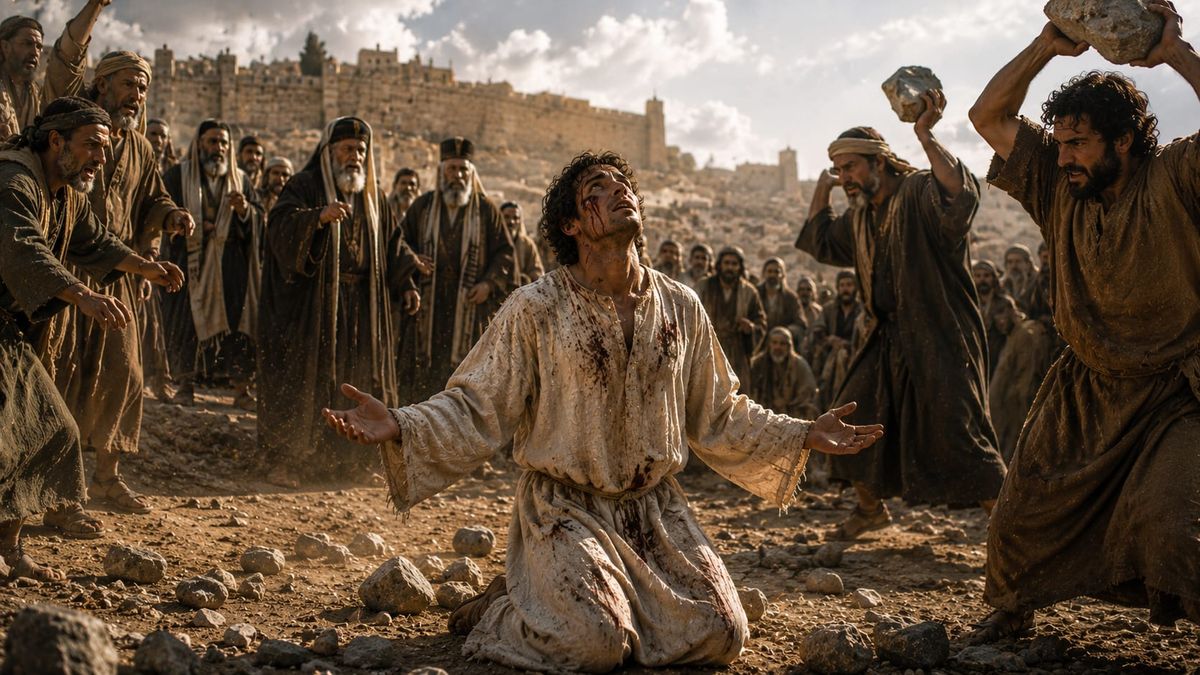
December 26, 2025, Saint Stephen, Deacon and Martyr, Red-Letter Holy Day, Season of Christmas
Matthew 23:29–39, Psalm 31:1–6, Acts 6:8–7:2a, 51–60, Jeremiah 26:1–9(10–11)12–15
The Anglican calendar is ordered by a hierarchy of holy days, each carrying a different weight of observance. At the top stand the seven Principal Feasts, the highest-ranking days of the liturgical year. Below them are the Red-Letter Holy Days appointed in the BCP 2019 with their own Collects and propers. The Feast of Saint Stephen, Deacon and Martyr, observed on December 26, is one of these Red-Letter Holy Days. The Prayer Book appoints his Collect on page 624, the Preface of Christmas, and Jeremiah 26:1–9(10–11)12–15, Psalm 31:1–6(7–27), Acts 6:8–7:2a, 51–60, and Matthew 23:29–39 as the Holy Day readings.
December 26 is the day after Christmas. The Church moves from the birth of the Word made flesh to the death of the first recorded Christian martyr without allowing Christmas joy to become sentimentality. The days immediately following Christmas honor witnesses to Christ in different ways: Stephen, Deacon and Martyr, on December 26; John, Apostle and Evangelist, on December 27; and the Holy Innocents on December 28. The cradle and the stones belong to the same Gospel. The Son who entered a world of sin, resistance, and death would gather a people who followed him even when faithfulness became costly.
The Biblical Portrait
Stephen first appears in Acts 6 when a dispute arises within the rapidly growing Jerusalem Church. Hellenistic Jewish Christians complain that their widows are being neglected in the daily distribution while Hebrew-speaking widows are receiving care. The apostles therefore call the congregation to choose seven men “of good repute, full of the Spirit and of wisdom” to oversee this ministry while the apostles devote themselves to prayer and the ministry of the Word. Stephen is named first and described as “a man full of faith and of the Holy Spirit.” (Acts 6:3, 5, ESV)
Luke immediately shows that Stephen’s ministry of service cannot be separated from spiritual power and Gospel witness. Acts 6:8 says, “And Stephen, full of grace and power, was doing great wonders and signs among the people.” The man chosen because widows are being overlooked becomes one of the most powerful public witnesses to Christ in the early chapters of Acts. Service to the vulnerable and proclamation of the Gospel arise from the same Spirit-filled life.
Opponents soon arise who cannot withstand “the wisdom and the Spirit with which he was speaking.” False witnesses are produced, and Stephen is brought before the council under accusations concerning Moses, the Temple, and the Law. The pattern deliberately echoes the opposition faced by Jesus, including the use of false testimony and controversy surrounding the holy place. Yet Luke tells us that as Stephen stands before his accusers, “all who sat in the council saw that his face was like the face of an angel.” (Acts 6:15, ESV)
Stephen’s defense in Acts 7 is the longest speech recorded in Acts. Beginning with Abraham, he moves through Joseph, Moses, the wilderness, David, and Solomon, showing that God’s saving presence has never been confined to one geographical place and that Israel has repeatedly resisted those whom God sent. The speech reaches its sharp climax when Stephen tells his hearers, “You stiff-necked people, uncircumcised in heart and ears, you always resist the Holy Spirit.”(Acts 7:51, ESV)
The council responds with fury, but Luke once again tells us where Stephen’s strength comes from. He is “full of the Holy Spirit.” He looks into heaven and sees “the glory of God, and Jesus standing at the right hand of God,” then cries, “Behold, I see the heavens opened, and the Son of Man standing at the right hand of God.” (Acts 7:55–56, ESV)
Elsewhere the New Testament commonly speaks of Christ as seated at the Father’s right hand. Here Stephen sees him standing. Scripture does not explain the posture, so a responsible reading should not turn a beautiful interpretation into certainty. Christian tradition has often understood the image as the risen Lord standing to receive or vindicate his faithful witness. What the text makes certain is even more important: Stephen is not abandoned. Heaven is opened, and the Lord for whom he suffers is before him in glory.
As the stones fall, Stephen prays, “Lord Jesus, receive my spirit.” Then he falls to his knees and cries, “Lord, do not hold this sin against them.” (Acts 7:59–60, ESV) His final prayers unmistakably echo the prayers of Jesus from the Cross. Stephen dies looking toward Christ, entrusting himself to Christ, and extending toward his murderers the mercy of Christ.
Stephen and Saul
Luke makes sure that we notice another man standing near the execution. The witnesses lay their garments “at the feet of a young man named Saul,” and Acts 8 begins by telling us plainly that “Saul approved of his execution.” (Acts 7:58; 8:1, ESV) The future apostle Paul enters the Christian story not as an admiring observer of Stephen’s courage but as a man aligned with those who kill him.
We should therefore resist the attractive but speculative idea that Stephen’s martyrdom immediately planted a quiet seed of conversion in Saul’s conscience. Scripture gives us something more dramatic. Saul does not leave the execution reconsidering his life. He becomes an active persecutor of the Church, “ravaging the church, and entering house after house,” dragging Christians away to prison. (Acts 8:3, ESV) Then, on the road to Damascus, the risen Christ acts.
The Lord whom Stephen saw standing in glory confronts the man who approved his death: “Saul, Saul, why are you persecuting me?” (Acts 9:4, ESV) Saul does not convert himself through gradual moral improvement. Christ seeks his enemy, stops him, reveals himself to him, and turns the persecutor into an apostle. The sequence is a powerful testimony to sovereign grace. Stephen cannot convert Saul. Stephen dies. Saul persecutes. Christ intervenes.
Persecution itself cannot stop the Gospel. After Stephen’s death the believers are scattered, but Acts immediately tells us that “those who were scattered went about preaching the word.” (Acts 8:4, ESV) The witness is killed and the Word continues. The persecution intended to suppress the Church becomes, under the providence of God, one of the means by which the Gospel spreads beyond Jerusalem.
The Appointed Readings
The BCP 2019 appoints Jeremiah 26:1–9(10–11)12–15, Psalm 31:1–6(7–27), Acts 6:8–7:2a, 51–60, and Matthew 23:29–39 for Saint Stephen. Together the readings place Stephen within the larger biblical pattern of God sending witnesses who faithfully speak his Word and are rejected by those to whom they are sent.
Jeremiah 26 presents the prophet speaking God’s Word in the Temple and facing the threat of death because of it. Jeremiah refuses to retract what God has commanded him to say: “The LORD sent me to prophesy against this house and this city all the words you have heard.” (Jeremiah 26:12, ESV) Stephen stands within the same prophetic pattern. Faithfulness does not consist in finding the version of God’s message least likely to provoke resistance. Jeremiah speaks because the LORD sent him; Stephen speaks because he is full of the Holy Spirit. Neither man’s authority rests in personality, cleverness, or natural courage.
Matthew 23 makes the connection sharper still. Jesus laments, “O Jerusalem, Jerusalem, the city that kills the prophets and stones those who are sent to it!” (Matthew 23:37, ESV) Stephen is about to enter that line of rejected witnesses. The city in which Jesus was condemned and outside which he was crucified soon casts Stephen outside and stones him because of his testimony to the risen Christ.
Psalm 31 joins Stephen’s death to the death of Jesus. The Psalm includes the prayer, “Into your hand I commit my spirit.”(Psalm 31:5, ESV) Jesus takes those words upon his lips from the Cross in Luke 23:46. Stephen’s prayer, “Lord Jesus, receive my spirit,” unmistakably echoes his Lord. The Church praying Psalm 31 on Saint Stephen’s Day therefore hears a biblical prayer move from the Psalmist to Christ and then echo through the death of Christ’s first martyr.
The appointed reading from Acts gives the heart of Stephen’s witness, trial, vision, and death, but reading Acts 6:8 through 7:60 privately gives the full sweep of his speech and makes clearer why his testimony produced such opposition. Hebrews 12:1–2 is not appointed for the feast, yet it offers a fitting resonance: Christians are surrounded by a “great cloud of witnesses” and look to Jesus, “the founder and perfecter of our faith.” Stephen becomes the first recorded Christian after Pentecost to seal his explicit confession of the risen Christ with his blood.
Stephen, the Diaconate, and Anglican Order
Acts presents Stephen as one of the Seven appointed to address the neglect of Hellenistic widows in the Church’s daily distribution. The passage does not formally call the Seven deacons, but their ministry became foundational to the Church’s understanding of the diaconate. The historic Church received Stephen in this way, and the BCP 2019 makes the identification explicit.
In the Ordination of a Deacon, the bishop prays to God as the one who “inspired your Apostles to appoint to the Order of Deacons the first martyr Stephen, with others.” The Prayer Book therefore does not speak hesitantly about Stephen’s place within the Anglican understanding of diaconal ministry. Within Anglican worship he is rightly remembered as Stephen, Deacon and Martyr.
This matters because Stephen’s ministry refuses any artificial separation between practical service and spiritual witness. He is appointed because vulnerable widows are being overlooked, yet Luke describes him as full of faith, full of the Holy Spirit, full of grace, and full of power. The same servant who attends to the Church’s material distribution stands before the council and bears fearless testimony to Christ.
The diaconal vocation is therefore not merely administrative, nor is practical service spiritually secondary to proclamation. Stephen’s care for those in need and his public witness arise from the same Spirit-filled life. Anglicanism’s threefold order of bishops, priests, and deacons places Stephen within the foundational pattern of the diaconate, so his feast speaks with particular force to deacons. Yet the whole Church can learn from what is joined together in him: humble service, biblical truth, Spirit-given courage, and faithfulness under opposition.
The BCP 2019 Collect
The Collect for Saint Stephen is found on page 624 of the BCP 2019. It remembers that Stephen looked toward heaven and prayed for those who persecuted him, then asks that Christians in their own sufferings may love and forgive their enemies while “looking steadfastly to Jesus Christ our Lord,” who sits at the Father’s right hand and intercedes for us. The Prayer Book then appoints the Preface of Christmas.
The Collect is built around two movements in Stephen’s death: he looks toward Christ, and he prays for his persecutors. The Church is then asked to follow him, but the Prayer Book does not leave Christian forgiveness resting upon sheer willpower. The decisive phrase is “looking steadfastly to Jesus Christ our Lord.” Stephen’s mercy is derivative before it is exemplary. He is full of the Holy Spirit, looking toward the risen Christ, and extending toward his enemies the mercy he himself has received.
This is pastorally important because the command to love enemies is among the most difficult commands Jesus gives. The Collect does not pretend suffering is painless, deny that genuine evil has occurred, or suggest that forgiveness consists in calling evil good. It asks God for grace to love and forgive while fixing our attention upon the Lord who sits at the Father’s right hand and intercedes for his people. Christian mercy is not generated from an untouched reservoir of goodness within ourselves. We receive mercy and, by grace, learn to extend it.
The Preface of Christmas
The Preface of Christmas is appointed for Saint Stephen’s Day, and its presence on December 26 makes a quiet but profound theological statement. The Preface gives thanks because God gave Jesus Christ, his only Son, to be born for us, truly assuming our human nature through the Holy Spirit and the Virgin Mary so that sinners might be cleansed and made God’s children.
The Incarnation and Stephen’s martyrdom therefore belong within one saving story. The one born for us on December 25 is the Lord for whom Stephen dies on December 26. The Word made flesh is not merely a child to be admired in the manger but the crucified, risen, and reigning Lord to whom Stephen entrusts his spirit. The Christmas Preface keeps the feast of the stones within the continuing proclamation of the manger.
Christmas consequently does not require the Church to look away from suffering in order to preserve its joy. Stephen’s martyrdom deepens Christmas by showing what the coming of Christ means in a world that may receive him with worship or resistance. God has truly come among us. Jesus Christ truly is Lord. Stephen stakes his life upon that confession and discovers, even as he dies, that the risen Lord has not abandoned him.
The First Martyr
Stephen has traditionally been called the protomartyr, meaning the first martyr. More precisely, Acts presents him as the first recorded Christian after Pentecost to die because of his explicit witness to the risen Jesus. His priority in the story of Christian martyrdom helps explain why his feast stands so prominently immediately after Christmas.
The English word martyr comes through Greek martys (MAR-toos), meaning a witness. In the New Testament the term does not initially refer only to someone who dies for the faith; it refers to one who bears testimony. The later Christian use grows naturally from the fact that some witnesses, like Stephen, sealed their testimony with their blood.
That distinction matters because Stephen does not seek death. The Church does not honor him because dying violently is intrinsically holy or because Christians are called to pursue suffering. She honors his fidelity to Jesus Christ when others impose suffering upon him because of that witness. Christian martyrdom is not a search for death. It is faithfulness to Christ maintained even when faithfulness becomes costly.
Saint Stephen in Anglican Worship
The Feast of Saint Stephen has been associated with December 26 since the early centuries of the Church and remained firmly embedded in the English and Anglican calendar through the Reformation. The historic Book of Common Prayer preserved Saint Stephen’s Day immediately after the Nativity, so the movement from Christmas to martyrdom is not a modern juxtaposition but a deeply rooted feature of Western and Anglican worship.
Red is customarily used for Saint Stephen in Anglican worship, fitting his martyrdom and his Spirit-filled witness. The Christmas season nevertheless continues, and the Preface of Christmas keeps his feast explicitly within Christmastide. The change of color does not suspend Christmas. It shows that Christmas joy is large enough to include the costly witness produced by allegiance to the incarnate Lord.
December 26 is also known as Boxing Day in Britain and in a number of countries shaped by British custom. The precise origin of the civic name is uncertain. Common explanations connect it with Christmas boxes given to servants and tradespeople or with charitable boxes and gifts associated with the poor. Whatever mixture of customs lies behind the later name, its association with generosity sits naturally beside Stephen’s biblical story without needing to be treated as a direct outgrowth of his feast.
Stephen first enters Scripture because widows are being neglected in the Church’s daily distribution. The first martyr is therefore also remembered within a ministry concerned with vulnerable people and the equitable sharing of the Church’s resources. Charity on Saint Stephen’s Day is not commanded by Acts as a feast-day observance, but generosity toward those in need fittingly recalls the ministry through which Stephen first enters the biblical narrative.
Observing the Feast
Saint Stephen, Deacon and Martyr, is observed on December 26. The Collect is found on page 624 of the BCP 2019, the Preface of Christmas is appointed, and the Holy Day readings are Jeremiah 26:1–9(10–11)12–15, Psalm 31:1–6(7–27), Acts 6:8–7:2a, 51–60, and Matthew 23:29–39. Red is customarily used in Anglican worship.
Begin with Acts. The appointed passage provides the essential narrative, but reading Acts 6:8 through 7:60 gives the full sweep of Stephen’s witness and helps reveal how consistently Luke attributes his faithfulness to divine grace. Stephen is full of faith, full of the Holy Spirit, full of grace, and full of power. Then notice where his attention rests as the crowd closes around him. His eyes are not finally fixed upon the stones but upon Jesus Christ.
Read Jeremiah 26 and Matthew 23 alongside Acts and recognize the long biblical pattern of those sent by God being rejected for faithfully speaking his Word. Then pray Psalm 31 and hear its words move through the biblical story: “Into your hand I commit my spirit.” The Psalmist prays them, Christ takes them upon his lips at the Cross, and Stephen echoes them as he entrusts himself to Jesus.
Continue, if possible, into Acts 8 and 9. Watch persecution scatter believers and spread the Word. Watch Saul ravage the Church after approving Stephen’s death. Then watch the risen Christ confront the persecutor and make him his own. The Lord Stephen sees in heaven remains sovereign over everything that follows on earth.
Finally, pray the Collect slowly. Its petition is not merely that we would admire Stephen’s courage. It asks that in our own sufferings we would love and forgive our enemies while looking steadfastly to Jesus. Saint Stephen’s Day is therefore not principally a celebration of extraordinary human heroism. It is a witness to what the grace of Christ, through the Holy Spirit, can produce in an ordinary servant who keeps his eyes upon the risen Lord.
Conclusion
Stephen, Deacon and Martyr, is the first recorded Christian after Pentecost to follow the Word made flesh into death because of his testimony to the risen Christ. The calendar moves directly from the manger to the stones because Christian faith has never promised that the coming of Christ would be welcomed by the world without resistance. Yet the transition does not undo Christmas joy. It reveals the Lord in whom that joy is grounded.
Stephen’s story is not finally a story about the power of the people who kill him. While his accusers rage, heaven is opened. While the stones fall, Stephen sees the glory of God. While his enemies condemn him, the risen Jesus stands at the Father’s right hand. While Stephen’s body is being destroyed, he entrusts his spirit to Christ and asks mercy for those who are killing him.
The stones do not stop the Gospel. The Church is scattered, and those who are scattered preach the Word. Saul approves Stephen’s death and ravages the Church, but the risen Christ confronts Saul and turns the persecutor into his apostle. The initiative belongs to God throughout. The witness is killed, but the Word continues because Jesus Christ is risen and reigning.
Stephen therefore dies with his Lord’s prayer on his lips, his Lord’s mercy toward his enemies, and his Lord before his eyes. He serves widows, bears witness before rulers, forgives his killers, and entrusts himself completely to Jesus. None of this begins in Stephen’s natural heroism. Acts repeatedly tells us the source: he is full of faith, grace, power, and the Holy Spirit.
The cradle and the stones belong to one Gospel. The Child born at Bethlehem is the Lord Stephen sees in glory, and the Word made flesh is the Lord for whom Stephen bears witness even unto death. Christmas announces that God has come among us in Jesus Christ. Saint Stephen’s Day shows both what allegiance to that Lord may cost and the greater grace by which Christ keeps his servants faithful when the cost comes.