That Which We Have Seen and Heard: Saint John, Apostle and Evangelist (John 21:9-25)
Feast of John, December 27. Three days of Christmas: Stephen the willing martyr, John the confessor who lived long, the Holy Innocents who died without choice. John’s witness was slow, sustained, written down for the Church forever.
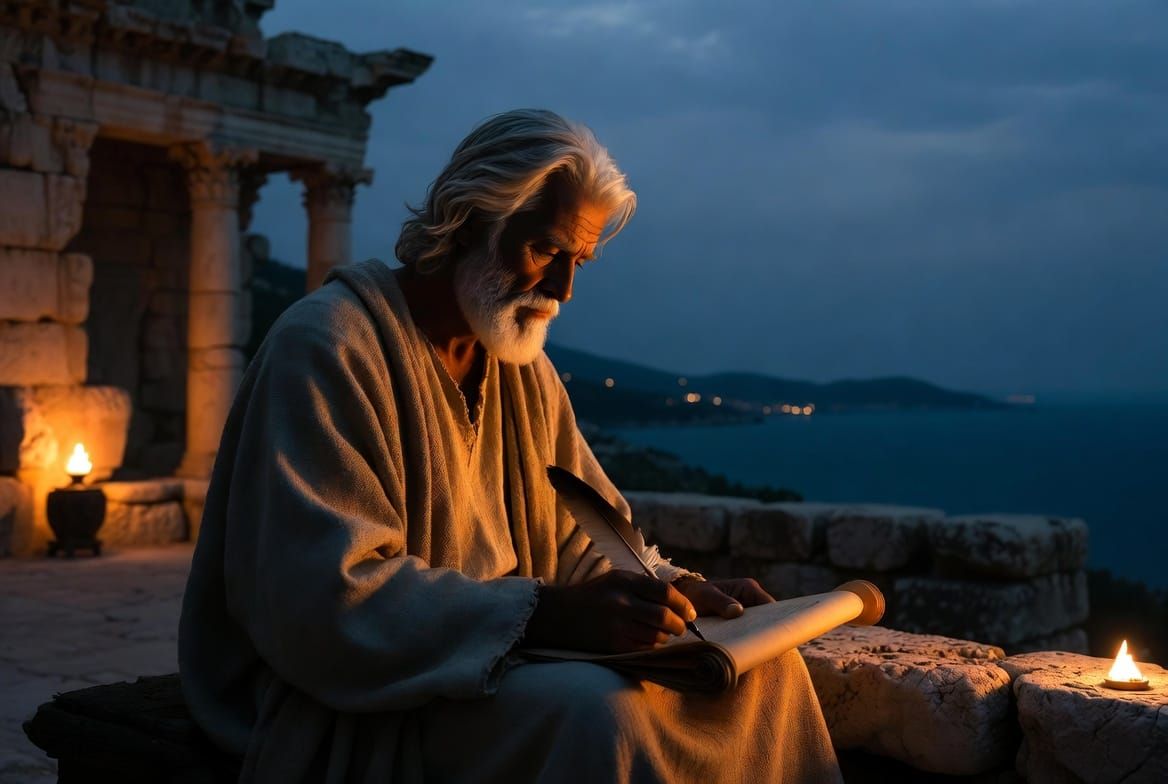
December 27, 2025, Saint John, Apostle and Evangelist, Red-Letter Holy Day, Season of Christmas
John 21:9–25, Psalm 92:1–4(5–10)11–14, 1 John 1:1–10, Exodus 33:18–23
That Which We Have Seen and Heard
Grace, mercy, and peace from God our Father and the Lord Jesus Christ be with you on this Feast of Saint John, Apostle and Evangelist.
Yesterday was Stephen. The day before was Christmas. Tomorrow will be the Holy Innocents. The three days following Christmas present the Church with three kinds of witness to the Child born on December 25: Stephen, the willing martyr who knowingly gave his life confessing Christ; John, the apostolic witness whose testimony endured through a long life; and the Holy Innocents, who died because Herod sought the Child without any choice or confession of their own. The Church has long placed John here, in the middle of this remarkable sequence, because his kind of witness is the most sustained and, in some ways, the most ordinary of the three: not the sudden violence of martyrdom, not the innocence of the slaughtered, but the long, faithful labor of one who was there and never stopped saying what he had seen.
John son of Zebedee is introduced in the Gospels as a fisherman, called alongside his brother James from their boat on the Sea of Galilee. Jesus gives the brothers a name in Mark 3:17: Boanerges (boh-AN-er-jeez), Sons of Thunder. The name fits something of the temperament we later see when John and James want to call down fire upon a Samaritan village that refuses to receive Jesus. Jesus rebukes them. Yet this same man would one day write, “God is love,” and mean it with the full weight of a life lived in that knowledge. He is one of three who form the innermost circle of the Twelve: present when Jairus’s daughter is raised, present at the Transfiguration, present when Jesus goes deeper into Gethsemane. The Church has from ancient times identified him with the disciple whom Jesus loved in the Fourth Gospel, and his identity becomes inseparable from the relationship: John is the man who knew himself to be loved by Christ and spent his life bearing witness to the one who loved him.
The arc of John’s character across his lifetime is itself a kind of testimony. The man who wanted to call down fire on a Samaritan village became the man who wrote, “Beloved, let us love one another, for love is from God.” (1 John 4:7, ESV)The man Jesus surnamed Son of Thunder became the man the Church remembers as the Apostle of Love. This did not happen because John merely mellowed with age. Christ disciplined his zeal, redirected it, and taught him what divine love actually looks like. Christian tradition remembers John as living to old age and serving the Church for decades, especially in connection with Ephesus. There is something pastorally beautiful in that. The transformation of John was not the work of an afternoon. It was the work of Christ across a lifetime.
Our Epistle reading gives us the clearest account of what John understood his own vocation to be. First John 1:1–3 says, “That which was from the beginning, which we have heard, which we have seen with our eyes, which we looked upon and have touched with our hands, concerning the word of life, the life was made manifest, and we have seen it, and testify to it and proclaim to you the eternal life, which was with the Father and was made manifest to us, that which we have seen and heard we proclaim also to you.” Heard. Seen. Looked upon. Touched. John accumulates the verbs of physical witness with deliberate insistence.
This is not theological speculation detached from history. It is the testimony of a man who heard the voice of Jesus, saw his face, ate with him, watched him suffer, and encountered him risen from the dead. The word translated “looked upon”is theaomai (theh-AH-oh-my), a word that can carry the sense of beholding or looking attentively upon something. John is not claiming a passing impression. He is bearing witness to the one he followed closely. His theology comes from sustained attention to Jesus Christ.
It is worth asking why John piles up these physical verbs so insistently at the opening of his letter. He is not simply being thorough. He is defending the reality of the Incarnation against teachers who denied that Jesus Christ had truly come in the flesh. Later forms of this denial would be called Docetism, from a word meaning “to seem,” because such teaching treated Christ’s humanity as something less than fully real. John will have none of it. Against every attempt to turn Jesus into a spiritual appearance, mystical principle, or religious idea, he asserts the physical reality of the Incarnation with every verb at his disposal: heard, seen, looked upon, touched.
And that is why this reading belongs so naturally on the third day of Christmas. Christmas is not the announcement that God sent us a new religious idea. Christmas is the announcement that “the Word became flesh and dwelt among us.”(John 1:14, ESV) The eternal Son assumed our nature. He entered human history. He could be heard with human ears, seen with human eyes, touched with human hands. Christianity is rooted in the astonishing claim that God has acted in a real place, at a real time, in the flesh.
John then tells us why he proclaims what he saw: “so that you too may have fellowship with us; and indeed our fellowship is with the Father and with his Son Jesus Christ.” (1 John 1:3, ESV) The eyewitness testimony is not given so that John can preserve a private spiritual privilege. He proclaims what he saw so that people who were not there may nevertheless share in the life revealed in Christ. John saw; John proclaimed; and through the apostolic testimony, those who did not see are brought into fellowship with the Father and the Son.
That includes us. We did not hear Jesus teaching beside the Sea of Galilee. We did not see his face at the Last Supper. We did not stand beneath the Cross, run to the empty tomb, or see the risen Christ beside the sea. But the apostles did. They bore witness, and the Holy Spirit has preserved that witness in Holy Scripture so that the Church in every generation may hear what they heard and receive the Christ whom they proclaimed.
The Old Testament reading from Exodus 33 gives us the background against which John’s testimony becomes even more staggering. Moses asks God for the thing he most longs to see: “Please show me your glory.” (Exodus 33:18, ESV) And the answer is the answer appropriate to a creature standing before the holy God: “you cannot see my face, for man shall not see me and live.” God places Moses in the cleft of the rock and covers him as his glory passes by. Moses receives a real revelation of God, but not an unrestricted vision of the divine glory.
Then John writes in the opening chapter of his Gospel, “And the Word became flesh and dwelt among us, and we have seen his glory, glory as of the only Son from the Father, full of grace and truth.” (John 1:14, ESV) John is not claiming that he gazed upon the unveiled divine essence in a way Moses was forbidden to do. Indeed, the Prologue itself tells us, “No one has ever seen God; the only God, who is at the Father’s side, he has made him known.” (John 1:18, ESV) The wonder is that the unseen God has made himself known in the incarnate Son.
The God whose glory Moses longed to behold has made himself known definitively in Jesus Christ. John sees the face of Jesus, hears his voice, reclines beside him, watches him suffer, and encounters him risen from the dead. The Christmas mystery answers Moses’s longing in a way Moses could scarcely have imagined. God’s glory comes near not because God ceases to be glorious, but because the eternal Son assumes our nature. The cleft of the rock and the manger belong to one story, and the story reaches its fulfillment in the Word made flesh.
Our Gospel reading is John 21:9–25, the closing scene of John’s Gospel. Seven disciples have gone fishing after the Resurrection. They fish through the night and catch nothing. At daybreak, Jesus stands on the shore, though they do not recognize him at first. He tells them to cast the net on the right side of the boat, and suddenly it is filled with fish. John is the first to recognize the stranger on the shore: “It is the Lord!” (John 21:7, ESV)
When they reach land, Jesus has a charcoal fire going with fish and bread. Verse 13 tells us, “Jesus came and took the bread and gave it to them, and so with the fish.” (John 21:13, ESV) Christians have long heard Eucharistic echoes in this scene: the risen Lord taking bread and giving it to his disciples. John does not tell us that the breakfast itself is a celebration of the Eucharist, so we need not make the scene carry more than it says. What it says is already beautiful enough. The risen Lord feeds his disciples.
There is another detail here that John almost certainly expects us to notice. The last charcoal fire in his Gospel was the one in the high priest’s courtyard where Peter warmed himself while denying Jesus three times. Now there is another charcoal fire, and this time the risen Lord sits beside it. After breakfast Jesus restores Peter with three questions: “Do you love me?” The Gospel does not state mechanically that each question cancels one denial, but the narrative correspondence is hard to miss. The place of failure becomes the setting of restoration. Peter is not discarded. Christ restores him and recommissions him to feed his sheep.
There is a word of grace there for anyone who has ever wondered whether failure has placed him beyond usefulness to Christ. Peter’s sin was real. His denial was public, repeated, and shameful. Jesus does not pretend it never happened. He brings Peter back to the wound, meets him there, and gives him work to do. Grace does not erase the truth about our sin. Grace meets us in the truth and gives forgiveness, restoration, and a future we could not give ourselves.
John is present for all of this. He is the one who recognized Jesus from the boat, and he is the one following when Peter turns to ask about him in verse 21. Jesus’ answer to Peter’s question about John becomes the closing movement of the Gospel: “If it is my will that he remain until I come, what is that to you? You follow me!” (John 21:22, ESV) A rumor spreads that John would not die before the Lord returned, and the Gospel takes care to correct it. Jesus had not promised that John would remain alive until the Second Coming. He had told Peter, in effect, that the other disciple’s future was not Peter’s concern.
There is pastoral wisdom in that sentence. Peter will have Peter’s calling. John will have John’s calling. Stephen had Stephen’s calling. Christ does not call us to live someone else’s discipleship. Comparison can become one of the great thieves of faithfulness because we spend our time wondering why another Christian received this ministry, that opportunity, this apparent blessing, or that particular path. Jesus’ answer remains wonderfully direct: “What is that to you? You follow me.” Christ determines the road of his servants. Our calling is to follow him on the road he gives us.
Then comes the passage that gives the whole Gospel its final framing: “This is the disciple who is bearing witness about these things, and who has written these things, and we know that his testimony is true.” (John 21:24, ESV) The Gospel closes by pointing us back to the witness. This disciple was there. He saw. He remembered. He testified. And the Church received that apostolic testimony as true.
Then the last verse gives us one of the most remarkable endings in the New Testament: “Now there are also many other things that Jesus did. Were every one of them to be written, I suppose that the world itself could not contain the books that would be written.” (John 21:25, ESV) John has written an entire Gospel, and at the end of it he tells us that he has not exhausted the subject. The witness’s final word is not, “I have told you everything,” but rather, “There is more here than I could ever write.”
Of course there is. The subject is Jesus Christ, the eternal Word through whom all things were made. John has told us what we need to know for faith. He has already stated his purpose: “these are written so that you may believe that Jesus is the Christ, the Son of God, and that by believing you may have life in his name.” (John 20:31, ESV) The testimony is sufficient for its saving purpose, but the person of Christ is inexhaustible. We can know him truly and spend eternity discovering that we have never reached the bottom of his glory.
Psalm 92, appointed for this feast, is the Psalm of a life that has learned to praise God across time: “It is good to give thanks to the LORD, to sing praises to your name, O Most High; to declare your steadfast love in the morning, and your faithfulness by night.” (Psalm 92:1–2, ESV) Morning and evening. Beginning and ending. Day after day, the steadfast love of God received and the faithfulness of God declared.
The Psalm later says, “The righteous flourish like the palm tree and grow like a cedar in Lebanon. They are planted in the house of the LORD; they flourish in the courts of our God. They still bear fruit in old age; they are ever full of sap and green, to declare that the LORD is upright.” (Psalm 92:12–15, ESV) That makes this Psalm particularly fitting for John. Christian tradition remembers him as the apostle who lived into old age, especially associated with Ephesus, and whose witness continued long after the more dramatic days of Galilee, Jerusalem, and the empty tomb had passed.
The Church has also traditionally identified John the Apostle with the John who writes from Patmos in Revelation: “I, John, your brother and partner in the tribulation and the kingdom and the patient endurance that are in Jesus, was on the island called Patmos on account of the word of God and the testimony of Jesus.” (Revelation 1:9, ESV) Whether in public ministry, exile, teaching, writing, or simply the endurance of old age, the Church remembers John as a man who kept bearing the same witness. The Word became flesh. Christ died and rose. God is light. God is love. Jesus Christ is Lord.
The contrast between yesterday’s feast and today’s is intentional and important. Stephen dies at the beginning of the Church’s life, his witness sudden and violent. John is remembered as living to old age, his testimony carried across decades. The calendar places them on consecutive days because the Church needs both kinds of witness. The martyrs show us what faith looks like when everything is demanded at once. John shows us what faith can look like when Christ asks us to remain, serve, teach, love, repent, forgive, and keep following year after year. Stephen’s witness is the flash. John’s is the sustained flame.
Most of us will probably be called to something more like John’s kind of faithfulness than Stephen’s. Most Christian lives are not marked by one dramatic moment in which everything is visibly at stake. Most faithfulness happens quietly. It happens when morning prayer is said again after having been said thousands of times before. It happens when Scripture is opened again. It happens when a husband and wife remain faithful through difficult years, when parents continue praying for children who have wandered, when someone keeps serving the Church without recognition, when we forgive the same person again, confess the same stubborn sin again, receive the Sacrament again, and begin another ordinary day as a Christian.
That sort of faithfulness can seem unimpressive because it accumulates slowly. But Psalm 92 says the righteous “still bear fruit in old age.” There is grace in continuing. Some of you have followed Christ for fifty, sixty, or seventy years. You have lived through prayers answered and prayers whose answers you still do not understand. You have buried people you loved. You have watched the Church change, watched the world change, watched your own strength change, and yet you are still here, still hearing the Gospel, still confessing the Creed, still receiving the Body and Blood of Christ, still saying that Jesus is Lord. Saint John reminds us not to despise that kind of witness.
The Collect for this feast gathers all of this under the image that runs through John’s entire apostolate: “Shed upon your Church, O Lord, the brightness of your light; that we, being illumined by the teaching of your apostle and evangelist John, may so walk in the light of your truth, that at length we may attain to the fullness of eternal life.” (BCP 2019, p. 625) John’s own language is everywhere in that prayer. “God is light, and in him is no darkness at all.” (1 John 1:5, ESV)The Word who became flesh was “the light of men,” and “the light shines in the darkness, and the darkness has not overcome it.” (John 1:4–5, ESV)
The Collect does not merely ask that we admire John’s teaching. It asks that, illumined by it, we walk in the light. John tells us what that looks like in First John 1:7: “If we walk in the light, as he is in the light, we have fellowship with one another, and the blood of Jesus his Son cleanses us from all sin.” Walking in the light is not pretending that we have reached sinless perfection. John immediately says, “If we say we have no sin, we deceive ourselves, and the truth is not in us.” (1 John 1:8, ESV)
Walking in the light means that we stop hiding from the truth about ourselves because we have learned the truth about Christ. John continues, “If we confess our sins, he is faithful and just to forgive us our sins and to cleanse us from all unrighteousness.” (1 John 1:9, ESV) There is something wonderfully pastoral about that. The light exposes, but it exposes in the presence of the Savior whose blood cleanses. Christianity does not ask us to drag our sins into the light so that God may shame us. Christ calls us into the light because there is forgiveness there.
And that is why John, the Apostle of Love, never reduces Christianity to the command that we should become more loving people. The order matters. “We love because he first loved us.” (1 John 4:19, ESV) God loved first. The Word became flesh before John understood who stood before him. Christ called John before John knew what discipleship would make of him. Christ laid down his life before John learned the full meaning of love. Christ rose before John ran to the tomb. Grace comes first, and everything else follows.
For those of us who have been doing this a long time, the Feast of Saint John carries a particular word. We are the recipients of his testimony. We did not hear the voice at the supper table. We did not see the face on the shore of Tiberias. We did not gaze upon the Word made flesh with our own eyes. What we have is the apostolic witness: “that which we have seen and heard we proclaim also to you.” John’s testimony was not written for people who had already seen. It was handed down precisely so that those who had not seen might believe.
Jesus says to Thomas, “Blessed are those who have not seen and yet have believed.” (John 20:29, ESV) That blessing reaches us. We are among those who have not seen and yet believe because those who did see bore witness. John saw the glory, heard the voice, stood near the Cross, saw the empty tomb, recognized the Lord on the shore, and spent the rest of his life saying: what we saw was real, what we heard was true, and the life that was with the Father has been manifested to us.
Now the testimony has come to us.
And the Collect asks us to walk.
Walking is not a dramatic act. It is the daily, ordinary movement of a life oriented in one direction. For those who have been walking in the light for fifty or sixty years, the question may not be whether to begin but whether to continue: whether the morning prayer still goes up, whether Scripture still opens, whether the Church is still the place where we receive the Word and Sacrament, whether we still confess our sins, whether we still love because we have first been loved, whether we still bear witness to the one who has carried us this far.
John’s life says that continuing is itself a witness.
Yesterday Stephen showed us faithfulness when everything is demanded at once. John shows us faithfulness when Christ says, year after year, “You follow me.” Morning and evening. Youth and old age. Joy and grief. Strength and weakness. Through all of it, the same Lord remains faithful.
The Word became flesh. John saw him. John heard him. John followed him. John proclaimed him. And what he saw and heard, he proclaimed also to us so that we might have fellowship with the Father and with his Son Jesus Christ.
Now, illumined by that testimony and sustained by the grace of the same Lord who sustained John, let us walk in the light until at length we attain to the fullness of eternal life.
In the Name of the Father, and of the Son, and of the Holy Spirit. Amen.