The Feast of Bartholomew the Apostle: An Anglican Perspective
August 24: Saint Bartholomew. The collect asks two things: love what he believed, preach what he taught. Not a rehearsal of his martyrdom. Not a chronicle of his mission. Just belief and proclamation; the whole apostolic vocation in a single petition.
Feast Day: August 24
The Anglican calendar is ordered by a hierarchy of holy days, each carrying a different weight of observance. At the top stand the seven Principal Feasts, the highest-ranking days of the liturgical year. Below them are the Red-Letter Holy Days appointed in the BCP 2019 with their own Collects and propers. The Feast of Saint Bartholomew the Apostle, observed on August 24, is one of these Red-Letter Holy Days. The BCP appoints his Collect on page 631 and his readings in the Holy Day lectionary on page 731. The Collect directs the Preface of Apostles, whose full Proper Preface heading is Apostles and Ordinations.
Bartholomew is among the most obscure of the Twelve in terms of what Scripture tells us directly. His name appears in all four apostolic lists: Matthew 10, Mark 3, Luke 6, and Acts 1. In the three Synoptic lists he is named immediately after Philip, while Acts places Thomas between Philip and Bartholomew. The New Testament records no individual saying or deed under the name Bartholomew. We know that he belonged to the Twelve and shared in the apostolic calling Christ gave that company. The Church remembers him even though Scripture gives us remarkably little biography, a reminder that the Kingdom of God does not depend upon earthly prominence.
The Biblical Portrait and the Nathanael Tradition
The name Bartholomew means “son of Tolmai” or “son of Talmai” and has the form of a patronymic, identifying someone by his father. Christian tradition has therefore commonly identified Bartholomew with Nathanael in John’s Gospel, although Scripture never explicitly states that the two names belong to the same man.
The identification fits the biblical evidence reasonably well. Bartholomew is closely associated with Philip in the Synoptic apostolic lists, while Nathanael is brought to Jesus by Philip. John names Nathanael but never names Bartholomew, and Nathanael appears again with several disciples when the risen Jesus manifests himself by the Sea of Tiberias in John 21. None of this proves the identification, but taken together it explains why the tradition arose and why Christians have long found it plausible.
On that traditional identification, John 1 gives us a striking portrait of the apostle whom Matthew, Mark, and Luke call Bartholomew. Philip finds Nathanael and tells him, “We have found him of whom Moses in the Law and also the prophets wrote, Jesus of Nazareth, the son of Joseph.” (John 1:45, ESV) Nathanael responds skeptically: “Can anything good come out of Nazareth?” Philip does not attempt an elaborate argument. He simply answers, “Come and see.” (John 1:46, ESV)
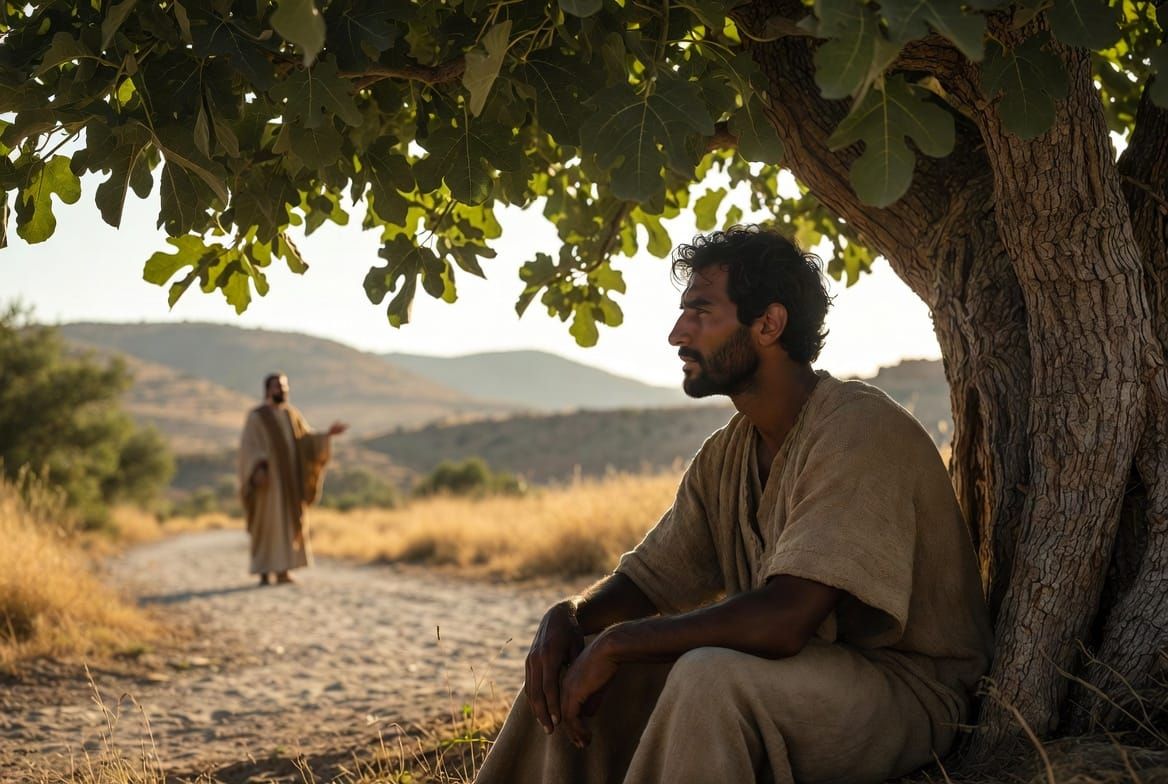
Nathanael comes, and before he says anything Jesus declares, “Behold, an Israelite indeed, in whom there is no deceit!”Nathanael asks, “How do you know me?” Jesus replies, “Before Philip called you, when you were under the fig tree, I saw you.” (John 1:47–48, ESV) Nathanael responds with one of the earliest great confessions in John’s Gospel: “Rabbi, you are the Son of God! You are the King of Israel!” (John 1:49, ESV)
The order matters. Nathanael comes to see Jesus, but he discovers that Jesus has already seen him. His confession does not begin with his own insight or spiritual achievement. Christ knows him first. Grace precedes confession.
An Israelite in Whom There Is No Deceit
Jesus’ words, “an Israelite indeed, in whom there is no deceit,” naturally evoke Jacob, the patriarch renamed Israel whose earlier life had been marked by deceit. The connection becomes even stronger when Jesus tells Nathanael, “You will see heaven opened, and the angels of God ascending and descending on the Son of Man.” (John 1:51, ESV) The language recalls Jacob’s dream at Bethel in Genesis 28, where he sees a stairway between earth and heaven with the angels of God ascending and descending.
Jesus now places himself at the center of that vision. He is the true meeting place of heaven and earth, the Son of Man through whom God comes to his people and through whom his people have access to God. Nathanael has confessed Jesus as Son of God and King of Israel, but Jesus promises that he will see still greater things.
The fig tree also carries biblical associations with peace and security, but Scripture does not tell us what Nathanael was doing beneath it. We should resist later speculation that tries to fill the silence. The theological point John gives us is sufficient: Jesus had seen Nathanael before Philip ever called him. Nathanael really comes, listens, believes, and confesses, but his response begins with the discovery that Christ already knows him. The initiative belongs to Jesus.
“Come and See”
Philip’s invitation is one of the simplest pictures of evangelism in the New Testament. Nathanael raises an objection about Nazareth, and Philip does not pretend the objection is impossible or try to win the entire argument in a sentence. He brings Nathanael to Jesus: “Come and see.”
Christian witness ultimately works in the same direction. The Church reasons, teaches, defends the faith, answers objections, and contends for the faith once delivered to the saints. Yet Christian evangelism is never finally an attempt to manufacture faith through human cleverness. The Church bears witness to the Christ who already knows the people to whom she speaks.
That is especially clear in Nathanael’s story. Philip does not produce the confession “You are the Son of God.” He brings his friend to Jesus, and Christ reveals himself as the one who had already seen and known Nathanael before Nathanael arrived. There is both humility and confidence in that pattern. Christians need not imagine that another person’s conversion finally depends upon the perfection of our presentation, but neither does that release us from speaking. Philip must still go to Nathanael, tell him that he has found the one promised in the Scriptures, and invite him to come. Grace does not abolish witness; it makes witness hopeful.
The Appointed Readings
The BCP 2019 appoints Deuteronomy 18:15–18, Psalm 91, 1 Corinthians 4:9–16, and Luke 22:24–30 for the Feast of Saint Bartholomew. The official ACNA Holy Day material confirms the same Collect and appointed lessons.
Deuteronomy 18 contains Moses’ promise: “The LORD your God will raise up for you a prophet like me from among you, from your brothers; it is to him you shall listen.” (Deuteronomy 18:15, ESV) The reading provides a natural Old Testament background for Philip’s announcement that he and the other disciples have found the one “of whom Moses in the Law and also the prophets wrote.” On the traditional identification with Nathanael, Bartholomew comes to see Jesus as the fulfillment of Israel’s hopes, and his encounter ends with a confession even greater than Philip’s opening description: Jesus is the Son of God and King of Israel.
Psalm 91 promises the presence and protection of God: “He who dwells in the shelter of the Most High will abide in the shadow of the Almighty.” (Psalm 91:1, ESV) Read on the feast of an apostle whom Christian tradition remembers as a martyr, the Psalm cannot mean that faithfulness guarantees immunity from suffering. Its deeper promise appears in God’s own words: “I will be with him in trouble.” (Psalm 91:15, ESV) God’s faithfulness does not always mean preventing trouble from reaching his servants. He may deliver from suffering, sustain through suffering, or finally vindicate beyond death, but his presence remains.
Apostles as the Last of All
In 1 Corinthians 4:9–16 Paul describes apostolic ministry in deliberately shocking terms. He says the apostles have been displayed “as last of all,” as “fools for Christ’s sake,” weak, dishonored, persecuted, and treated as “the scum of the world, the refuse of all things.” (1 Corinthians 4:9–13, ESV)
Paul speaks particularly from his own apostolic experience, but the reading is fitting for Bartholomew because it strips away romantic ideas about what apostleship meant. The Twelve were not called into an earthly life of prestige and immunity. They were sent to preach Christ in a world that had crucified Christ.
This also deepens the meaning of Bartholomew’s obscurity. The Church does not honor apostles because every one of them became famous in the historical record. The apostolic calling was to bear witness faithfully to Christ, whether later history preserved the details or not. Paul therefore tells the Corinthians to imitate him not because he has become impressive by worldly standards but because his life has been conformed to the crucified Lord he proclaims. Apostolic authority and apostolic suffering belong together because Christian leadership is patterned after Christ.
Greatness and Service
Luke 22:24–30 takes us to the Last Supper, where a dispute arises among the disciples about which of them should be considered the greatest. Bartholomew, as one of the Twelve, is among those who hear Jesus answer.
The Lord contrasts the kingdoms of the world with his own: “Let the greatest among you become as the youngest, and the leader as one who serves.” He then asks, “For who is the greater, one who reclines at table or one who serves?” and gives the decisive answer: “But I am among you as the one who serves.” (Luke 22:26–27, ESV)
Christian greatness is therefore defined by Christ himself. Authority is not abolished, and the apostles will indeed receive extraordinary authority within the Church. Jesus immediately promises those who have remained with him through his trials that they will share his Kingdom, eat and drink at his table, and sit on thrones judging the twelve tribes of Israel. Yet the authority of those thrones cannot be separated from the Lord who says, “I am among you as the one who serves.”Apostolic greatness is not domination but service patterned after Christ.
If the traditional identification with Nathanael is correct, there is a beautiful movement from John 1 to Luke 22. The man Jesus saw beneath the fig tree before Philip ever called him is now among those who have remained with Jesus through his trials and are promised a place in the Kingdom. The apostolic vocation runs from being known by Christ, to confessing Christ, to being sent by Christ, and finally to serving in the manner of Christ.
The BCP 2019 Collect
The BCP appoints the Collect on page 631: “Almighty and everlasting God, you gave your apostle Bartholomew grace truly to believe and to preach your Word: Grant that your Church may love what he believed and preach what he taught; through Jesus Christ our Lord, who lives and reigns with you and the Holy Spirit, one God, for ever and ever. Amen.” The BCP itself directs the Preface of Apostles.
The Collect gathers Bartholomew’s apostolic vocation into two things: he believed truly, and he preached the Word. It then asks the same pattern for the Church: love what he believed and preach what he taught. The whole apostolic vocation is compressed into a remarkably concise prayer.
The phrase “grace truly to believe” carries particular weight. The Collect does not present faith as an achievement Bartholomew produced by his own spiritual strength. It begins with grace. The order matters: grace comes first, belief follows, and proclamation grows out of belief. Grace does not eliminate human response; grace creates and sustains it. On the traditional Nathanael identification, he comes, listens, believes, and confesses, yet before all of those actions stands the word of Christ: “Before Philip called you, when you were under the fig tree, I saw you.”
The Church therefore prays not merely for correct ideas about Christianity but for grace truly to believe the apostolic faith and then to speak faithfully from that belief. Faith becomes confession, and confession becomes witness.
Love What He Believed
The first petition for the Church is striking: “Grant that your Church may love what he believed.” Christianity is more than intellectual agreement with propositions, but it is never less than truth believed. Bartholomew’s feast therefore joins love and doctrine rather than setting them against one another.
The Church is not asked to invent a faith fitted to the preferences of each generation. She receives the historic, apostolic faith once delivered in the Scriptures and learns to love it. The doctrines handed down to the Church are not burdens from which enlightened Christians must escape. They are the truth about the God who created us, the Son who redeemed us, the Holy Spirit who gives life, the forgiveness of sins, the resurrection of the body, and the life of the world to come.
To love what the apostles believed means more than tolerating orthodox doctrine because ecclesiastical rules require it. It means learning to see the apostolic faith as good news, to delight in what God has revealed, and to trust that the truth received from Christ is better than the religious constructions we might devise for ourselves. That love matters especially when Christian teaching becomes unfashionable or offensive to the surrounding culture, because the Church cannot faithfully preach what she has first learned to dislike, apologize for, or quietly replace.
Preach What He Taught
The second petition follows naturally: “preach what he taught.” The Church that loves the apostolic faith is called to proclaim it. Not every Christian is called to a pulpit, Holy Orders, or the particular teaching office of the Church, yet the whole Church bears witness to Christ. Parents teach children. Christians speak with friends, neighbors, and coworkers. Congregations confess the Creed. Clergy proclaim the Scriptures publicly. The Church’s life in the world becomes a continuing testimony to the Lord she has received.
The Collect does not ask the Church to preach only those portions of the apostolic inheritance that each age finds acceptable. Nor does it ask Christians to reshape the faith until it becomes indistinguishable from the assumptions of the surrounding culture. It asks that the Church preach what the apostle taught.
That does not require harshness or arrogance. The traditional Gospel portrait gives us Philip saying simply, “Come and see.” Christian confidence does not depend upon hostility. We can speak the historic, apostolic faith with clarity because its truth does not depend upon our forcefulness. The Church therefore needs both petitions together: love what he believed, so that proclamation is not cold repetition; preach what he taught, so that love does not collapse into vague religious sentiment.
The Proper Preface
The Collect directs the Preface of Apostles. The full heading of that Proper Preface in the Eucharistic material and the official Bartholomew Holy Day leaflet is Apostles and Ordinations. It gives thanks through Jesus Christ, the great Shepherd of the flock, who after his Resurrection sent forth his apostles to preach the Gospel and teach all nations and promised to be with them always, even to the end of the ages.
The Preface places Bartholomew within the mission of the risen Christ. The apostles do not originate their own message or appoint themselves to their task. Jesus Christ, the great Shepherd of the flock, sends them to preach the Gospel and teach the nations.
The promise of Christ’s presence is equally important. The apostolic mission is difficult precisely because the apostles are sent into a world that will not always welcome the Gospel. Psalm 91 promises, “I will be with him in trouble,” and the Preface places the same confidence upon the lips of the Church: the risen Lord remains with those he sends. Later Christian tradition remembers Bartholomew as a missionary and martyr who remained faithful to that apostolic calling. Whatever regions he traveled or the precise circumstances of his death, the theological center of his ministry remains the promise of the Preface: the Shepherd sends, and the Shepherd remains with those he sends.
Bartholomew in Later Christian Tradition
Scripture says nothing about Bartholomew’s ministry after Acts 1, so later Christian traditions preserve most of what has been remembered about his subsequent life. Eusebius records a tradition concerning Pantaenus, a Christian teacher associated with Alexandria who traveled eastward in the second century. According to Eusebius, Pantaenus found among people in “India” a Gospel according to Matthew in a Hebrew language that they said Bartholomew had left with them after preaching there.
The report is ancient enough to deserve respectful attention, but it does not allow us to reconstruct Bartholomew’s itinerary with precision. Ancient geographical usage of “India” could be considerably broader than the modern nation, and later discussions have variously connected the report with regions farther west, including Arabia. The safest historical conclusion is therefore that an early tradition remembered Bartholomew as a missionary toward the East, while the exact geography remains uncertain.
Other traditions associate Bartholomew with Armenia, where later Armenian Christian memory regarded him as one of the apostles connected with the evangelization of that land. Medieval and later accounts of his martyrdom also differ. Some traditions say he was beheaded, others that he was flayed and then killed, and still others preserve different combinations of these details. The famous image of Bartholomew holding a knife or his own skin in Christian art comes from the flaying tradition.
These accounts belong to later Christian tradition rather than the New Testament record. They may be remembered as part of the Church’s historical inheritance without being given the authority or certainty of Scripture. Their persistence nevertheless reflects the way Bartholomew was remembered: not simply as a name in an apostolic list, but as an apostle sent among the nations and faithful in witness to Christ.
The Liturgical Character
Red is customarily used for Saint Bartholomew in Anglican worship. It fittingly reflects apostolic witness and the Church’s ancient memory of his martyrdom. His feast therefore interrupts the green ordinarily associated with the Season after Pentecost with the color of costly Christian witness.
The color does not require certainty about whether Bartholomew was flayed, beheaded, crucified, or died in some other manner. Scripture does not tell us how he died, and the later accounts differ. The theological significance of the feast rests more securely upon his calling as one of the Twelve and upon the apostolic mission entrusted to him.
The feast’s appointed texts keep the observance rooted in that biblical foundation. Deuteronomy points to the prophet whom God’s people must hear. Psalm 91 promises God’s presence in trouble. Paul describes apostolic weakness and suffering. Jesus defines greatness as service. The Collect asks for grace truly to believe and preach.
An Apostle We Barely Know
Bartholomew’s obscurity is not an inconvenience to be overcome by filling the gaps with legend. It is itself part of the pastoral gift of his feast. Christian culture can become fascinated with visible influence, memorable personalities, large ministries, public success, and names that survive in history. Yet most of the saints of God will never be widely known. Most Christians serve Christ in households, congregations, workplaces, friendships, and communities that history books will never record.
Bartholomew reminds us that obscurity before the world is not obscurity before Christ. If the traditional identification with Nathanael is correct, his story begins precisely with this discovery. Before Philip speaks to him, Jesus sees him. Before Nathanael knows Jesus, Jesus knows Nathanael.
That truth extends far beyond one apostle. Christ knows the unnoticed servant, the quiet intercessor, the faithful parent, the parishioner who serves for decades without public recognition, and the Christian who bears witness in a place no historian will remember. Heaven does not measure faithfulness by visibility.
The apostolic lists themselves make the same point in another way. Peter dominates much of the Gospel narrative. John appears repeatedly. Matthew gives his name to a Gospel in the Church’s received tradition. Bartholomew appears principally as a name in a list, yet he is still numbered among the Twelve whom Christ chose. The absence of an extensive biography does not diminish the reality of his calling.
When August 24 Falls on Sunday
Saint Bartholomew is a Red-Letter Holy Day. Under the BCP’s rules of precedence, Holy Days of this class falling on a Sunday outside Advent, Lent, and Easter may be observed on that Sunday or transferred according to the Prayer Book’s calendar provisions. Because August 24 always falls within the Season after Pentecost, the feast may therefore be observed on the Sunday when the dates coincide or transferred to the nearest following weekday.
The permanent article should not tie Saint Bartholomew to a particular numbered Proper, lectionary year, or neighboring Sunday Gospel. Those change from year to year. His fixed-date Collect and readings provide the stable liturgical and biblical frame for the feast.
Observing the Feast
Saint Bartholomew the Apostle is observed on August 24. The Collect is found on page 631, the BCP directs the Preface of Apostles, whose full Proper Preface heading is Apostles and Ordinations, and the readings are Deuteronomy 18:15–18, Psalm 91, 1 Corinthians 4:9–16, and Luke 22:24–30. Red is customarily used in Anglican worship.
Begin with the Collect and allow its petitions to examine your own discipleship: love what he believed and preach what he taught. Read the appointed lessons and then read John 1:43–51 as the traditional Nathanael portrait.
John invites us to meet a skeptical man who comes to Jesus and discovers that Jesus already knows him. Deuteronomy points toward the prophet God would raise up and command his people to hear. Psalm 91 teaches trust in God’s presence when trouble comes. First Corinthians strips away romantic ideas about apostolic ministry. Luke 22 shows that greatness in Christ’s Kingdom takes the form of service.
The Collect then asks questions the Church cannot evade. Do we merely possess Christian beliefs, or do we truly believe? Do we love the faith once delivered to the saints, or have we begun quietly replacing difficult parts of it with a Christianity more congenial to our own age? Are we willing to preach what the apostles taught when that teaching is welcomed and when it is not?
Philip’s “Come and see” also provides a simple model for witness. Think of the people God has placed around you. You are not responsible for manufacturing faith in them. You are responsible to bear faithful witness and, in every way available to your vocation, bring them toward the Christ who already sees and knows them.
Finally, receive Bartholomew’s obscurity as encouragement rather than deficiency. The Kingdom of God is not built only through people whose names become famous. Much of the work of the Gospel is carried by Christians whose faithfulness is known more fully to Christ than to the world.
Conclusion
Bartholomew is an apostle the Church remembers without knowing very much about him, and that is part of the gift of his feast. Scripture gives us his name in the apostolic lists and, through the traditional identification with Nathanael, a compelling portrait of a man who comes skeptically to Jesus and discovers that Jesus had already seen him. We should hold that identification as tradition rather than explicit biblical statement, but its theological center is thoroughly scriptural: the initiative belongs to Christ. He knows before the disciple confesses, calls before the apostle is sent, and gives the grace from which faith and witness grow.
The Collect therefore gives the Church precisely the prayer she needs. God gave Bartholomew “grace truly to believe and to preach your Word,” and we ask that the same God would teach his Church to “love what he believed and preach what he taught.” Grace comes first, but grace does not remain invisible. It produces faith, and faith becomes confession and proclamation.
Bartholomew’s relative obscurity also frees the Church from confusing faithfulness with fame. The Kingdom of God is not built only through Christians whose ministries become large, whose names become widely known, or whose stories receive extensive historical record. Much of Christ’s work is carried by servants whose faithfulness is known chiefly to him.
We therefore do not need to become remarkable in order to be faithful. We need the grace to believe truly, the love to hold fast to the historic, apostolic faith, the courage to preach what Christ has given his Church, and the humility to serve wherever he sends us. The Lord who saw Nathanael beneath the fig tree still knows his servants before the world notices them, calls them by grace, and sends them to bear witness to the Son of God and King of Israel.