Watch Therefore (Matthew 25:1–13)
Here is the parable's searching insight: the foolish virgins were not surprised that the bridegroom came. They were unprepared for him to come. There is a difference between believing Christ will return and living in faith because Christ will return.
November 8, 2026, Year A, Proper 27, Twenty-Fourth Sunday after Pentecost, Season after Pentecost
Matthew 25:1–13, Psalm 70, Amos 5:18–24
Grace, mercy, and peace from God our Father and the Lord Jesus Christ be with you on this Twenty-Fourth Sunday after Pentecost.
For several months we have been following Jesus through Matthew's Gospel, tracing the great movements of his ministry and the revelation of his Kingdom. We began with The King Calls His People, as Jesus summoned his disciples and sent them into the harvest. Then came The Kingdom Described, with his teaching about what the Kingdom is like. In The King Acts and Is Recognized, we witnessed his mighty works and heard Peter confess him as the Christ. Most recently, in The Cost of the Kingdom, we heard Jesus call us to take up our cross, forgive one another, and follow him in humility and obedience.
Today we begin Movement V, The Coming King. Over these final three Sundays of the Church year, Matthew 25 leads us from the ten virgins awaiting the bridegroom, to the servants entrusted with their master's possessions, and finally to the Son of Man seated upon his glorious throne. Are we ready for his coming? Are we faithful with what he has entrusted to us? And how shall we stand before him when he comes in glory?
This movement brings us into what we call Extended Advent. The formal Season of Advent begins November 29, but these final Sundays already direct us toward Christ's return, the resurrection, judgment, and the fulfillment of his Kingdom. Last Sunday, on All Saints' Day, we glimpsed the multitude gathered before God's throne, their earthly pilgrimage complete. We are still making ours. Today Jesus tells us how to live as we await the Lord who will bring us home.
The parable stands within Jesus' final teaching in Jerusalem. He has confronted the religious leaders, warned against a faith that is only outward, and spoken of coming judgment. Now he addresses disciples who will have to carry on after his death, resurrection, and ascension. His warning belongs not to a distant speculation about the end of the world, but to the present life of the Church. We would do well to pay attention to that. Most teaching about his return is more about this, than when. It is easy to get distracted with timelines, rather than to examine ourselves to see if we are ready and actively engage mission and discipleship.
We confess every Sunday that Christ will come again in glory to judge the living and the dead. Yet those words can become familiar without shaping our lives. With the cross approaching, Jesus prepares his disciples for the time between his first coming and his return. Our Gospel this morning is Matthew 25:1–13. Listen to what he teaches us about being ready to meet him.
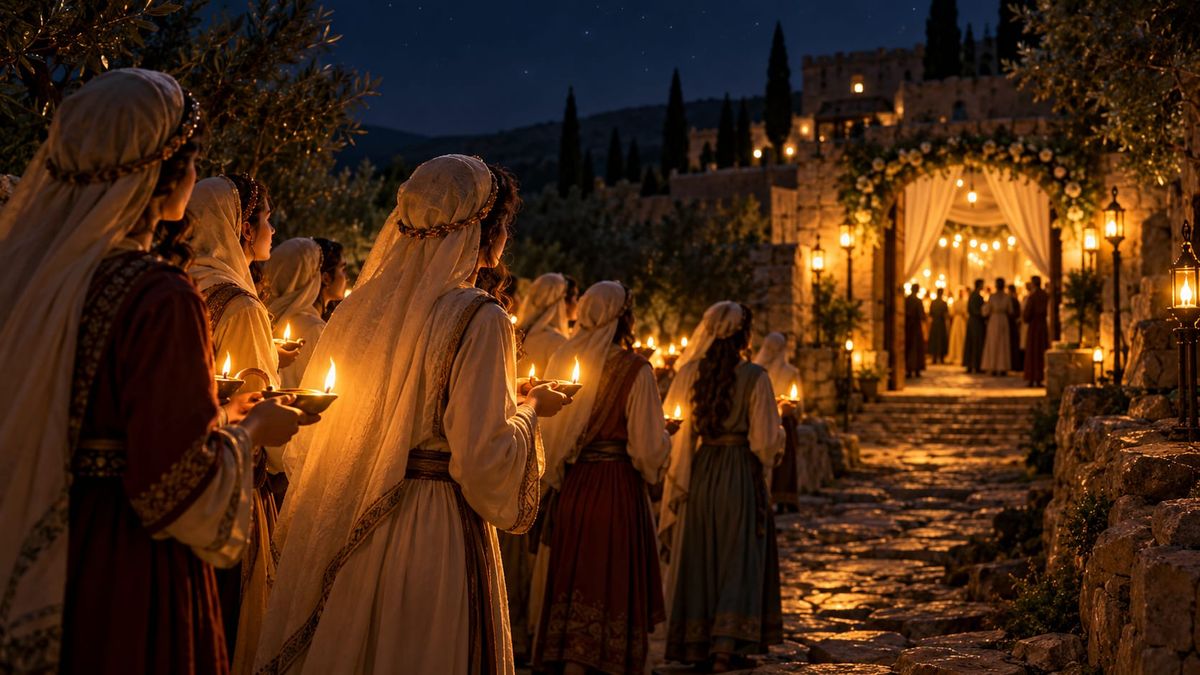
First, we must be prepared to wait for the Bridegroom. In verse 1 Jesus says, “Then the kingdom of heaven will be like ten virgins who took their lamps and went to meet the bridegroom” (Matthew 25:1, ESV). It is a wedding celebration. All ten expect the bridegroom, carry lamps, and intend to enter the feast. From the outside, they appear to share the same hope.
But in verse 2, Jesus says, “Five of them were foolish, and five were wise” (Matthew 25:2, ESV). The foolish bring their lamps without additional oil; the wise bring flasks of oil as well. The wise do not know the hour of his arrival. They are simply prepared for a longer wait. The Church has long understood the oil as pointing to the spiritual readiness of living faith, sustained by the Holy Spirit. The distinction is between genuine readiness and its outward appearance.
Then Jesus tells us in verse 5 that as the bridegroom was delayed, “they all became drowsy and slept” (Matthew 25:5, ESV). Notice that all ten slept. The wise did not remain physically awake while the foolish dozed. They had prepared for his coming. Jesus does not command anxious excitement or constant speculation about the date. He calls for a faith that endures the delay.
And the delay has been long. Nearly two thousand years have passed since Christ accomplished our redemption through his death and resurrection, ascended into heaven, and promised to return. His Kingdom has begun, but its fulfillment is still ahead. We belong to him now, while awaiting the day when every enemy will be defeated, every wrong set right, and every promise fulfilled.
A delay tests something that an immediate arrival does not: whether our expectation is rooted in the bridegroom himself, or only in the excitement of an occasion. It is easy to rejoice in the promise of Christ's return when life is going well. It is harder to keep hoping through long years when prayers seem unanswered and familiar burdens return. Jesus does not promise a short wait. He calls us to remain his people throughout the wait.
The danger is that familiarity with Christian life can become complacency. We may attend worship while neglecting God's word and prayer throughout the week. We can know the responses of the liturgy so well that they pass across our lips without engaging our hearts. We may confess our sins without considering which sins we are actually refusing to surrender. Spiritual carelessness often develops quietly, while the outward habits remain.
This warning speaks to those of us who have followed Christ for decades. We have endured illness, buried loved ones, and watched the world change. Perhaps our faith no longer feels as lively as it once did. But readiness is not the ability to recover an earlier feeling. It means continuing to turn to Christ, hear his word, confess our sins, and depend upon his mercy. Peter reminds us that the Lord's delay is patience, giving time for repentance (2 Peter 3:9). We should not mistake that mercy for permission to become indifferent.
Here is the parable's searching insight: the foolish virgins were not surprised that the bridegroom came. They were unprepared for him to come. There is a difference between believing Christ will return and living in faith because Christ will return.
Second, his coming will reveal the difference between outward expectation and genuine readiness. In verse 6, at midnight, comes the cry: “Here is the bridegroom! Come out to meet him” (Matthew 25:6, ESV). All ten rise to prepare their lamps, but the foolish discover that theirs are going out. They ask the wise for oil. The wise answer that there will not be enough for both groups and tell them to obtain their own.
This is not a lesson against sharing with people in need. Jesus commands us to love our neighbors and bear one another's burdens. Rather, readiness to meet him cannot be borrowed from another person at the decisive hour. We may have been raised by faithful parents, sustained by a believing spouse, or nourished in a faithful congregation. Thank God for those gifts. But if asked why we hope to enter Christ's Kingdom, would we appeal to our family, membership, and years of service? Or to the Savior who died and rose again for sinners, and in whom we ourselves trust?
Our reading from Amos makes the warning sharper. The people of Israel anticipated the Day of the Lord, confident that it would vindicate them as God's covenant people. But Amos declares, “Woe to you who desire the day of the LORD!” (Amos 5:18, ESV). They expected light, yet the prophet warns of darkness. They presumed that belonging outwardly to God's people guaranteed his approval, even while refusing his commands.
They continued their sacrifices, assemblies, and songs, but injustice and unrighteousness marked their lives. In verse 24 Amos calls for justice to roll down like waters and righteousness like an ever-flowing stream (Amos 5:24). God was not condemning the worship he had commanded. He was exposing the contradiction between their worship and their conduct.
Amos is not calling Israel to exchange worship for social action, as though one could replace the other. He calls the people to live before God with integrity. The God whom we honor in prayer is the God before whom we must answer for our dealings with our neighbors. That is why the prophet's words are not a distraction from the parable. They show how easily confidence in belonging to God can grow detached from obedience to him.
We should examine that same contradiction in ourselves. Do we speak reverently of God on Sunday yet treat our families impatiently at home? Do we confess God's mercy while withholding forgiveness? Do we pray for his will to be done while excusing dishonesty because it benefits us? Amos will not let us separate the faith we profess from the people we become and the way we treat our neighbors.
The answer is not to trust more confidently in our own righteousness, but to turn again to Jesus Christ. We cannot buy entrance to the Kingdom with good works. We are sinners who cannot make ourselves righteous before God. Our hope is the Savior who bore our sins on the cross and rose again for our justification. Eternal life is God's gift, received by faith, not payment for religious performance.
Yet the grace that saves us changes us. Paul teaches that grace brings salvation and trains us to renounce ungodliness, live faithfully, and await Christ's appearing (Titus 2:11–13). Repentance and obedience do not purchase salvation. They are the fruit of living faith, because Christ is at work in those who belong to him.
Our Collect of the Day holds these truths together. It begins by confessing that God's Son came to destroy the works of the devil and make us children of God and heirs of eternal life. On the basis of that hope, we ask God to grant that we may purify ourselves as Christ is pure, so that when he comes in glory we may be made like him in his eternal Kingdom. His saving work comes first. Even our growth in holiness depends upon his gracious help.
That is why the ordinary means of grace matter. Through Scripture the Lord calls us to repentance and strengthens faith. In prayer we confess our need and seek his help. In the Church we encourage one another, and in Holy Communion Christ nourishes us with the grace of his body and blood. These are not religious achievements that earn heaven. They are the gifts of a Savior who knows that we need him every day.
Finally, Jesus teaches us that the time to respond is now. In verse 10, while the foolish virgins are away, the bridegroom arrives. Those who are ready enter the wedding feast, and “the door was shut” (Matthew 25:10, ESV). The waiting has ended. Those who assumed there would always be more time are now outside the celebration they expected to attend.
In verses 11 and 12, they return and plead to be admitted. The answer is devastating: “I do not know you” (Matthew 25:12, ESV). They had carried their lamps, waited with the others, and spoken as though they belonged at the feast. Yet the bridegroom does not receive them. Their outward association had not made them ready.
Jesus gave a similar warning in the Sermon on the Mount. Some will call him Lord and appeal to their religious activity, only to hear that he never knew them (Matthew 7:21–23). At the beginning and near the end of his great teaching in Matthew, Jesus exposes the danger of an outward profession without genuine faith. His warning is directed to those who expect to be welcomed, and we should hear it ourselves.
The shut door is difficult to hear, especially for those of us who love someone who has wandered from the Church or resisted the Gospel. We may wish Jesus had ended the story differently. But he gives this warning while there is still time to hear it. The seriousness of the judgment is itself a reason to pray for those we love, speak the Gospel faithfully, and refuse the comforting illusion that an outward connection to the Church is enough.
But we should not confuse the struggling believer with the presumptuous person who refuses to repent. Peter denied Jesus three times, yet the risen Christ restored him. Our assurance is not that we have lived flawlessly or have never been weary. It is that Christ receives sinners who turn to him and remains faithful to his promises.
Psalm 70 gives us the right words for such dependence: “Make haste, O God, to deliver me!” (Psalm 70:1, ESV). The psalmist admits his poverty and need and calls the Lord his help and deliverer. He does not boast of his strength. He cries out to the One who can save him. For those who are grieving, doubtful, or spiritually dry, this is a particular comfort. The wise virgins themselves grew tired. Weariness is not the same as unbelief. Watchfulness may sound less like a confident declaration than a needy prayer: Lord, come to my aid.
And dependence upon grace has practical consequences. If we have been excusing a sin, today is the day to confess it and turn from it. If we have refused forgiveness, today is the day to seek grace to forgive. If we have neglected Scripture, prayer, or worship, today is the day to return. These are not tasks by which we manufacture readiness. They are responses to the Savior who calls us to himself and sustains us through his gifts.
Nor is it a private concern detached from the people around us. The same Lord who calls us to be ready has taught us to forgive, to seek the wandering brother or sister, to show mercy, and to receive God's generosity without resentment. Those lessons from earlier in Matthew do not disappear when we reach chapter 25. They show what persevering faith looks like while we wait for the King whose teaching we have heard throughout this season.
Watchfulness also belongs in ordinary life. We love our families, care for neighbors, encourage the discouraged, and bear witness to Christ. For some, such service looks different now than it did twenty years ago. We may lack the strength we once had, but a prayer, a kind word, or patient endurance may still be precious service. The Lord does not measure faithfulness by how prominent our work appears.
Nevertheless, the closed door is a real warning. There comes a time when the waiting ends and the opportunity for repentance has passed. None of us knows the hour of Christ's return or how many earthly days remain. We cannot presume upon tomorrow. Today his Gospel is proclaimed; today his mercy is offered. The One who warns us is the same Lord who went willingly to the cross to save sinners. His invitation calls for faith and repentance now.
In verse 13, Jesus gathers the parable into his command: “Watch therefore, for you know neither the day nor the hour” (Matthew 25:13, ESV). He does not instruct us to discover the date. He calls us to live faithfully because his return is certain. And we should remember who the Bridegroom is: Jesus Christ, who loved the Church and gave himself up for her. He sanctifies his people and will present them in splendor (Ephesians 5:25–27). At the marriage supper of the Lamb, God's promises will reach their fulfillment (Revelation 19:6–9). We wait not for a stranger whose favor we must earn, but for the Redeemer who has made us his own.
We must remember that the goal of watchfulness is not simply to survive the final judgment. It is to be welcomed into the joy of our Lord. The marriage feast is an image of celebration, not merely an examination that we hope to pass. Christ has not redeemed his people in order to leave them perpetually uncertain whether he wants them. He has loved them, called them, and promised to bring them into his everlasting Kingdom. The certainty of his love does not cancel his warning; it gives us a reason to heed it with hope.
So let us watch with repentant and trusting hearts. We do not wait merely because we fear being shut out, although we take his warning seriously. We wait in hope because the Bridegroom is coming, and the feast awaits his people. Let us continue in his word, prayer, and the fellowship of his Church, trusting him for the grace to persevere. We do not know the day or the hour, but we know the One who has promised to return. The Lord who began his good work in us will bring it to completion on the day of Jesus Christ.
In the Name of the Father, and of the Son, and of the Holy Spirit. Amen.