The Greatest Commandment (Matthew 22:34–46)
The greatest commandment tells us what God requires. Jesus' question tells us whom we must trust. We have failed to love God and neighbor as we ought, but the Son of David, who is David's Lord, has fulfilled the righteousness we lack and given himself for our salvation.
October 25, 2026, Year A, Proper 25, Twenty-Second Sunday after Pentecost, Season after Pentecost
Matthew 22:34–46, Psalm 1, Exodus 22:21–27
Grace, mercy, and peace from God our Father and the Lord Jesus Christ be with you on this Twenty-Second Sunday after Pentecost.
For several Sundays, we have been following Jesus through what we have called the Cost of the Kingdom. We began when Jesus told his disciples that following him means denying ourselves, taking up our crosses, and following him. Since then, he has confronted our reluctance to forgive, our tendency to keep accounts of what God owes us, our willingness to profess obedience without actually obeying, and our temptation to reserve parts of our lives for ourselves. This morning, as we conclude this movement through Matthew's Gospel, Jesus brings these demands together in the two greatest commandments. The cost of following Christ reaches into every part of our lives, because he commands us to love God with all that we are and our neighbors as ourselves.
Last Sunday we considered Jesus' command to render to Caesar what belongs to Caesar and to God what belongs to God. Caesar's coin bore his image, but we bear the image of God. Our lives belong to the Creator who made us. This morning Jesus takes us to the heart of what that means. If our lives belong to God, what does he require of us? And if our neighbors also bear his image, what do we owe them? Jesus answers those questions, but then asks a question of his own, one that reveals why knowing God's commandments is not enough.
Our Gospel is Matthew 22:34–46. In Jerusalem, shortly before the crucifixion, the Sadducees have tried to make the resurrection appear absurd with a question about a woman married successively to seven brothers in the passage before this morning's. Jesus exposes their misunderstanding of Scripture and God's power, astonishing the crowds(Matthew 22:23–33).
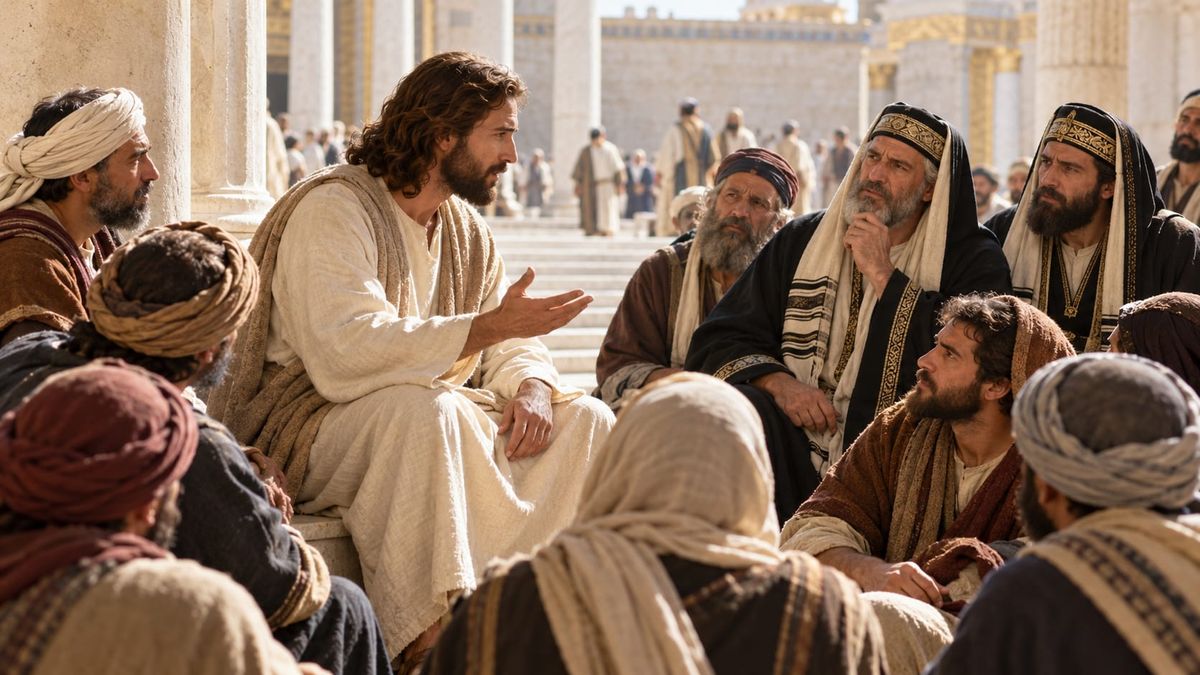
In verse 34, the Pharisees hear that Jesus has silenced the Sadducees and gather together. One of them, a lawyer trained in Moses' Law, asks a question to test Jesus, as Matthew tells us in verse 35. The question is legitimate, but the motive is not.
In verse 36 he asks, “Teacher, which is the great commandment in the Law?” (Matthew 22:36, ESV) Jewish teachers debated how commandments concerning worship, family, and justice related to one another. Jesus goes straight to the heart of God's will. We too can question Scripture in order to obey, or to escape what God has made plain.
In verses 37 and 38, Jesus answers from Deuteronomy 6:5: “You shall love the Lord your God with all your heart and with all your soul and with all your mind.” (Matthew 22:37, ESV) He then declares, “This is the great and first commandment” (Matthew 22:38, ESV). This comes from the Shema (shuh-MAH), Israel's confession that the Lord alone is God, words to be remembered, taught to children, and lived each day.
Jesus commands a love that claims the whole person. Our affections, understanding, loyalties, and conduct belong to the Lord. We cannot reserve Sunday for God while claiming final authority over the rest of life. God commands our whole love because he is Lord of everything.
And that should make us examine what we mean when we say we love God. We may attend church faithfully, know the Creeds, defend biblical doctrine, and maintain respectable habits. All of those things can be good. But do we allow God's Word to correct us when we discover that we are wrong? Do we obey him when obedience is inconvenient? Or have we become more committed to being regarded as faithful Christians than to being corrected by the Lord we profess to follow?
Love for God is not merely a feeling. Sometimes worship fills us with joy; sometimes our affections feel cold and obedience is difficult. God's worthiness does not change with our feelings. We love him by trusting his promises, receiving his Word, turning from sin, and walking in his ways even when it costs us something.
Our Psalm this morning describes the blessed man whose “delight is in the law of the LORD” (Psalm 1:2, ESV). He meditates on God's Law day and night, like a tree planted beside streams of water, bearing fruit. Yet our delight is divided. We welcome promises that comfort us while resisting commandments that expose our sins.
In verse 39 Jesus continues, “And a second is like it: You shall love your neighbor as yourself” (Matthew 22:39, ESV). The lawyer asked for one great commandment, and Jesus gives him two, because love for God and love for neighbor belong together. The second comes from Leviticus 19:18. We cannot profess love for the Creator while treating his creatures with contempt.
When Jesus tells us to love our neighbors as ourselves, he is not giving us a separate commandment to develop greater self-esteem or admiration for ourselves. He is appealing to the ordinary concern we already have for our own lives. We want our needs taken seriously, our reputations treated fairly, and our well-being protected. Jesus commands us to extend that same genuine concern to our neighbors. Their needs do not cease to matter because they are not ours, and their reputations do not become expendable because we dislike them. But this does not mean indulging their sins any more than we should indulge our own. True love seeks what is genuinely good for another person according to God's Word. We are remarkably skilled at recognizing when we have been treated unfairly. Jesus calls us to become equally attentive when someone else is being treated unfairly.
And the neighbor we are commanded to love bears the image of God, just as we do. That includes the people we like and the people we find difficult, those who agree with us and those who oppose us. God's image does not make every human action righteous or eliminate the need for repentance and justice. But every person possesses a dignity grounded in God's act of creation, not in our approval. The neighbor who bears God's image does not cease to bear it when we become angry.
We may need to oppose an argument, condemn evil, or defend Scripture without compromise. But have we begun to enjoy speaking contemptuously about people? Do we pass along damaging stories without caring whether they are true? Are we careful with another person's reputation when he is absent?
Jesus says in verse 40, “On these two commandments depend all the Law and the Prophets” (Matthew 22:40, ESV). He is not replacing God's commandments with vague kindness. The laws against murder, adultery, theft, false witness, and coveting teach what love refuses to do; the laws concerning worship and idolatry teach faithfulness to God. Love does not replace obedience. It gives obedience its proper character.
Our Old Testament reading from Exodus 22 shows us how practical this love must become. In verse 21, the Lord forbids Israel from wronging or oppressing a sojourner and reminds them that they themselves had been sojourners in Egypt. The Hebrew word is ger (gare), meaning a resident foreigner, someone living among Israel who did not belong to one of its ancestral families and often lacked the protection of inherited land and established family standing. This was not merely someone passing through. The sojourner had taken up residence among God's people.
But we should not imagine that such a person lived outside Israel's laws. Scripture repeatedly teaches that the same standards of justice and moral conduct applied to native Israelites and resident foreigners (Leviticus 18:26; 24:22). In Exodus 12, a foreigner who wished to participate in Passover had to meet the requirements of that observance (Exodus 12:48–49). The sojourner was entitled to protection from mistreatment, but he was also accountable to the laws of the community. There were responsibilities as well as protections.
That matters today, when immigration is such a contentious subject. Ancient Israel did not have our modern visa or immigration system, so we should not equate the biblical sojourner with any one modern legal category. Civil authorities have a legitimate responsibility to maintain order and enforce just laws, and those residing within a nation have responsibilities under those laws. But the enforcement of law does not excuse cruelty, dishonesty, or exploitation. Scripture calls us to uphold justice while recognizing the God-given dignity of every human being.
Notice the connection: Jesus quotes Leviticus 19:18 about loving neighbors as ourselves, but later in that chapter God commands Israel to love the sojourner as themselves (Leviticus 19:34). Israel knew what it was to live as strangers in Egypt, and the Lord forbade them to reproduce that oppression. Love for neighbor does not disappear when our neighbor is a foreigner, and neither do the responsibilities of justice.
The Lord then speaks about widows, fatherless children, and the poor who borrow money. Even a cloak taken as security for a loan must be returned by sunset, for it may be a poor man's only covering at night. The Lord of heaven and earth cares whether that man can keep warm. Love for neighbor is not merely a position we hold. It is something we do.
Sometimes that means providing material assistance, visiting the sick, listening patiently, or refusing to take advantage of someone. Sometimes it means an uncomfortable conversation. When we considered Jesus' teaching about gaining our brother, we saw that love can require speaking truth and seeking reconciliation rather than gossiping or avoiding a problem. Our purpose must be the other person's good, not humiliation or victory.
And when another person has wronged us, we must remember the mercy Christ commands us to extend because we ourselves have received mercy. Forgiveness does not make evil good or erase every earthly consequence. But neither may we turn a genuine offense into permission to cultivate hatred. There is a difference between recognizing that a person has sinned and deciding that we are entitled to despise that person.
This is where the greatest commandments become uncomfortable. We may agree with them completely and still fail to obey them. We may know the correct answer just as surely as the lawyer did. But knowing what God requires is not the same as loving him with our whole hearts, nor is defending biblical morality the same as loving the people whom God commands us to serve. We have been proud, impatient, selfish, resentful, and sometimes indifferent. We need more than a clearer explanation of the commandments. We need forgiveness and hearts renewed by grace.
Psalm 1 describes the blessed man whose delight is in God's Law and whose life bears its proper fruit. We ought to desire that life, but we cannot honestly claim to have lived it perfectly. The Psalm shows us the righteous life we lack, and the Gospel directs us to the righteous man who has lived it. And that brings us to the second half of our Gospel, because Jesus turns from what God commands to the identity of the Christ.
In verse 41, while the Pharisees are gathered together, Jesus begins asking the questions. In verse 42 he says, “What do you think about the Christ? Whose son is he?” (Matthew 22:42, ESV) They answer that the Christ is the son of David. That answer is correct. God had promised David an enduring royal line, and the prophets had foretold a King who would come from his house. Matthew begins his Gospel by identifying Jesus as the son of David.
But Jesus asks them to consider something more. In verses 43 and 44, he points to Psalm 110, where David, speaking in the Spirit, calls the promised Messiah his Lord. David hears the LORD say to his Lord, “Sit at my right hand, until I put your enemies under your feet” (Matthew 22:44, ESV). To sit at God's right hand is to share the place of supreme royal honor and authority, not merely to occupy David's earthly throne. The promised King reigns by God's appointment, and his enemies will not finally prevail against him. Jesus then asks in verse 45, “If then David calls him Lord, how is he his son?” (Matthew 22:45, ESV)
Jesus is not denying the Messiah's descent from David. He is revealing that the Messiah is greater than the Pharisees have understood. David's promised descendant is also David's Lord. He is not merely another earthly king who will reign for a time and then die. He is the eternal Son of God, who has taken our humanity upon himself and come to fulfill the promises given through David.
Notice what has happened. The Pharisees asked Jesus to identify the greatest commandment, and he answered them from Scripture. When Jesus asks them about the Messiah, they cannot answer. Matthew has already told us that the lawyer came to test him, and these leaders have repeatedly opposed him. They can debate what God's Law requires while refusing to receive the Lord standing before them. They are concerned with testing the teacher while failing to reckon with who the teacher is.
That warns those of us who have been Christians for many years. We can defend doctrine and know biblical morality yet resist the Lord when he confronts our sin. Are we more interested in proving ourselves right than humbling ourselves before Christ? Sound doctrine matters profoundly, but its purpose is not merely to make us right. It is to teach us to know, worship, trust, and obey the living God.
And this question about Christ's identity is also the answer to our deepest need. If Jesus were merely a moral teacher, the greatest commandments would leave us condemned by our failure to keep them. We would know what we ought to do, but we could not undo our sins or make ourselves righteous before God. We need more than instruction and stronger determination. We need a Savior.
The Lord who commands perfect love is himself the one who has loved perfectly. Jesus loved his Father without reservation and his neighbors without selfishness. Within days of this conversation he will be crucified, bearing the sins of those who have broken the commandments he proclaimed. He will rise again on the third day. Our salvation does not rest on the perfection of our love for God, but on the perfect obedience and saving sacrifice of Jesus Christ.
That does not make the commandments irrelevant. The grace that forgives us also begins to renew us. By the Holy Spirit, Christ teaches us to love the Lord and the neighbors he has placed before us. Our obedience does not purchase forgiveness; it grows from forgiveness already given. Our acts of mercy are fruits of the new life that his grace brings forth.
Our Collect speaks directly to this passage. We addressed Almighty and everlasting God, who governs heaven and earth, and asked him to hear our supplications and grant us his peace. His commandments reach into our hearts and relationships, where sin disturbs our fellowship with him and with others. We need peace with God through Jesus Christ, and by his Spirit we seek peace with our neighbors.
So consider the people and responsibilities the Lord has placed before us this week. Is there someone whose name immediately raises resentment in our hearts? Someone whose need we have noticed but avoided? Someone whose reputation we have treated carelessly because we disagree with him? Perhaps there is a conversation that needs to happen, an apology to offer, or practical help we have been postponing. We cannot resolve every difficulty, but we can ask what obedience requires in the circumstances God has given us.
And what of our relationship with the Lord? Have we become content with respectable habits while neglecting prayer or holding tightly to sin? Familiarity with Christian teaching is not wholehearted love. Where his Word exposes our failure, we must repent and trust Christ anew.
Throughout these past weeks, Jesus has shown us what following him costs. It costs our pride, our claims of superiority, our cherished resentments, and our determination to remain masters of our own lives. He gathers those demands into two commandments that reach into everything: love God with all that we are, and love our neighbors as ourselves. But the King who calls us to obedience first gave himself for us. The Lord who commands perfect love has loved us to the end.
In verse 46, Matthew tells us no one could answer Jesus or dared question him further. The Pharisees came to test him, but could not answer his question about the Christ. We must not congratulate ourselves for knowing their missing answer. Do we receive Jesus as Lord and Savior, or speak correctly about him while resisting his authority?
The greatest commandment tells us what God requires. Jesus' question tells us whom we must trust. We have failed to love God and neighbor as we ought, but the Son of David, who is David's Lord, has fulfilled the righteousness we lack and given himself for our salvation. So let us come to him in repentance and faith, receive his mercy with thanksgiving, and ask his Spirit to teach us to love the God who made us and the neighbors who bear his image.
In the Name of the Father, and of the Son, and of the Holy Spirit. Amen.