The King and His Sheep: Christ the King Sunday 2026 (Matthew 25:31–46)
But before the year ends, the Church asks us to confess something that governs every other Sunday: Jesus Christ is King. For us this is especially personal. We are Christ the King Church. Our name is not simply a description of the Lord we admire. It is a confession of the Lord to whom we belong.
November 22, 2026, Year A, Proper 29, Christ the King Sunday, Last Sunday after Pentecost, Season after Pentecost
Matthew 25:31–46, Psalm 95, Ezekiel 34:11–20
Grace, mercy, and peace from God our Father and the Lord Jesus Christ be with you on this Christ the King Sunday, the Last Sunday after Pentecost.
Today the Christian year comes to its conclusion. Next Sunday we begin Advent, looking again toward the coming of our Savior. But before the year ends, the Church asks us to confess something that governs every other Sunday: Jesus Christ is King. For us this is especially personal. We are Christ the King Church. Our name is not simply a description of the Lord we admire. It is a confession of the Lord to whom we belong.
The feast itself is relatively recent. In 1925, in the years following the First World War, Pope Pius XI established Christ the King Sunday through an encyclical called Quas Primas (kwas PREE-mas). Nationalism, secularism, and political ideologies were demanding the sort of ultimate allegiance that belongs to God alone. The feast reminded Christians that no ruler, nation, movement, or government is sovereign in the way Jesus Christ is sovereign. Originally observed on the last Sunday of October, it later came to be kept at the close of the Christian year, where its emphasis falls naturally upon the King's return. Our 2019 Book of Common Prayer appoints it as Christ the King Sunday. The observance is new; its confession is ancient.
That history has something to say to us. Elections matter, and Christians should take seriously their responsibilities as citizens. Laws can protect our neighbors or harm them. We should seek justice and pray for rulers. A nation is not converted in a voting booth. The Gospel advances as people hear the Word of Christ, repent, believe, are baptized, and learn to obey him. If we desire a more Christian country, our first calling is to live more faithfully as Christians ourselves, and make more Christians.
Our primary text is Matthew 25:31–46. Two Sundays ago the ten virgins taught us to watch for the Bridegroom. Last Sunday the talents taught us to serve faithfully while our Master is away. Today Jesus tells us what happens when he returns. The waiting ends, and the King separates those who truly belong to him from those who do not.
Look at verse 31. Jesus says, “When the Son of Man comes in his glory” (Matthew 25:31, ESV). He comes with his angels and sits upon his glorious throne. In Daniel 7:13–14, one like a son of man approaches the Ancient of Days and receives everlasting dominion. Jesus takes that title to himself. Jesus, the promised King, is about to be betrayed and crucified. In a few days earthly rulers will sit in judgment over him. They will mock him with a crown of thorns. Yet the one they condemn will return to judge them. The Cross is not a failure of his kingship. It reveals the King who gives himself to save sinners.
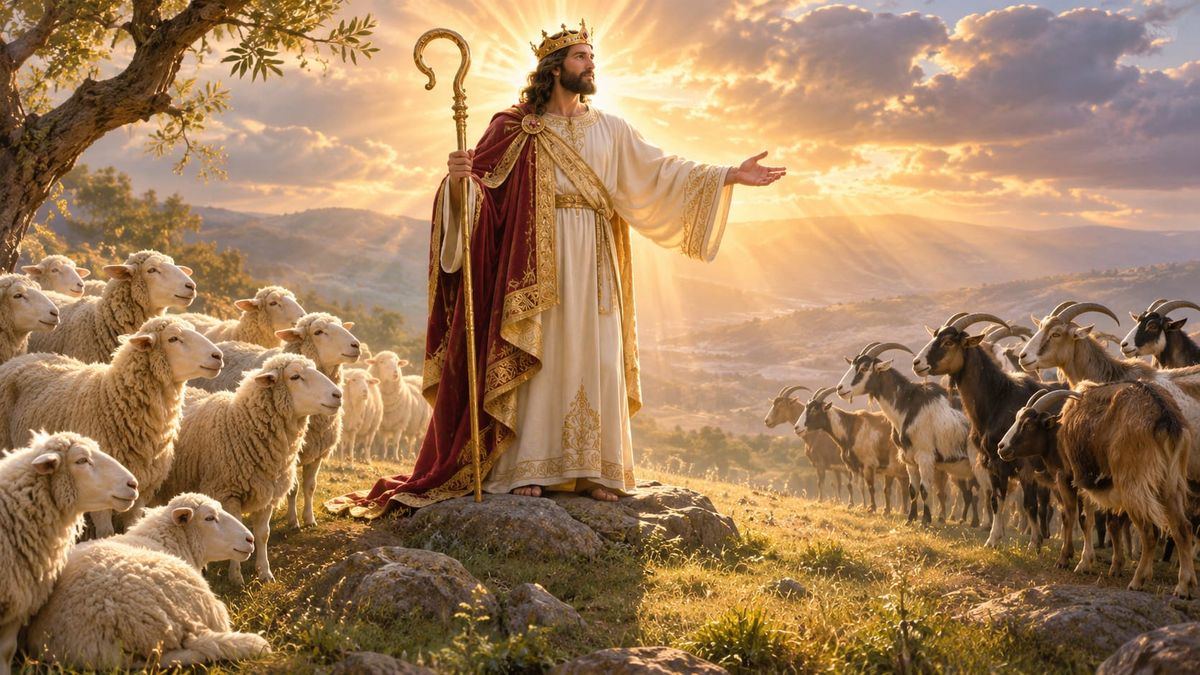
In verses 32 and 33, Jesus says that all the nations will be gathered before him. Then, “he will separate people one from another as a shepherd separates the sheep from the goats” (Matthew 25:32, ESV). Notice that the nations are gathered, but people are separated. We do not stand before Christ on the strength of nationality, ethnicity, political allegiance, or membership in the right church. Each person stands before the King and gives an account. Do we belong to him? That is the question pressing in on us throughout Extended Advent.
Why sheep and goats? Sheep and goats could graze together, though a shepherd knew how to separate them. The foolish virgins waited alongside the wise, and the unfaithful servant belonged outwardly to the master’s household. We too may hear the same sermons and stand beside one another in worship. But the Shepherd knows his own, and their faith bears fruit.
In verse 33 the sheep are placed on his right and the goats on his left. The right-hand place signifies welcome and favor. The King makes this separation. Only he can see the heart.
Our Old Testamet reading makes the shepherd imagery even more important. In Ezekiel 34, Israel's shepherds, her leaders, have cared for themselves and neglected the flock. God promises in verse 11, “I, I myself will search for my sheep and will seek them out” (Ezekiel 34:11, ESV). He will gather the scattered, feed them, and strengthen the weak. In Ezekiel 34:17 the Lord says, “Behold, I judge between sheep and sheep” (Ezekiel 34:17, ESV). Ezekiel goes on to mention rams and male goats, and strong animals pushing aside the weak. Its focus is judgment amid God's flock; Matthew applies the shepherd's image to the final separation of people from all nations. The pictures overlap without being identical, and both proclaim the Shepherd's authority to distinguish and judge. In Matthew, Jesus is the Shepherd-King doing the work the LORD promised to do. He gathers, he distinguishes, and he judges.
Then in verse 34 the King speaks to those on his right: “Come, you who are blessed by my Father, inherit the kingdom prepared for you from the foundation of the world” (Matthew 25:34, ESV). Hear the order. Before he names their works, he welcomes them as blessed by his Father. And he says inherit. An inheritance is received, not purchased by accumulating good deeds. The Kingdom was prepared by God long before these people could do anything to earn it. The mercy Jesus describes next is the fruit of belonging to the King, not the price of admission.
Hear the King’s words in verses 35–36: “For I was hungry and you gave me food, I was thirsty and you gave me drink” (Matthew 25:35, ESV). He also names the stranger welcomed, the naked clothed, and the sick and imprisoned visited. Listen to the righteous in verse 37: “Lord, when did we see you hungry and feed you, or thirsty and give you drink?” (Matthew 25:37, ESV). They ask the same about the other needs. They are surprised. They were not calculating how many deeds would earn heaven. They loved because they belonged to the King who first loved them.
Now hear the King's explanation in verse 40: “as you did it to one of the least of these my brothers, you did it to me” (Matthew 25:40, ESV). The phrase my brothers deserves attention. In Matthew, Jesus uses this family language for his disciples. When he sent the Twelve, he said, “Whoever receives you receives me” (Matthew 10:40, ESV). There is good reason, then, to hear a particular reference here to vulnerable disciples who bear his name and carry his Gospel. Their treatment matters personally to him.
That does not cancel our responsibility to anyone else. The same Lord commands us to love our neighbors and even our enemies. We cannot use an argument about the word brothers as an excuse to neglect a hungry stranger. But the particular force of this verse is striking: the King identifies himself with his people, including those who appear least important in the eyes of the world. A sick Christian whom nobody visits, a lonely believer, a missionary with little support, or a fellow parishioner quietly struggling with hardship is not forgotten by Christ.
Jesus has named the stranger welcomed and the sick visited. When a visitor stands alone after worship, will we introduce ourselves and welcome that person? When someone who regularly worships beside us has been absent for several Sundays, whose responsibility is it to notice? The priest should know, but that person is also our brother or sister in Christ. We have prayed together and received Holy Communion together. Why wait for someone else to call? Visiting the sick, arranging a ride, or sitting with someone who lives alone belongs to every member, not merely the priest, vestry, or pastoral staff. The sheep should know their Shepherd has not forgotten them because his people remember them.
Our responsibilities also extend beyond these walls. We can help neighbors who suffer, support those carrying the Gospel, welcome people who do not yet know anyone here, and speak the truth of Christ with patience. A bag of groceries is an act of mercy. So is an invitation to hear the Gospel, though they are not the same act. We must not replace evangelism with charity, or charity with evangelism. The King commands us to proclaim his saving Word and to love the people he places before us.
Now the scene changes. In verse 41 the King turns to those on his left: “Depart from me” (Matthew 25:41, ESV). Then the contrast in verse 42: “For I was hungry and you gave me no food” (Matthew 25:42, ESV). They withheld the very mercy the righteous showed. In verse 44 they too ask, “Lord, when did we see you hungry or thirsty or a stranger or naked or sick or in prison, and did not minister to you?” (Matthew 25:44, ESV). Hear the answer in verse 45: “you did not do it to me” (Matthew 25:45, ESV). What they withheld from the least of these, they withheld from him.
Sheep and goats do not represent flawless people and people who made mistakes. The difference lies deeper. Their lives reveal two different relationships to the King. The sheep's mercy is evidence of living faith. The goats' settled indifference exposes the emptiness of a profession that never bore the fruit of obedience. Their failure is especially sobering because it is expressed in things left undone. We can sin by refusing the good that love requires.
The buried talent from last Sunday warns us likewise: the Lord's patience is not permission to do nothing. Confessing Christ as King while refusing to obey him is no refuge.
And yet this is not salvation by works. Article XI of our Thirty-Nine Articles teaches justification by faith, and Article XII teaches that good works follow justification and spring from true and living faith. Our acts of mercy do not remove our sins or purchase the Kingdom. Christ alone saves. His grace, however, is not barren. The Holy Spirit works in his people, making them increasingly holy and teaching them to love. The King's judgment reveals the fruit, or the absence of fruit, of the faith we profess.
Some of us need that warning. We may know the right answers, defend Christian doctrine, and speak indignantly about what is wrong with our country, while remaining impatient, dishonest, unforgiving, or indifferent in our own homes. If we want a society more shaped by Christ, one place to begin is with our own repentance. Before asking whether a candidate honors Christ, we should ask whether we honor him in the way we speak to our spouse, care for an aging parent, treat an employee, handle money, or respond to someone who has offended us.
And if we want our neighbors to know Christ, we must tell them about him. Pray for someone by name. Invite that person to worship. Read a Gospel with a friend. Teach your children and grandchildren why Jesus died and rose again. Support those who carry the Gospel beyond this community. Christ commanded his Church to make disciples, baptize, and teach obedience. Through his Word and Spirit he brings sinners to faith and forms them in holiness. That is our mission as we await his return; the final restoration of his Kingdom is his work, not ours to accomplish by politics or human effort.
Others among us will hear this passage and fear that every neglected opportunity has placed our salvation in doubt. None of us has loved perfectly. We have all passed by needs we should have noticed. The answer is not to pretend our sins are small; it is to bring them to Christ. The King who will judge is the same Savior who bore our sins on the Cross. We repent, receive his forgiveness, and ask him to change us. Our assurance rests in his mercy and promises, not in a flawless record of charity.
Now consider our Psalm. Psalm 95 begins by calling us to sing to the LORD, the great King above all gods. In verse 7 it describes us as the people of his pasture and the sheep of his hand. That is not an accidental connection with Ezekiel and Matthew. The King is our Maker, our Shepherd, and our Lord. We bow before him because we belong to him.
But Psalm 95 does not end with worshipful singing. It warns us not to harden our hearts when we hear his voice. The people in the wilderness saw God's works and yet resisted him. We face the same danger whenever we confess Christ's authority with our lips but refuse his Word in our lives. The question on Christ the King Sunday is not simply whether we can sing that Jesus reigns. Will we obey him when worship ends and ordinary life begins again?
Our Collect gives us the proper starting point. We ask Almighty God, whose will is to restore all things in his beloved Son, the King of kings and Lord of lords, to free the peoples of the earth who are divided and enslaved by sin and bring them together beneath Christ's most gracious rule. Notice that God must free us. The peoples do not save themselves by a better law, a better election, or even a better record of behavior. Christ rescues sinners and gathers them under his gracious rule. His grace creates the obedience that his Kingdom requires.
Finally, look at verse 46. Jesus says, “And these will go away into eternal punishment, but the righteous into eternal life” (Matthew 25:46, ESV). We cannot remove this warning because it is difficult to hear. But hold it beside the King’s invitation in verse 34: “Come, you who are blessed by my Father” (Matthew 25:34, ESV). Our hope is not that we have done enough; it is the Savior who died and rose again, whose grace bears fruit in his people. He is both the righteous Judge and the Good Shepherd who saves.
On Trinity Sunday, the first Sunday after Pentecost, we heard the risen Lord send his Church to make disciples of all nations. Today Matthew shows those nations gathered before him. Between the sending and the judgment lies our calling: to proclaim the Gospel, teach obedience, and love those Christ places in our care. We bear witness to the King who already reigns. He alone will bring his Kingdom to its fullness when he returns.
So as this Season after Pentecost ends, remember whose name we bear. We are Christ the King Church. May that name be heard in our worship and witness, and seen in our repentance, holiness, faithfulness at home, and mercy toward those in need. But our hope is not that we have borne his name perfectly. Our hope is that he has made us his own. The Shepherd who sought us, the Savior who died for us, and the King who reigns over us is the same Lord who will return in glory. And those who belong to him will hear his invitation: “Come, you who are blessed by my Father, inherit the kingdom prepared for you from the foundation of the world” (Matthew 25:34, ESV).
In the Name of the Father, and of the Son, and of the Holy Spirit. Amen.