He Knows Not How: Monday of Rogationtide 2026 (Mark 4:26-32)
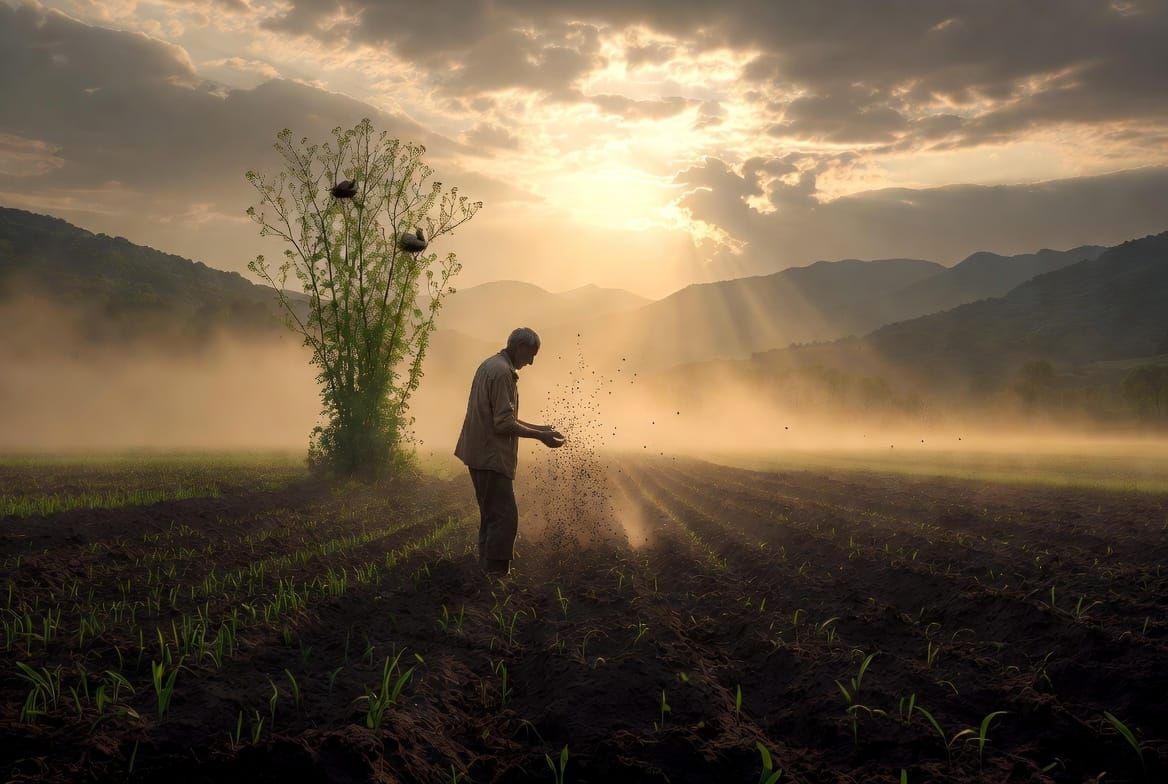
"The seed sprouts and grows; he knows not how." Mark 4:27. The farmer does not make the seed grow. He cannot watch it happen and intervene. He scatters, sleeps, and in the morning there is a blade where yesterday there was bare ground. Rogation Day I: the growth is in God's hands, not ours.
Rogation Day I, Year A, 2026, Monday of Rogationtide
Mark 4:26–32, Psalm 147, Romans 8:18–25
Grace, mercy, and peace be with you on this first day of Rogationtide.
The readings for the first Rogation Day are appointed in the BCP 2019 on page 732: Psalm 147, Romans 8:18–25, and Mark 4:26–32. The Rogation Days are the Monday, Tuesday, and Wednesday before Ascension Day — ancient days of prayer for God’s blessing on the earth, on agriculture, on industry, and on all who labor. The word rogation comes from the Latin rogare — to ask, to beseech. These three days are the Church’s annual posture of asking: standing before the God who made the earth and makes it fruitful, with open hands.
Here in the mountains of Northeast Georgia we do not need to be told that the earth does not produce on demand. We know something of what it means to watch the sky for rain, to wait on a late frost, to hope the spring comes gently enough that the garden is not ruined before it starts. But even those of us who have never planted a seed or tended a field live downstream of the same dependence. Every meal we eat traces back, through however many links in the chain, to seed in ground and rain from heaven. The Rogation Days are the calendar’s annual insistence that we remember this.
These Rogation Days invite us to bring our dependence before the God who alone gives growth. Over the three days of Rogationtide we will hear Jesus speak to creaturely dependence, faithful stewardship, and trust in the Father’s provision. Today is where the arc begins.
There is a phrase in the first parable that stops us if we pay attention to it. Jesus says the farmer scatters seed on the ground. He sleeps and rises night and day. And “the seed sprouts and grows; he knows not how.” (Mark 4:27, ESV) He knows not how. That phrase is worth sitting with. The farmer in this parable is not ignorant. He knows how to prepare the soil. He knows when to plant and when to harvest. He knows the difference between good seed and bad. But the process by which a seed becomes a plant — the actual mechanism of growth — is beyond his knowledge. He can describe what happens. He cannot produce it.
This is not a parable about human incompetence. It is a parable about creaturely limitation, which is a different thing entirely. God made us to be farmers, to tend and to cultivate, to scatter and to harvest. That is our proper work and it is good work. But he did not make us to be the source of growth. He reserved that to himself. The earth, Jesus says, “produces by itself.” (Mark 4:28, ESV) The Greek word is automatē — of itself, automatically, spontaneously. The same word gives us our English word automatic. The earth produces by itself: not because it is autonomous, but because God built the capacity for growth into the creation at the beginning and it continues to work by his sustaining power. The farmer did not install that capacity. He receives it.
Psalm 147 is the great Rogation psalm precisely because it names the one who gives what the farmer cannot give. Verse 8: God “covers the heavens with clouds; he prepares rain for the earth; he makes grass grow on the hills.” (Psalm 147:8, ESV) Verse 14: he “fills you with the finest of the wheat.” (Psalm 147:14, ESV) The psalmist is not embarrassed to say these things plainly. He does not soften them with qualifications about secondary causation. He says: God covers the heavens with clouds. God prepares the rain. God makes the grass grow. The farmer who knows not how is working within a system whose sustaining power belongs to God alone, and the psalmist wants us to know whose name belongs on the grain in the storehouse.
The second parable presses the same truth from a different angle. The mustard seed is the smallest of all seeds on earth. In it there is nothing visible that could account for what it becomes. Plant it, and it will become larger than all the garden plants, with branches large enough for the birds of the air to nest in. The contrast between the seed and the tree is the parable’s whole argument. The smallness is real. The greatness is also real. And the farmer who planted the tiny seed did not manufacture the tree. He only put the seed in the ground.
Jesus is making a point about the Kingdom of God in both parables. But he is making it through agricultural images that carry their own weight as descriptions of the natural world, and he is making it to people who know what seeds and harvests are. The Rogation Days take these parables seriously as descriptions of creation as well as declarations about the Kingdom. The Kingdom of God grows the way a mustard seed grows: by a power that is not in our hands, at a pace we did not set, toward a greatness we could not have predicted from looking at the seed.
Paul in Romans 8 adds a dimension that the parables only hint at. The creation that the farmer works is not simply a productive mechanism waiting to be harvested. It is a creature. It is groaning. Paul writes that the creation was “subjected to futility, not willingly, but because of him who subjected it, in hope.” (Romans 8:20, ESV) The thorns and thistles of Genesis 3 are not only an agricultural nuisance. They are the mark of a creation that has been caught in the consequences of the fall and is waiting, along with us, for its liberation. The farmer who knows not how the seed grows is farming ground that is itself waiting for the redemption of the sons of God.
And yet it still grows. That is the grace of it. The creation groans and it still produces. God’s sustaining mercy holds the earth’s fruitfulness in place even in the time of its corruption, so that his creatures can be fed while they wait for the restoration of all things. Every harvest in the history of the world has been an act of grace performed by a God who was under no obligation to keep a fallen creation productive, and who kept it productive anyway, because he is merciful and his people need to eat.
We are in the Easter season. Ascension Day is three days away. The risen Christ who walked out of the tomb on Easter morning is the same Christ who said “the earth produces by itself.” And we are praying, in these three Rogation Days, to the Father who raised him. The God who raised Jesus from the dead is the God who covers the heavens with clouds and fills us with the finest of the wheat. The resurrection does not remove us from creaturely dependence. It gives us the right name for the one on whom we depend.
There is something fitting about the placement of the Rogation Days in the liturgical calendar. They fall three days before Ascension — the feast on which the risen Christ, having walked among his disciples for forty days, ascends to the Father's right hand. The one who is about to ascend, who will be received out of their sight into heaven, is the one of whom Colossians will tell us: in him all things hold together. The Lord who made the mustard seed and the blade of grass and the grain in the ear is the Lord who is ascending to his throne. The Rogation Days are the Church's way of naming this plainly before he goes: Lord, you are the one who makes the grass grow on the hills. You are the one in whom the seed that grows, grows. We ask you, as you ascend, to remain the Lord of the harvest — not because we doubt it, but because we need to say it out loud.
These days also carry a particular texture for those of us who live in the mountains. In Northeast Georgia, the rhythms of the created order are not abstract. The planting season in the southern Appalachians has its own character — late frosts that can undo a week’s work, sudden rains in summer, the dependence on weather that no forecast fully masters. The farmer in Jesus’ parable is not a figure of ancient romanticism. He is our neighbor. And the truth Jesus tells about him — he sleeps and rises and the seed grows and he knows not how — is as true in Towns County as it was in Galilee. The Rogation Days are for us, because we live in a place where the ground still teaches the lesson.
On the first Rogation Day we come before God with this simple and honest acknowledgment: we do not know how. We scatter and sleep and the seed grows and we do not know how it happens. We receive our daily bread from a hand we cannot see and through a process we cannot replicate, from a creation that is itself waiting for what we are waiting for. The prayer of the Rogation Days is the prayer of the farmer in the parable: not the prayer of one who pretends to understand, but the prayer of one who knows whose hands hold the harvest, and asks those hands to open again.
In the Name of the Father, and of the Son, and of the Holy Spirit. Amen.